
Definition
podcast website growth: Podcast website growth is the process of using your podcast website to increase the ways people can discover and engage with your podcast — through search, episode pages, topics, guests, articles, internal search, newsletter signup, and returning visits — so visitors don't need to know your show name before they find your ideas.
In simple terms: Podcast website growth is the process of using your podcast website to increase the ways people can discover and engage with your podcast — through search, episode pages, topics, guests, articles, internal search, newsletter signup, and returning visits — so visitors don't need to know your show name before they find your ideas.
Quick Answer
Give every episode a dedicated podcast episode page, add transcripts, make the archive searchable, organize topics and guest profiles, publish supporting articles for podcast SEO,
Give every episode a dedicated podcast episode page, add transcripts, make the archive searchable, organize topics and guest profiles, publish supporting articles for podcast SEO, and capture an audience with a clear newsletter path.
MicNest helps podcasters turn a podcast website into a growth engine — episode pages, search, transcripts, topics, guests, articles, newsletters, and audience tools. Start at https://app.micnest.ai/auth/signup.
Key Takeaways
- ➔ A basic podcast website helps people listen; a growth-focused site helps them discover, explore, and return.
- ➔ Podcast website growth means more entry points — not only more homepage visits.
- ➔ Dedicated podcast episode page templates with show notes, transcripts, and related content outperform title + player.
- ➔ Search, topics, and guests turn a chronological feed into a usable library.
- ➔ Podcast SEO works when conversations become structured web content.
- ➔ Your back catalog can keep attracting visitors when it stays searchable and connected.
- ➔ Newsletter capture turns discovery into a direct relationship.
- ➔ MicNest connects episode pages, search, topics, guests, articles, and audience tools around your show.
For many shows, the podcast website is an afterthought — logo, short description, embedded player, episode list. That is enough to *have* a website. It isn't enough to build a podcast website that grows with your show.
Your podcast website can become the place where people discover your show, explore conversations, find specific ideas, learn about guests, subscribe, and return. A basic site helps people listen. A growth-focused site helps people discover, understand, engage with, and return to your podcast.
Instead of treating your site as a digital business card, treat it as the home for everything your podcast is becoming — the same idea behind a strong podcast website builder choice.
What Is Podcast Website Growth?
Podcast website growth is the process of using your website to increase the ways people can discover and engage with your podcast.
That can include:
- Organic search traffic
- Podcast episode discovery
- Newsletter subscribers
- Returning visitors
- Guest discovery
- Topic discovery
- Internal search
- Content engagement
- Social and direct traffic
- Listener-to-subscriber conversion
The goal isn't simply more homepage visits. The goal is more entry points into your podcast.
Someone shouldn't have to know your podcast name before they discover your ideas. A potential listener may never search "Episode 87 of [Podcast Name]." They might search "How do I validate a SaaS idea?" If that conversation has a structured, searchable webpage, it becomes a discovery point. That's where your podcast website starts doing real work — and why how to grow a podcast increasingly includes owned-site strategy, not only directory rankings.
Why Many Podcast Websites Don't Help Podcasts Grow
The problem usually isn't that sites are badly designed. They're designed around listening rather than discovery.
A typical site might look like:
- Homepage → description, latest episodes, player, social links
- Episode page → title, player, short description
That's functional. But ask:
- Can someone search the entire archive?
- Can they browse by topic?
- Can they discover guests?
- Can they find the transcript?
- Can search engines understand the conversation?
- Can visitors find related episodes?
- Can someone subscribe?
- Can an old episode keep bringing visitors?
- Can someone arrive from Google without knowing your show exists?
Those questions turn a publishing destination into a growth system.
Your Podcast Website Is Your Owned Content Hub
Podcast apps are excellent for distribution. Your website gives you ownership.
Your site can connect:
Episodes → Topics → Guests → Articles → Search → Newsletter → Audience
Every new episode adds another piece. Every guest creates another path. Every topic connects conversations. Every article can target another query. Every subscriber becomes someone you can reach directly.
This is why your website shouldn't simply mirror your podcast feed. It should add value around it — the foundation of a durable podcast marketing system.
Basic Podcast Website vs. Growth-Focused Podcast Website
| Basic Podcast Website | Growth-Focused Website |
|---|---|
| Episode list | Searchable episode library |
| Embedded player | Dedicated episode pages |
| Short descriptions | Detailed show notes and transcripts |
| One homepage | Multiple discovery paths |
| Guest names | Guest profiles |
| Episode categories | Topic pages |
| Social links | Newsletter and audience capture |
| Latest episodes | Full searchable back catalog |
| Basic navigation | Connected content |
| Website as destination | Website as content engine |
The second approach creates more opportunities for someone to discover your podcast — and is closer to what people expect from a best podcast website experience.
What Should a Modern Podcast Website Include?
A strong podcast website doesn't need hundreds of features. It needs the right structure.
1. A Clear Homepage
Your homepage should answer:
- What is this podcast?
- Who is it for?
- Why should I listen?
Include positioning, host information, latest and popular episodes, topics, featured guests, newsletter signup, search, and listening-platform links. The homepage is the entry point — it should help visitors find what matters next.
2. Dedicated Podcast Episode Pages
Every episode deserves its own podcast episode page.
Instead of "Episode 87: John Smith," create a page with:
- Episode title and guest
- Description
- Audio/video player
- Key takeaways and show notes
- Transcript
- Topics
- Guest information
- Related episodes and articles
- Share options
This gives every conversation a permanent home — and another page that can be discovered through search.
3. Transcripts
Your podcast is audio. Search engines primarily understand text. A transcript bridges that gap.
A 60-minute conversation about AI, startups, hiring, fundraising, and product can stay locked in audio without a transcript. With one, those ideas become accessible to visitors and search engines — and improve accessibility.
Don't treat transcripts only as SEO content. They're part of the knowledge layer of your podcast.
4. Search
Once you have dozens or hundreds of episodes, browsing gets hard. Visitors may remember an idea, guest, or question — not the title.
Useful search should cover keywords, topics, questions, guests, titles, transcript content, and concepts — for example "episodes about hiring engineers" or "fundraising advice."
This is one of the biggest opportunities for shows with large back catalogs. See Build a Searchable Podcast Archive.
5. Topic Pages
Recurring themes shouldn't disappear inside individual episodes. Turn them into collections — startups, AI, marketing, leadership — so visitors explore by interest, not publish date. That also strengthens connections between content.
6. Guest Profiles
Guests can become another discovery engine. A guest page can include biography, links, episodes featuring them, topics discussed, related articles, and key conversations.
Your podcast starts to feel like a knowledge network rather than only a chronological feed.
7. Articles and SEO Content
Your podcast already contains ideas. Those ideas can become written content.
An episode about hiring your first engineer can support an article like "How to Hire Your First Software Engineer as a Startup Founder," linking back to the episode:
Search query → Article → Episode → Related content → Newsletter
That's practical podcast SEO / seo for podcasts. For a deeper strategy, see our Podcast SEO Guide.
8. Newsletter Signup
Listening once is useful. Coming back is more valuable. Give visitors a clear next step:
"Get the best ideas from our latest conversations, delivered to your inbox."
The basic journey becomes: Episode → Website → Newsletter → Future Episodes.
9. Mobile Experience
Much discovery happens on phones. Prioritize fast loading, readable typography, simple audio controls, responsive episode pages, and easy signup. A desktop-only experience isn't a successful podcast site.
10. Analytics
Ask better questions than "how many visited?":
- Which episodes and topics attract visitors?
- Which guests generate interest?
- Which pages come from search?
- Which articles lead to episodes?
- How many visitors subscribe?
- What are people searching for?
Your website can become a source of audience intelligence — related to podcast analytics.
Your Website Can Become a Discovery Engine
Someone might find your podcast name — or an idea from your podcast. The second opportunity is larger.
Example: they search "How do startup founders find product-market fit?", discover an article, open the episode, find the guest, explore related episodes, and subscribe. One query becomes an entire journey. That's what a content-driven podcast website enables — and a quieter path for podcast discoverability.
Build Around Topics, Not Just Episodes
Feeds are chronological. Websites can be structural:
Topic → Episodes → Guests → Articles → Related Topics
That structure helps humans and search engines understand what your show covers.
Your Back Catalog Is a Growth Asset
Your newest episode isn't always your most valuable. Older conversations may still answer today's questions — if they aren't buried.
Surface them through search, topic pages, related episodes, guest profiles, articles, and internal links. Your podcast back catalog should become an expanding library, not a graveyard.
Connect New Episodes to Old Conversations
Every new episode can reactivate your archive.
Publish an AI episode and connect it to older AI episodes, relevant guests, related articles, and a topic page. One new episode creates a flywheel:
New episode → New content → New discovery → Links to older episodes → More archive discovery → More subscribe opportunities
The value of your website grows as the library grows.
Turn Guests Into Discovery Paths
Someone searching for a guest can find their profile, then their episode, other episodes, topics, articles, and more guests. Instead of attaching a guest to one title, make them part of your content structure.
Your Website Should Help People Decide to Listen
Not everyone wants to press play immediately. A strong podcast episode page can answer: what is this about, who is the guest, what will I learn, key ideas, length, and topics — then let visitors listen, read, search, explore, or subscribe.
A Practical Podcast Website Structure
```
Homepage
├── Episodes (dedicated pages)
├── Topics
├── Guests
├── Articles
├── Search
├── Newsletter
└── About
```
Connections matter as much as pages:
Episode → Guest → Topics → Transcript → Related episodes → Related articles → Newsletter
That's a connected content system — closer to turning your podcast into a platform than a feed mirror. Whether you create a podcast website from scratch or improve an existing one, this structure is the growth foundation.
How to Measure Podcast Website Growth
Start with a few useful categories:
Discovery — organic visitors, impressions, top landing pages, queries
Content — episode, article, topic, and guest page engagement; search activity
Engagement — pages per visit, returning visitors, plays
Audience — newsletter signups and conversion
Performance — most discovered episodes, searched topics, popular guests
The objective is understanding what your audience cares about — not collecting vanity numbers.
Common Podcast Website Mistakes
- Only showing the latest episodes — older episodes shouldn't disappear.
- One generic episode template — title + player + two paragraphs isn't enough.
- Ignoring search — archives get harder to browse as you grow.
- Forgetting the guest — guests deserve proper pages.
- Treating SEO as an afterthought — podcast SEO works best as a publishing habit.
- No audience capture — visitors leave with no way to stay connected.
- Desktop-only design — mobile must feel effortless.
A podcast website template or theme can help with layout — but structure and content connections matter more than skin.
The Podcast Website Growth Flywheel
Publish an episode → optimized episode page → extract ideas → articles and supporting content → connect topics, guests, related episodes → make everything searchable → get discovered → convert visitors into subscribers → bring them back → add more content → repeat.
You aren't starting from zero each publish. You're adding another node to an existing network.
How MicNest Approaches Podcast Website Growth
This is one of the ideas behind MicNest.
A podcast website shouldn't simply reproduce your feed. Your show already contains conversations, guests, topics, stories, questions, and knowledge. The website should organize that knowledge.
With MicNest, a connected podcast feed can become the foundation for a broader content platform:
- Dedicated episode pages
- Searchable conversations
- Topics and guests
- SEO-focused written content
- Discovery beyond the episode title
The goal is simple: turn your podcast into a platform.
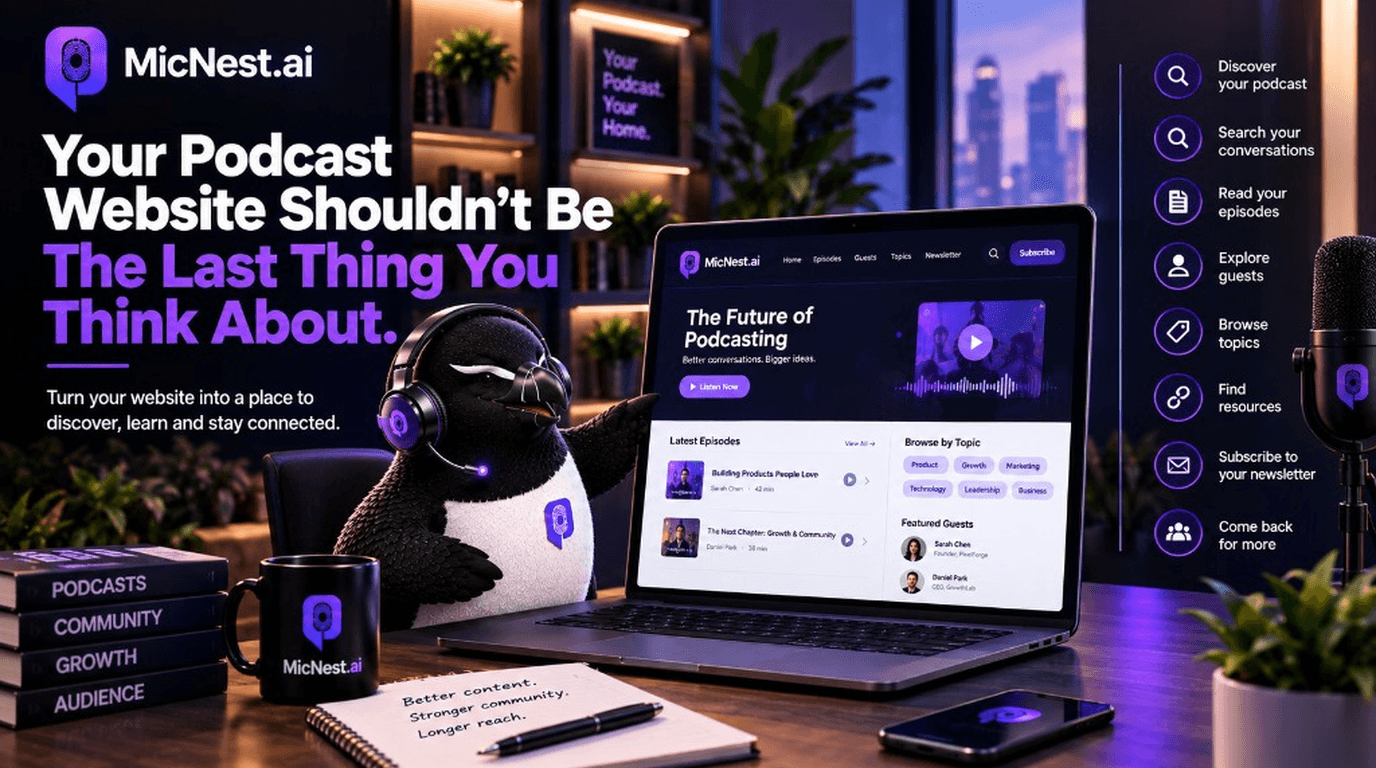
Discover → Search → Listen → Read → Explore → Subscribe → Return
That's the kind of podcast website — and podcast website builder experience — we're building with MicNest.
The Real Opportunity Isn't More Content
Podcasters are often told to publish more. Sometimes the bigger opportunity is better infrastructure around content you already have.
Your existing show may already contain hundreds of conversations, valuable guests, searchable questions, and evergreen insights. Make that content easier to discover and navigate. That's where podcast website growth becomes powerful — you're building a better way to experience your podcast.
Final Thoughts
Your podcast website shouldn't exist only because every show is "supposed" to have one. It should have a job:
- Help people discover your show
- Help them understand conversations
- Make the archive useful
- Connect episodes, topics, guests, and content
- Give visitors somewhere to return
- Build a direct audience relationship
Your platforms help people listen. Your website can help your podcast grow.
One episode becomes a page. One page becomes part of a topic. Topics connect conversations. Conversations create more content. Content creates discovery. Discovery creates audience opportunities.
Your podcast already has the content. Now build the infrastructure that helps it work harder.
Frequently Asked Questions
What is podcast website growth?
Podcast website growth is the use of your podcast website to increase discovery, engagement, audience growth, search visibility, and returning visitors.
Does every podcast need a website?
Not every podcast needs a complex site, but a dedicated website can provide more control over content, SEO, audience relationships, and discovery than relying only on podcast platforms.
What should a podcast website include?
At minimum: a clear homepage, dedicated episode pages, an archive, strong mobile design, listening options, and subscription functionality. For growth, add search, transcripts, topics, guest pages, articles, newsletter signup, and analytics.
How does podcast SEO help website growth?
Podcast SEO makes conversations easier for search engines to understand. Dedicated episode pages, transcripts, structured content, internal links, and topic-focused articles create additional discovery opportunities.
Can old podcast episodes help grow a show?
Yes. Older episodes keep providing value when they're easy to discover through search, topic pages, guest profiles, related content, and a searchable archive.
Should podcast episodes have their own webpages?
Yes. A dedicated podcast episode page gives each conversation a permanent destination for the player, show notes, transcript, guest information, related episodes, and more.
How can a podcast website build an audience?
It can turn visitors into subscribers through newsletter signup, valuable content, clear calls to action, and reasons to return — a path from discovery to a direct relationship. See Own Your Podcast Audience and Build a Podcast Community.
Build a Website Around Your Podcast, Not Just a Website For It
Your podcast is more than an RSS feed. It's a growing collection of conversations, ideas, people, and knowledge. Your website should reflect that.
Turn every episode into more. Explore how MicNest can turn your podcast into a connected content and audience platform.
Related Reading
Before vs after
Before
- — Website is logo + player + episode list
- — Old episodes disappear into an unsearchable archive
- — Visitors leave with no next step
After
- + Episode pages, topics, guests, and search create discovery paths
- + Back catalog keeps attracting visitors
- + Newsletter and related content turn visits into return traffic
Who is this for?
Podcasters
Creators who want their website to drive discovery, not just host a player.
Growth marketers
Teams using SEO, episode pages, and newsletters to grow owned traffic.
Show producers
Teams connecting episodes, topics, guests, and articles into one hub.
Turn your podcast website into a growth engine
A podcast website should do more than host episodes. MicNest helps turn conversations into searchable episode pages, topics, guests, articles, newsletters, and growth paths.
Explore MicNest or start freeSources
- MicNest product — MicNest connects episode pages, search, topics, guests, articles, and audience tools around a podcast website.
Frequently Asked Questions
What is podcast website growth? +
Podcast website growth is the use of your podcast website to increase discovery, engagement, audience growth, search visibility, and returning visitors.
Does every podcast need a website? +
Not every podcast needs a complex site, but a dedicated website can provide more control over content, SEO, audience relationships, and discovery than relying only on podcast platforms.
What should a podcast website include? +
At minimum: a clear homepage, dedicated episode pages, an archive, strong mobile design, listening options, and subscription functionality. For growth, add search, transcripts, topics, guest pages, articles, newsletter signup, and analytics.
How does podcast SEO help website growth? +
Podcast SEO makes conversations easier for search engines to understand. Dedicated episode pages, transcripts, structured content, internal links, and topic-focused articles create additional discovery opportunities.
Can old podcast episodes help grow a show? +
Yes. Older episodes keep providing value when they're easy to discover through search, topic pages, guest profiles, related content, and a searchable archive.
Should podcast episodes have their own webpages? +
Yes. A dedicated podcast episode page gives each conversation a permanent destination for the player, show notes, transcript, guest information, related episodes, and more.
How can a podcast website build an audience? +
It can turn visitors into subscribers through newsletter signup, valuable content, clear calls to action, and reasons to return — a path from discovery to a direct relationship.

