
Definition
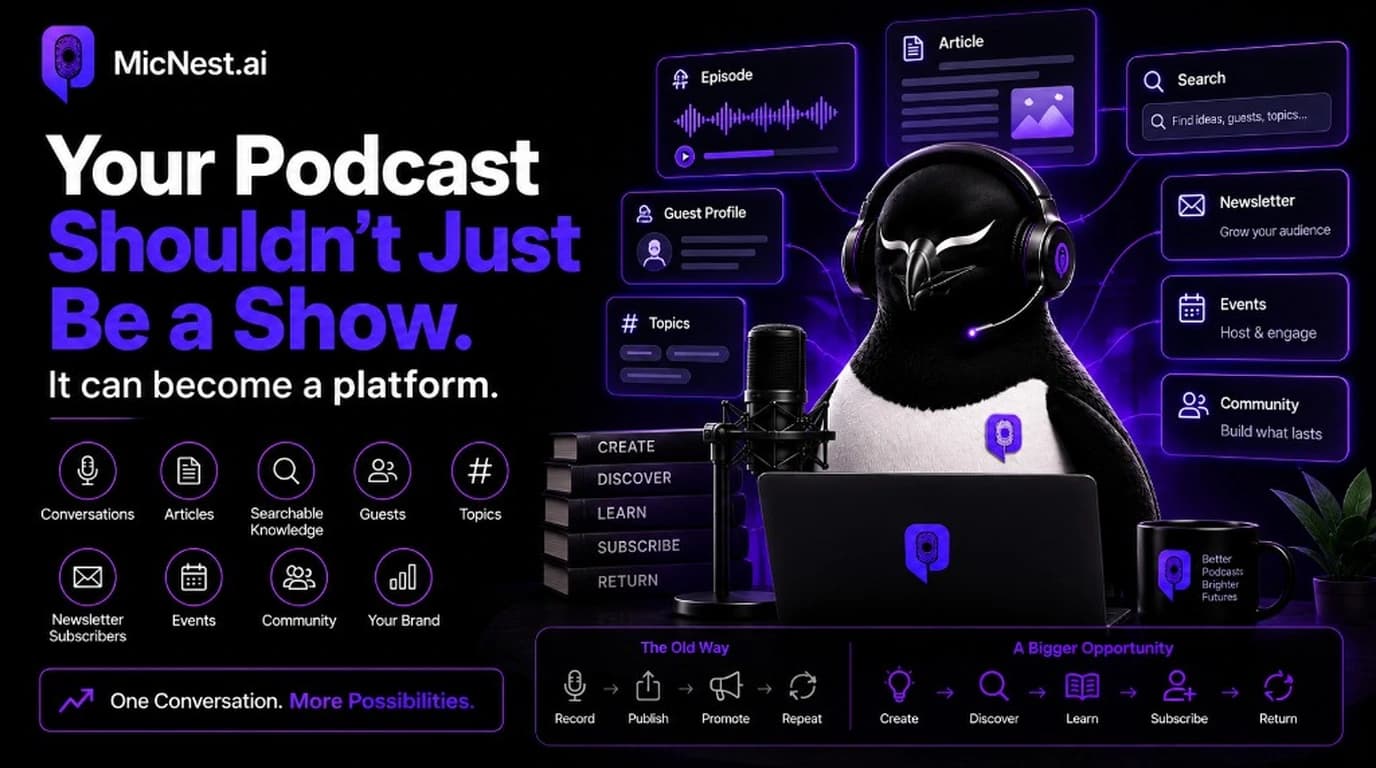
podcast platform: A podcast platform is an ecosystem built around your podcast — connecting episodes, website, articles, search, guests, topics, newsletter, and subscribers — so every conversation creates more ways for people to discover and interact with your work.
In simple terms: A podcast platform is an ecosystem built around your podcast — connecting episodes, website, articles, search, guests, topics, newsletter, and subscribers — so every conversation creates more ways for people to discover and interact with your work.
Quick Answer
Create a proper website as home base → give every episode a dedicated page → make the archive searchable → turn valuable conversations into articles → organize by topics and guests
Create a proper website as home base → give every episode a dedicated page → make the archive searchable → turn valuable conversations into articles → organize by topics and guests → collect subscribers → measure what people use → keep connecting content with every new episode.
MicNest helps podcasters turn conversations into a content and audience platform — website, SEO articles, searchable archives, guest profiles, newsletters, and analytics. Start at https://app.micnest.ai/auth/signup.
Key Takeaways
- ➔ A podcast platform is broader than hosting — it's the ecosystem around your show.
- ➔ One conversation can become episodes, articles, topics, guests, search, newsletters, and more.
- ➔ Chronological feeds hide older episodes; libraries organize knowledge for discovery.
- ➔ Your website is the owned home that connects distribution platforms to audience relationships.
- ➔ Search, topics, and guest profiles create multiple entry points beyond the feed.
- ➔ Evergreen episodes keep working through articles, links, guests, and newsletters.
- ➔ Build for usefulness — Discover, Understand, Listen, Read, Search, Subscribe, Return.
- ➔ You don't replace Spotify or Apple Podcasts; you build an owned layer around them.
- ➔ Start with foundation steps: website, episode pages, search, articles, topics, guests, subscribers.
- ➔ MicNest helps turn every podcast episode into more.
A podcast starts with a conversation. You record it, edit it, publish it, people listen — then you record the next one. For many shows, that's the entire system: Record → Publish → Repeat. A podcast platform builds something bigger around those conversations.
What if every conversation contributed to a growing library of episodes, articles, topics, guests, searchable knowledge, subscribers, newsletters, events, community, and brand authority?
Instead of building only a podcast show, you could build a platform around the conversations you're already creating.
What Is a Podcast Platform?
A podcast platform isn't simply a podcast hosting service. It's an ecosystem built around your podcast.
Instead of only providing audio, it can connect:
- Episodes
- Website
- Articles
- Search
- Guests
- Topics
- Newsletter
- Subscribers
- Audience
The podcast remains at the center. But every episode creates additional ways for people to discover and interact with your work.
A Podcast Is More Than an Audio File
Consider a one-hour conversation. Inside it could be:
- 20 useful ideas
- 10 questions
- 5 major topics
- Several memorable quotes
- Multiple stories
- A guest with their own audience
- Answers to questions people search for
The final MP3 or video is only one representation of that conversation. The underlying knowledge can be used in many ways. That's where the platform approach becomes powerful.
The Traditional Podcast Model
The traditional workflow is simple:
Record → Edit → Publish → Promote → Next episode
This works. But it creates a problem.
Every episode becomes another item in a chronological feed. After 100 episodes, your first conversations are increasingly difficult to discover. A listener might have to scroll through dozens or hundreds of episodes to find one relevant conversation.
The Platform Model
A podcast platform can work differently:
Conversation → Episode → Topics → Articles → Search → Guest profiles → Newsletter → Subscribers → Returning audience
Now each episode contributes to a larger system. Your podcast isn't just getting bigger. The ecosystem around it is getting bigger.
Your Podcast Can Become a Knowledge Library
Imagine your podcast has 250 episodes.
Instead of showing only Episode 250, 249, 248, 247… you could organize those conversations around:
Topics
AI, Marketing, Leadership, Startups, Sales
Guests
Guest A, Guest B, Guest C
Questions
How do you build a startup? How do you hire your first employee? How do you raise funding?
Articles
Complete guides based on your best conversations.
Now visitors can explore your podcast based on what they're interested in. That's much more useful than simply browsing by date.
Search Changes Everything
Think about how people discover information. They don't always search "The Example Podcast Episode 137."
They search:
- How do I build a personal brand?
- Best way to hire a startup team?
- How does AI affect marketing?
- How should founders price SaaS?
If your podcast contains answers to those questions, your content should have opportunities to surface for those searches.
That's where podcast SEO becomes important. Your conversations can become searchable.
Your Website Becomes the Home
Spotify is useful. Apple Podcasts is useful. YouTube is useful. Social media is useful.
But your own website can connect everything. It becomes the place where people can:
- Explore episodes
- Search conversations
- Read articles
- Discover guests
- Browse topics
- Subscribe
- Learn about your brand
Instead of your podcast being scattered across different platforms, your website becomes the central destination.
Every Episode Can Have a Life Beyond Its Publication Date
A traditional episode often has a short promotional lifecycle: launch day → social posts → a few days of promotion → next episode.
But useful conversations don't necessarily expire that quickly. An evergreen episode can remain relevant for months or years.
A searchable article can bring someone to that episode long after publication. A guest can share it months later. A newsletter can resurface it. A related episode can link to it.
Your archive can keep working. That's why we believe your podcast should be built like a library, not a feed — a searchable podcast archive.
Your Guests Become Part of the Platform
A podcast platform can also organize your guests.
Imagine visiting a guest profile and seeing: bio, featured episode, topics discussed, related episodes, articles, quotes, website, and social links.
Now guests aren't just names attached to individual episodes. They're part of your podcast's knowledge graph. Someone interested in a specific expert can discover their entire contribution to your podcast.
Topics Connect Your Content
Topics provide another layer of organization.
Suppose you have 30 episodes about AI. Instead of keeping them scattered throughout your archive, connect them.
Create an AI topic page containing:
- Relevant episodes
- Related articles
- Guests
- Questions
- Key conversations
Now someone interested in AI can explore the subject deeply. The more episodes you publish, the more valuable these topic connections become.
Your Newsletter Connects the Audience
Discovery is only one part of growth. What happens after someone finds you?
You want a reason for them to come back. A newsletter can help — this week's conversations, a new episode, a recommended episode, a new article, an interesting insight.
The newsletter creates another relationship between your podcast and your audience. This connects directly to the idea of owning your podcast audience.
Your Podcast Can Have a Content Flywheel
A platform creates a flywheel:
Record a conversation → Publish the episode → Extract the ideas → Create useful content → Get discovered through search → Bring people to your website → Convert visitors into subscribers → Bring subscribers back → Create another conversation → Repeat
Every new episode strengthens the system. Podcast content repurposing is how one conversation feeds many of those steps.
One Episode Can Feed the Entire Platform
Imagine publishing an episode about building a successful SaaS company.
That one conversation could become:
Episode
The original conversation.
Article
How to Build a SaaS Company.
Topic
SaaS.
Guest
The founder you interviewed.
Search
Questions discussed in the conversation.
Newsletter
The biggest lesson from the episode.
Social content
Quotes and insights.
Related episodes
Other conversations about SaaS.
One recording. Many connected assets. That's the difference between publishing content and building a content platform.
Your Back Catalog Becomes More Valuable Over Time
A platform approach changes how you think about old episodes.
Instead of "That's an old episode," you can ask: "What valuable knowledge is already inside our archive?"
Your older episodes can continue contributing to search, topic pages, articles, guest profiles, recommendations, newsletters, and internal links.
Your library compounds. The more useful content you add, the more connections you can create between it.
Don't Build a Platform Just for the Sake of It
A platform doesn't mean adding dozens of unnecessary features. The goal isn't complexity. The goal is usefulness.
Every feature should help people:
- Discover
- Understand
- Listen
- Read
- Search
- Subscribe
- Return
If a feature doesn't improve the experience, you probably don't need it.
The Website Should Serve the Audience
A podcast website shouldn't exist simply because someone told you every podcast needs a website. It should solve a problem.
A good podcast website can answer:
- What is this podcast?
- What should I listen to?
- Who has been interviewed?
- What topics are covered?
- Can I search the archive?
- Where can I read more?
- Can I subscribe?
- What's coming next?
The website becomes useful because it gives the audience more ways to interact with the podcast.
A Platform Gives Your Podcast Multiple Entry Points
Someone might discover you through Google and land on an article. Someone else comes through YouTube and discovers an episode. Another person finds a guest and visits their page. Someone searches a topic and finds your archive. Another person receives your newsletter and returns.
Different paths. Same destination: your podcast platform.
Podcast Platform vs Podcast Feed
A podcast feed is excellent for distribution. A platform is broader.
| Podcast Feed | Podcast Platform |
|---|---|
| Episodes | Episodes + content |
| Chronological | Connected |
| Primarily listening | Listening + reading + discovery |
| Limited discovery paths | Search + topics + guests |
| Distribution focused | Audience focused |
| Episode-centric | Knowledge-centric |
You don't need to replace the feed. You build the platform around it.
The Future of Podcasting Is More Than Audio
Podcasting started primarily as an audio format. Today, conversations can exist as audio, video, text, search, articles, clips, newsletters, and communities.
The conversation is the valuable asset. The format is simply one way of delivering it. That means podcast creators have an opportunity to build much more around every episode.
How to Start Turning Your Podcast Into a Platform
You don't need to transform everything overnight. Start with the foundation.
1. Create a proper podcast website
Make it the central home for your show.
2. Give every episode a dedicated page
Include useful context, not just an embedded player.
3. Make your archive searchable
Let visitors discover conversations by topics, guests, and questions.
4. Turn valuable conversations into articles
Create content people can discover through search.
5. Organize your content by topic
Connect related conversations.
6. Build guest profiles
Give guests a dedicated destination.
7. Collect subscribers
Create a direct relationship with your audience.
8. Measure what people actually use
Use podcast analytics to understand your audience.
9. Keep connecting the content
Link episodes, topics, guests, and articles together.
10. Repeat with every new episode
Let the platform grow naturally.
How MicNest Fits Into This Vision
This is the bigger idea behind MicNest.
We don't want to build another place where you simply upload an audio file. We want to help podcasters build the layer around the conversation.
MicNest brings together:
- Podcast websites
- Episode pages
- SEO articles
- Searchable archives
- Guest profiles
- Newsletter tools
- Subscriber growth
- Analytics
- Content discovery
The goal is simple: Turn every podcast episode into more.
Your podcast remains distributed across Spotify, Apple Podcasts, YouTube, and other platforms. But your own website becomes the place where your content, audience, and brand come together.
The Bigger Vision
A podcast can start with one conversation. Then another. Then another. Eventually you have 100, 500, or 1,000 conversations.
At that point, you're not just publishing episodes. You've created a body of knowledge.
The opportunity is to make that knowledge discoverable, searchable, readable, connected, useful — and accessible to the people who need it.
That's when a podcast starts becoming a platform.
Frequently Asked Questions
What is a podcast platform?
A podcast platform can refer to a broader ecosystem built around a podcast, including its website, episodes, searchable content, articles, guests, topics, subscribers, and audience tools.
Is a podcast platform the same as podcast hosting?
No. Podcast hosting primarily handles podcast media distribution and feeds. A podcast platform can provide a broader content and audience experience around the show.
Why should my podcast have its own website?
A website gives your podcast a central destination that you control. It can host episodes, articles, search, guest profiles, newsletter signup, and other content.
Can a small podcast become a platform?
Yes. You don't need hundreds of episodes. You can start by creating a strong website, organizing your content, and building useful audience relationships from the beginning.
Does turning a podcast into a platform replace Spotify or Apple Podcasts?
No. These platforms remain valuable distribution channels. A platform approach adds an owned layer around that distribution.
How does SEO help a podcast platform?
SEO can help people discover podcast content when they search for topics, questions, guests, and ideas discussed in your episodes.
What should a podcast platform include?
The exact features depend on the show, but useful components can include episode pages, search, articles, topic organization, guest profiles, newsletter signup, analytics, and audience tools.
From Podcast to Platform
The podcast industry has never been only about audio. It's about conversations. And conversations contain knowledge.
That knowledge can become content, search, articles, topics, guest profiles, subscribers, and community.
The podcast is the starting point. The platform is what you build around it.
So instead of asking "How do we publish our next episode?" consider asking "How do we make every episode contribute to something bigger?"
That's the direction we're taking with MicNest.
One conversation. A growing content library. A searchable platform. An audience you can build. A podcast that keeps working long after you hit publish.
Turn Your Podcast Into a Platform
MicNest helps podcasters turn their conversations into a complete content and audience platform with a website, SEO articles, searchable episodes, guest profiles, newsletters, and more.
Related Reading
Before vs after
Before
- — Record → Publish → Promote → Next episode
- — Chronological feed that's hard to explore
- — Episodes fade after launch week
After
- + Conversation → Episode → Topics → Articles → Search → Subscribers
- + A connected knowledge library around the show
- + Back catalog keeps working through SEO and links
Who is this for?
Podcasters
Creators who want each episode to grow a lasting content library.
Interview hosts
Hosts connecting guests, topics, and articles into one ecosystem.
Content marketers
Teams building owned discovery and subscribers around podcast conversations.
Turn your podcast into a platform
A podcast can be more than a chronological feed. MicNest helps you build a website, searchable archive, SEO articles, guest profiles, newsletters, and an audience around every conversation.
Explore MicNest or start freeSources
Quick Comparison
| Episodes | Episodes + content |
|---|---|
| Chronological | Connected |
| Primarily listening | Listening + reading + discovery |
| Limited discovery paths | Search + topics + guests |
| Distribution focused | Audience focused |
| Episode-centric | Knowledge-centric |
Pros & Cons
| ✅ Pros | ❌ Cons |
|---|---|
| ✔ Multiple discovery paths beyond the chronological feed | ✖ Requires intentional website and content structure |
| ✔ Evergreen episodes keep working through search and links | ✖ More moving parts than publish-and-promote alone |
| ✔ Owned website and newsletter relationships | ✖ Features without usefulness create noise |
| ✔ Guests, topics, and articles compound the value of each conversation | ✖ Compounds over time — not an overnight transformation |
Frequently Asked Questions
What is a podcast platform? +
A podcast platform can refer to a broader ecosystem built around a podcast, including its website, episodes, searchable content, articles, guests, topics, subscribers, and audience tools.
Is a podcast platform the same as podcast hosting? +
No. Podcast hosting primarily handles podcast media distribution and feeds. A podcast platform can provide a broader content and audience experience around the show.
Why should my podcast have its own website? +
A website gives your podcast a central destination that you control. It can host episodes, articles, search, guest profiles, newsletter signup, and other content.
Can a small podcast become a platform? +
Yes. You don't need hundreds of episodes. You can start by creating a strong website, organizing your content, and building useful audience relationships from the beginning.
Does turning a podcast into a platform replace Spotify or Apple Podcasts? +
No. These platforms remain valuable distribution channels. A platform approach adds an owned layer around that distribution.
How does SEO help a podcast platform? +
SEO can help people discover podcast content when they search for topics, questions, guests, and ideas discussed in your episodes.
What should a podcast platform include? +
The exact features depend on the show, but useful components can include episode pages, search, articles, topic organization, guest profiles, newsletter signup, analytics, and audience tools.

