
Definition
podcast community: A podcast community is a group of people connected by an interest in your podcast, its topics, its guests, or the ideas discussed in your conversations — through email, your website, events, social channels, or other shared spaces — where people return, participate, and feel connected to what you're building.
In simple terms: A podcast community is a group of people connected by an interest in your podcast, its topics, its guests, or the ideas discussed in your conversations — through email, your website, events, social channels, or other shared spaces — where people return, participate, and feel connected to what you're building.
Quick Answer
Create a podcast website as a home base, start a newsletter for a direct relationship, ask your audience questions, turn that feedback into episodes and articles, connect related c
Create a podcast website as a home base, start a newsletter for a direct relationship, ask your audience questions, turn that feedback into episodes and articles, connect related conversations and topics, and give people clear reasons to return. Start early — even with a small group of engaged podcast listeners.
MicNest helps podcasters turn listeners into an owned audience — website, searchable content, newsletters, guest profiles, topics, analytics, and audience tools. Start at https://app.micnest.ai/auth/signup.
Key Takeaways
- ➔ A podcast community is about relationships, not only Discord or Facebook Groups.
- ➔ Podcast listeners and community members are different stages of the same journey.
- ➔ Your podcast website can become the home that connects episodes, articles, guests, and signup.
- ➔ Email creates a direct path that doesn't depend on one algorithm.
- ➔ Ask questions so your audience shapes topics, guests, and follow-ups.
- ➔ Podcast guests can expand reach and create new interaction opportunities.
- ➔ Topic collections and a searchable archive make discovery easier for returning members.
- ➔ Ownership comes first — then community is easier to grow.
- ➔ MicNest connects website, searchable content, guests, topics, newsletters, and audience tools around the show.
A listener presses play. They listen to your episode. Maybe they enjoy it. Then they close the app. And that's it. For many podcasts, the relationship ends there — but a podcast community can turn occasional podcast listeners into people who return, subscribe, and participate.
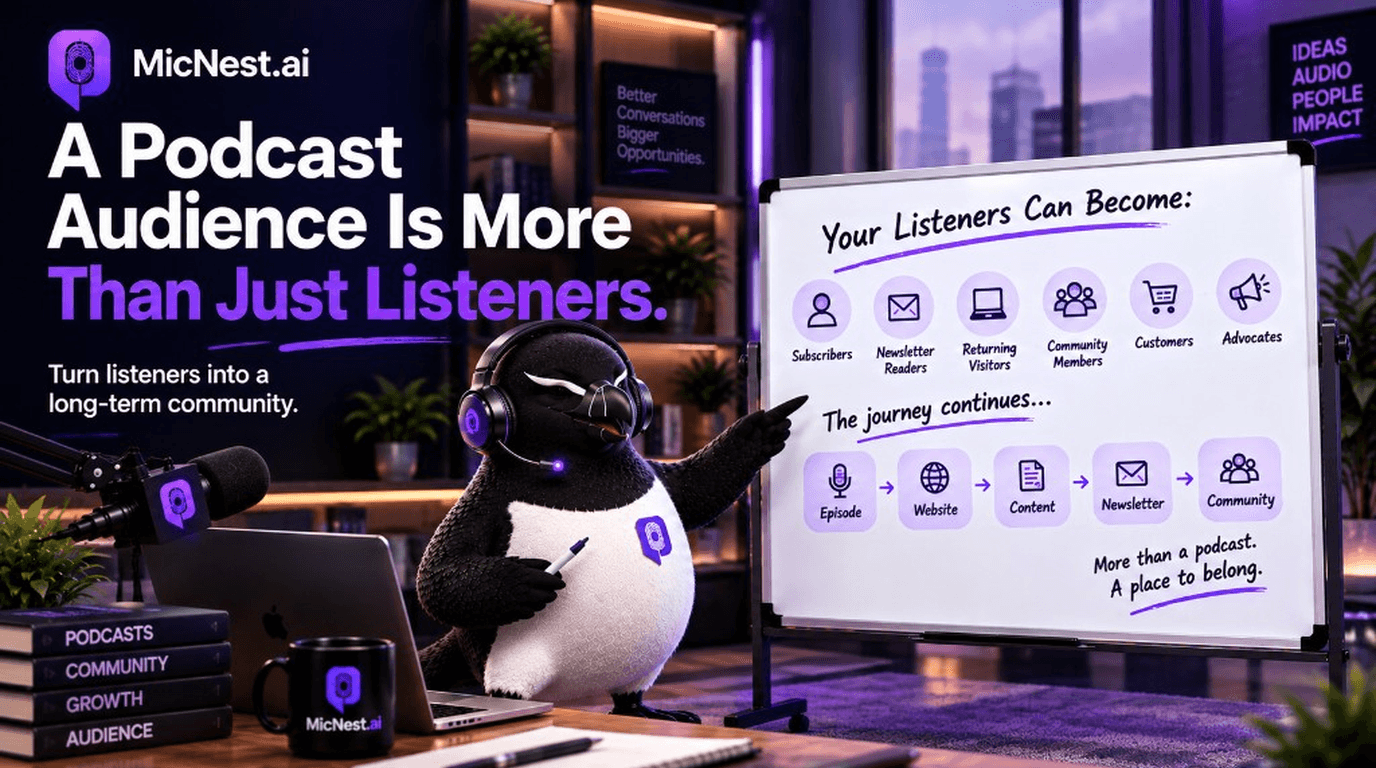
Your listeners can become subscribers, newsletter readers, returning visitors, community members, customers, advocates, and contributors. The challenge is creating a path between those stages — because listeners don't automatically become a community. You have to give them a reason to stay connected. That's core to podcast marketing and how to grow a podcast beyond downloads alone.
What Is a Podcast Community?
A podcast community is a group of people connected by an interest in your podcast, its topics, its guests, or the ideas discussed in your conversations.
It doesn't necessarily mean creating a huge private forum or Discord server. Podcast communities (and broader podcasting communities) can exist through:
- Your website
- Comments
- Events
- Social media
- Online groups
- Member areas
- Live conversations
- Newsletters
The technology matters less than the relationship. The goal is a place where people don't simply consume your content — they return, participate, and feel connected to what you're building.
Listeners and Community Members Are Different
Someone can listen to your podcast once. That doesn't necessarily mean they're part of your community.
A community member is more likely to:
- Return regularly
- Subscribe
- Read your content
- Participate
- Share episodes
- Recommend your show
- Attend events
- Interact with other podcast listeners
Think about the progression:
Listener → Visitor → Subscriber → Returning audience member → Community member
Your job isn't to force people through this funnel. It's to create useful reasons for them to move deeper into your ecosystem.
Why Podcast Communities Matter
Podcasting is often treated as a one-way medium: the host speaks, the guest speaks, the audience listens.
Strong communities create a feedback loop. The audience can tell you what they want to hear, which topics matter, which guests they like, which questions they have, and what problems they're trying to solve.
That feedback can improve the podcast itself. The relationship becomes:
Create → Listen → Respond → Learn → Create
instead of:
Create → Publish → Repeat
Start With Your Podcast Website
Your podcast website can become the home of your community.
Social platforms are useful for discovery. Podcast apps are useful for listening. Your website can bring everything together so visitors can:
- Explore episodes
- Search conversations
- Read articles
- Discover guests
- Browse topics
- Subscribe
- Find events
- Return for new content
This gives your audience a consistent destination outside individual platforms — which is why a strong site matters for how to grow a podcast over time.
Give People a Reason to Come Back
The easiest way to build a community is to give people something worth returning for:
- New conversations every week
- Useful articles based on your podcast
- Curated newsletters with the best ideas
- Exclusive resources for subscribers
- Events and live discussions with guests
- Topic collections around subjects they care about
The important question is: what does someone get by coming back?
Build an Email List Around Your Podcast
Email is one of the simplest ways to create a direct relationship with your audience.
Someone visits your website. They enjoy an episode. Then they see: "Get the best conversations and ideas from our podcast every week." They subscribe. Now you have another way to communicate — without waiting for an algorithm to surface your next episode.
Your Newsletter Shouldn't Just Announce Episodes
A newsletter that only says "New episode available. Listen now." can work — but it doesn't give subscribers much additional value.
Turn your newsletter into its own content experience:
- This week's idea — one lesson from your latest conversation
- Recommended conversation — an older episode worth revisiting
- What we're reading — a resource mentioned by the guest
- Question of the week — a prompt for your audience
- New episode — then introduce the full conversation
The newsletter becomes something people want to receive. A useful podcast email newsletter is one of the simplest podcast marketing habits that keeps people connected between episodes.
Ask Your Audience Questions
A community shouldn't be completely one-way. Ask questions:
- What's the biggest challenge you're facing with hiring right now?
- Which topic should we explore next?
- Who should we invite to the podcast?
These questions can produce engagement, new episode ideas, guest recommendations, and useful feedback. Your audience becomes part of the content process.
Let Your Audience Influence the Podcast
Suppose many subscribers tell you they want an episode about AI agents for small businesses. That's useful information.
You can find an expert, prepare questions, record the conversation, publish it, and send it to the people who requested it. Now your audience sees a direct connection between their feedback and your content — and relationships get stronger.
Create Conversations Around Conversations
Your podcast already creates conversations between hosts and guests. Extend those to your audience:
Podcast episode → "What did you think about this idea?" → Audience discussion → "Here are the best responses." → Follow-up episode
Now your audience isn't simply consuming the podcast. They're contributing to it.
Your Guests Can Help Build the Community
Podcast guests bring more than expertise — they bring perspective and reach.
After publishing an episode, invite the guest to share it, answer audience questions, join a live discussion, contribute an article, recommend another guest, or participate in a follow-up conversation. That creates more opportunities for interaction.
Build Around Shared Interests
People rarely join communities simply because they like a podcast. They join because they care about something — entrepreneurship, AI, marketing, technology, leadership.
The community should reflect that shared interest. The podcast becomes the gathering point. The topic becomes the reason people stay.
Create Topic-Based Experiences
Imagine your podcast covers major topics. Instead of making visitors browse every episode, create topic collections:
- AI — 25 episodes
- Marketing — 40 episodes
- Leadership — 32 episodes
- Startups — 50 episodes
Community members can follow the subjects they care about. You can also recommend new conversations based on those interests — so the message becomes "here's something relevant to you," not only "here's our latest episode."
Create a Community Funnel
A simple journey could look like:
Social post → Podcast episode → Website → Useful article → Newsletter signup → Subscriber → Community interaction → Returning listener
Each step should provide value. Don't ask someone to join a community before giving them a reason to care.
Your Podcast Website Can Connect the Entire Journey
This is where an owned podcast website becomes especially valuable.
A listener might discover you on YouTube, visit your episode page, read an article, explore a guest, search a topic, then subscribe to your newsletter. The website connects these experiences.
That's why your site should be more than a digital business card. It can become the home of the entire podcast ecosystem — the same idea behind turning your podcast into a platform.
Build Community Before You Need It
You don't need 100,000 listeners to start. Starting early can be better.
Imagine you have 200 listeners and 50 subscribers. You can communicate with those people, ask questions, learn what they care about, and invite them to participate. As the podcast grows, the relationship grows with it.
A smaller engaged group can be more useful than a much larger audience that never interacts — especially if you're learning how to grow a podcast with limited time.
Community Doesn't Mean Constant Engagement
You don't need to post every day or force discussion threads.
A healthy community can be simple:
- One useful newsletter each week
- One audience question regularly
- One live session each month
- Interesting conversations shared
- Community responses highlighted
Consistency matters more than volume.
Events Can Bring the Audience Together
As your audience grows, events can create stronger connections:
- Live Q&A with a recent guest
- Community discussion of a topic from the latest episode
- Expert session that teaches something practical
- Listener meetup
- Virtual roundtable on a shared problem
The podcast becomes the starting point for real interaction.
Turn Audience Questions Into Episodes
One of the easiest ways to involve your community is to use their questions.
"How should a startup decide when to hire its first salesperson?" can become a podcast episode, an article, a newsletter, and a social post. The audience helps shape your content.
Turn Community Insights Into Content
The relationship works both ways. Useful community responses can become content:
"We asked listeners what their biggest marketing challenge was."
You now have audience insight, a potential article, a podcast topic, social content, and newsletter material. Your community becomes part of your content engine — related to podcast content repurposing.
Avoid Building Your Community Entirely on One Platform
Discord, Facebook Groups, Reddit, and Slack can all be useful. Don't make one third-party platform the only place your community exists.
Platforms can change. Your audience should always have a connection to your own ecosystem too. Your website and email list can act as the foundation. External communities can sit around them.
Audience Ownership Comes Before Community
A community becomes much easier to build when you have a direct relationship with your audience.
That's why we previously discussed owning your podcast audience.
The progression is:
Discovery → Listener → Website visitor → Subscriber → Community member
The website and email relationship help bridge the gap.
Search Makes Community Discovery Better
Your community also benefits from a searchable podcast archive.
Someone asks: "Have you ever discussed AI agents?" Instead of guessing, you search the archive, find the conversation, share it, and continue the discussion. Your content library becomes part of the community experience.
Your Back Catalog Can Serve the Community
You don't always need something new.
Someone asks about startup fundraising. You already have 8 episodes, 3 articles, 2 guests, and a guide. Point them toward the existing knowledge. Your podcast back catalog becomes a resource for the community — and a quieter form of podcast marketing where evergreen content keeps working long after publish day.
What Makes a Podcast Community Strong?
Common characteristics:
- Shared interest — people care about the subject
- Consistent value — the podcast keeps providing useful content
- Participation — people have opportunities to contribute
- Recognition — audience members feel heard
- Accessibility — content is easy to find and consume
- Continuity — there's a reason to return
You don't need elaborate technology. You need consistency and a clear purpose.
A Simple Podcast Community Strategy
If you're starting from scratch:
- Build your podcast website — create a central home.
- Start a newsletter — give listeners a direct relationship.
- Ask one question every week — learn what your audience cares about.
- Use audience questions — turn them into content.
- Connect related episodes — help people explore your archive.
- Create topic collections — make discovery easier.
- Highlight audience contributions — show that participation matters.
- Experiment with live events — create interaction opportunities.
- Measure engagement — look beyond downloads with podcast analytics.
- Keep improving — let the audience shape what you build.
How MicNest Fits Into This
At MicNest, we think the podcast shouldn't end when someone finishes listening. The conversation can lead somewhere:
Episode → Website → Content → Search → Newsletter → Audience → Community
That's why MicNest brings podcast content and audience tools together. Your podcast can have:
- A dedicated website
- Searchable episodes
- Articles
- Guest profiles
- Topics
- Newsletter tools
- Audience insights
- Connected content
The goal isn't simply to get more listeners. It's to help creators build something around those listeners.
Frequently Asked Questions
What is a podcast community?
A podcast community is a group of people connected by a shared interest in a podcast, its topics, guests, or ideas — where people return and participate, not only listen once.
How do I build a podcast community?
Start by creating useful content, building a podcast website, collecting subscribers, asking your audience questions, and creating opportunities for people to participate.
Do I need a large audience to build a community?
No. A small, engaged group of podcast listeners can be a strong foundation for a community.
Does a podcast community need Discord or Facebook?
No. A community can exist through your website, newsletter, events, social platforms, or dedicated community software. Ownership of website and email should come first.
How can I turn listeners into subscribers?
Give listeners a clear reason to stay connected — a useful newsletter, exclusive content, resources, or regular updates.
How can guests help build my podcast community?
Podcast guests can introduce new audiences, participate in discussions, answer listener questions, and help create additional content around their episode.
What should I send podcast subscribers?
You can send new episodes, useful insights, recommended conversations, articles, resources, questions, and curated content — not only "new episode" announcements.
Don't Just Build a Listener Base
A listener presses play. A subscriber chooses to stay connected. A community member chooses to participate.
That's the progression worth thinking about when you work on how to grow a podcast.
Your podcast can be the starting point. Your website can become the home. Your newsletter can become the direct connection. Your content library can become the shared knowledge. And your podcast community can become the people who keep coming back.
You don't need millions of listeners to start. You need to give the people who already care about your podcast a reason to stay.
Don't just grow your listener count. Build somewhere your listeners want to return to.
Turn Listeners Into an Audience
MicNest helps podcasters build more than an episode feed — with a website, searchable content, guest profiles, newsletters, analytics, and tools designed around audience growth.
Related Reading
Before vs after
Before
- — Relationship ends when the listener closes the app
- — No owned destination beyond podcast directories
- — Feedback never shapes the next episode
After
- + Listeners become subscribers and returning visitors
- + Website + newsletter connect the full journey
- + Audience questions and topics feed new content
Who is this for?
Podcasters
Creators who want listeners to return, subscribe, and participate.
Growth marketers
Teams building newsletters, websites, and owned audience paths around shows.
Community builders
Hosts turning feedback, guests, and topics into ongoing relationships.
Turn listeners into a real audience
Listeners shouldn't disappear after they press stop. MicNest helps turn conversations into a website, searchable content, newsletters, guests, topics, and audience growth paths.
Explore MicNest or start freeSources
- MicNest product — MicNest connects website, searchable content, guests, topics, newsletters, and audience tools around a podcast.
Frequently Asked Questions
What is a podcast community? +
A podcast community is a group of people connected by a shared interest in a podcast, its topics, guests, or ideas — where people return and participate, not only listen once.
How do I build a podcast community? +
Start by creating useful content, building a podcast website, collecting subscribers, asking your audience questions, and creating opportunities for people to participate.
Do I need a large audience to build a community? +
No. A small, engaged group of podcast listeners can be a strong foundation for a community.
Does a podcast community need Discord or Facebook? +
No. A community can exist through your website, newsletter, events, social platforms, or dedicated community software. Ownership of website and email should come first.
How can I turn listeners into subscribers? +
Give listeners a clear reason to stay connected — a useful newsletter, exclusive content, resources, or regular updates.
How can guests help build my podcast community? +
Podcast guests can introduce new audiences, participate in discussions, answer listener questions, and help create additional content around their episode.
What should I send podcast subscribers? +
You can send new episodes, useful insights, recommended conversations, articles, resources, questions, and curated content — not only new-episode announcements.

