
Definition
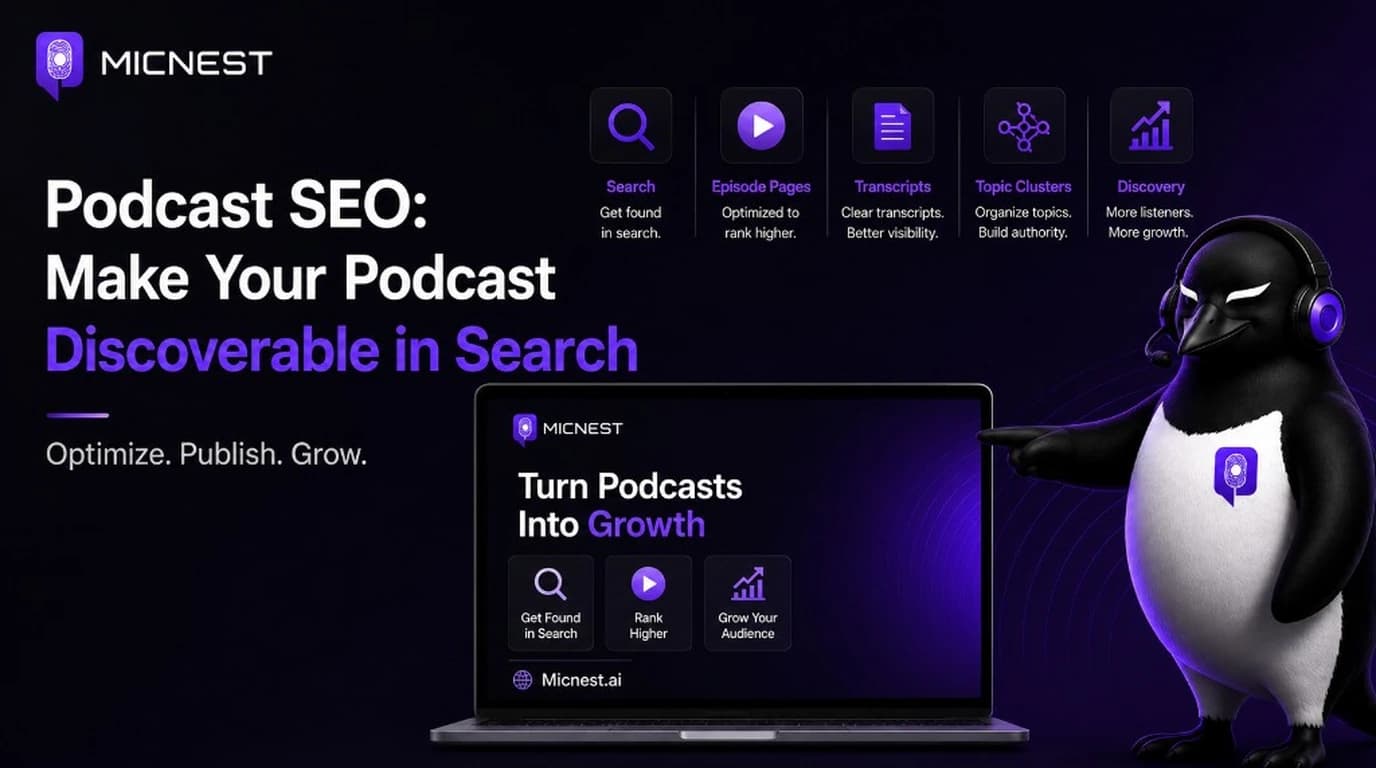
podcast SEO: Podcast SEO is the process of optimizing your podcast, episode pages, website, transcripts, and related content so people can discover your conversations through search engines and other discovery systems.
In simple terms: Podcast SEO is the process of optimizing your podcast, episode pages, website, transcripts, and related content so people can discover your conversations through search engines and other discovery systems.
Quick Answer
Podcast SEO helps your content become discoverable when someone searches for a topic, question, guest, or problem discussed in your episodes — instead of relying only on someone se
Podcast SEO helps your content become discoverable when someone searches for a topic, question, guest, or problem discussed in your episodes — instead of relying only on someone searching for your podcast's name. The fundamental shift: don't only optimize for people who already know your podcast. Optimize for people who don't know you yet.
MicNest helps creators build the content layer around their podcast — website, searchable episodes, SEO articles, guest profiles, and newsletters. Start at https://app.micnest.ai/auth/signup.
Key Takeaways
- ➔ Publishing an episode and making it discoverable are two different problems.
- ➔ People search for questions and problems — not episode numbers.
- ➔ A raw audio file doesn't give search engines enough to work with; you need a web content layer.
- ➔ Podcast transcripts are raw material — structure them into articles that answer reader needs.
- ➔ One episode can support multiple searchable assets: pages, topics, guest profiles, and articles.
- ➔ Internal linking and topic organization turn a feed into a knowledge graph.
- ➔ Old evergreen episodes can keep attracting visitors when represented through accessible web content.
- ➔ Podcast marketing creates attention; podcast SEO creates discovery paths that outlast promotion.
- ➔ A strong podcast website is the owned home where all these pieces connect.
You can create an incredible podcast and still have a discoverability problem. Someone searching for exactly what you discussed may never find your episode — because publishing a podcast and making it discoverable are two different things. Podcast SEO is how you close that gap.
Why podcast SEO matters
Podcasting has become a massive content format.
But podcast discovery is still different from traditional web search.
Imagine you have a 60-minute episode about growing a startup.
During that conversation, you discuss:
- Getting the first customers
- Building a sales team
- Startup marketing
- Hiring
- Pricing
- Founder mistakes
Someone searching Google for "How to get your first 10 customers" might benefit enormously from that conversation.
But the search engine needs something it can understand, index, and present to that person.
A raw audio file doesn't provide the same searchable surface as a well-structured web page.
That's why your podcast needs a web content layer around the audio — the same philosophy behind why we built MicNest.
The difference between podcasting and podcast discoverability
Publishing an episode answers: "Is the episode available?"
Podcast SEO asks: "Can someone who doesn't know about this episode find it?"
Those are different questions.
Traditional workflow
Record → Edit → Publish → Promote
Search-focused workflow
Record → Edit → Publish → Understand → Structure → Optimize → Discover
The second workflow doesn't replace the first.
It adds another layer.
Your podcast remains the core content.
SEO helps people discover it.
People search for questions, not episode numbers
This is one of the biggest opportunities for podcasters.
Your internal organization might look like:
Episode 84: The Future of Content Marketing with Sarah
But your potential audience might search:
- How will AI change content marketing?
- Is content marketing still worth it?
- How should startups approach content marketing?
The conversation may answer all three.
But the episode title doesn't necessarily communicate that.
This is why understanding search intent matters.
What is search intent?
Search intent is the reason behind a search.
Someone searching "best microphones for podcasting" has a different intention from someone searching "how to start a podcast."
And both are different from "Joe Rogan podcast."
A simple way to think about it is:
Informational — The person wants an answer.
Examples: How does podcast SEO work? How do I start a podcast? How do podcast transcripts help SEO?
Commercial — The person is researching a solution.
Examples: Best podcast website builder, podcast SEO tools, podcast website platforms.
Navigational — The person is looking for a specific destination.
Examples: Spotify podcast, MicNest, [specific podcast name]
Your podcast content can address multiple types of intent.
The key is matching the right content to the right question.
Your episode title is not your SEO strategy
A strong episode title is important.
But it shouldn't be the only thing search engines have to work with.
Consider this title: Episode 47: John Smith
It tells a listener almost nothing.
Compare it with: How John Smith Built His First 1,000 Customers
The second communicates the subject much more clearly.
But even that may not capture everything discussed in the conversation.
The episode page can provide additional context:
- What the episode is about
- Questions answered
- Key topics
- Guest information
- Transcript
- Important timestamps
- Related episodes
- Supporting articles
- Structured metadata
Now search engines have much more information to understand.
Build a website around your podcast
Your podcast should have an owned home on the web.
A good podcast website shouldn't simply contain Home, Episodes, About.
It should become the searchable layer around your podcast.
A strong episode page can include:
- Episode title — Clearly communicate what the conversation covers.
- Description — Explain the episode in natural language.
- Guest information — Help people understand who they are listening to.
- Topics — Connect the episode to relevant subjects.
- Transcript — Make the conversation available as text.
- Key moments — Help visitors quickly find valuable sections.
- Related content — Connect the episode to articles and other conversations.
- Subscribe option — Give visitors a way to stay connected.
The goal is simple: give every episode a useful home on the web.
If you're evaluating platforms, see our guide to the best podcast website builder and what is a podcast creator platform.
Podcast transcripts are important
A podcast transcript turns spoken content into text.
That matters for several reasons. A transcript can:
- Make conversations accessible to readers
- Help people scan an episode
- Make quotes easier to find
- Provide additional context
- Create raw material for articles
- Make specific discussions easier to search
But there's an important distinction.
A transcript is not automatically a great SEO article.
A transcript represents the conversation.
An article represents the answer.
For example, a guest might spend 15 minutes discussing customer acquisition.
The transcript contains everything they said.
An article might turn that discussion into: 7 Lessons for Getting Your First Customers
The article organizes the information around a reader's need.
That's much more useful than simply publishing a wall of spoken text.
For the full workflow from audio to written pages, see how to turn a podcast into a blog.
Turn conversations into searchable content
This is where your existing podcast library becomes powerful.
One episode can contain multiple topics.
For example, an episode titled "How We Built a $10M Company" might cover inside the conversation:
- Finding product-market fit
- Getting the first customers
- Hiring the first employees
- Raising funding
- Building a marketing strategy
Instead of treating that as one isolated episode, identify the questions inside it.
You might create supporting content around:
- How to find product-market fit
- How to get your first customers
- When should a startup hire?
- How should founders approach fundraising?
- How to build a startup marketing strategy
The conversation is still the source.
You're simply making its knowledge easier to discover — the same idea behind treating your show as a podcast content library.
The podcast SEO content pyramid
Think about your content as several layers.
Layer 1: The conversation — The original recording.
Layer 2: The episode — The published podcast episode.
Layer 3: The transcript — The complete written conversation.
Layer 4: Structured content — Articles, questions, topics, quotes, and key moments.
Layer 5: Discovery — Search engines, social platforms, newsletters, and other channels.
The deeper you go, the more ways people have to discover the original conversation.
Create one strong page per episode
Every important episode should have its own page.
That page should clearly communicate:
- Who? — Who was the guest?
- What? — What was discussed?
- Why? — Why should someone care?
- Where? — Where can they listen?
- When? — When was the conversation published?
- How? — How can someone explore more related content?
This gives your podcast catalog a real web structure.
Instead of 100 audio files, you now have 100 searchable episode pages connected to your broader content ecosystem.
Connect related episodes
Internal linking is one of the simplest ways to improve the structure of a podcast website.
Suppose you have:
- Episode 12: How to Build an Audience
- Episode 38: Growing an Email List
- Episode 71: Turning Followers Into Customers
These conversations are related. Connect them.
At the bottom of each page, you could show related conversations linking to each other.
Now visitors can move through your library.
Search engines can also better understand the relationships between your pages.
Your podcast starts behaving like a knowledge graph rather than a chronological list.
For a deeper dive on catalog structure, see build a searchable podcast archive.
Use topics to organize your podcast
Chronological organization isn't enough.
Your newest episode isn't necessarily your most relevant episode.
Create topic-based connections. For example:
Marketing — content marketing, SEO, email marketing, social media, brand strategy
Business — leadership, hiring, sales, pricing, operations
Technology — AI, automation, software, data
Now someone interested in one subject can explore multiple conversations.
This also makes your website more useful to people who discover you through search.
Guest pages create another discovery path
Your guests are another SEO opportunity.
Instead of mentioning a guest only inside an episode description, give important guests their own profile.
A guest profile might contain:
- Name and biography
- Company and expertise
- Episodes and topics discussed
- Related articles and external links
Now there is another page people can discover.
And guests have something useful to share with their own audience.
One conversation can therefore create multiple entry points into your podcast.
Don't stuff keywords into your podcast
Podcast SEO doesn't mean repeating "podcast SEO" over and over.
That makes content worse.
Instead, understand what people actually want.
If you're writing about podcast discoverability, naturally explain:
- How podcast search works
- Why transcripts matter
- How episode pages help
- How internal links connect content
- How websites support podcast discovery
Write for humans first.
Good SEO is usually good communication with better structure.
Optimize your episode pages
Here's a practical checklist.
- Create a clear title that communicates the topic
- Write a useful description — explain what someone will learn
- Include the guest and give context about who is speaking
- Add the transcript and make the conversation readable
- Highlight important moments for quick navigation
- Add relevant topics connecting to your broader library
- Link related episodes to help visitors continue exploring
- Add relevant articles for deeper written content
- Add a subscription opportunity so visitors don't disappear
- Make the page technically accessible so search engines can crawl it
Podcast SEO starts with your existing catalog
You don't need to wait until your next episode.
Start with the episodes you've already published.
Take your 10 best episodes. For each episode, identify:
- Main topic — What is the central subject?
- Questions — What questions did the conversation answer?
- Subtopics — What other useful subjects came up?
- Guest expertise — What does the guest know?
- Evergreen ideas — Which parts will still be useful six months from now?
- Search opportunities — What might someone type into Google to find this information?
This exercise can reveal dozens of content opportunities.
A simple podcast SEO workflow
Here's a practical workflow you can use for every new episode.
- Record — Have a genuinely useful conversation.
- Publish — Make the original episode available through your distribution channels.
- Transcribe — Turn the conversation into searchable text.
- Identify topics — Find the strongest ideas and questions.
- Create the episode page — Give the conversation an owned home.
- Create supporting content — Turn valuable topics into useful articles where appropriate.
- Connect everything — Link articles, episodes, guests, and topics together.
- Make discovery possible — Optimize titles, headings, descriptions, metadata, and page structure.
- Build an audience — Give visitors a reason to subscribe.
- Repeat — Every new episode expands the library.
Podcast SEO vs podcast marketing
These two concepts overlap, but they're not identical.
| Podcast marketing | Podcast SEO |
|---|---|
| Focuses on getting attention | Focuses on being discoverable when someone is actively looking |
| Social media, clips, partnerships | Search-friendly episode pages, transcripts, topic pages |
| Paid promotion, guest promotion | Articles, internal linking, structured metadata |
| Newsletters for immediate reach | Search-focused content that compounds over time |
You need both.
Marketing can create immediate attention.
SEO can create a discovery path that continues after the promotion ends.
SEO can give old episodes another life
Imagine publishing an episode in January.
You promote it for a week.
Then the promotion ends.
Without additional discovery mechanisms, attention can drop quickly.
But suppose that episode answers an evergreen question.
Six months later, someone searches for that question.
If your website has useful content connected to that conversation, the episode can have another opportunity to be discovered.
That's one of the biggest advantages of building a searchable podcast library.
Your content doesn't have to expire when your promotion ends.
The podcast SEO flywheel
A strong podcast SEO strategy creates a loop:
Conversation → Episode → Transcript → Insights → Articles → Search → New visitors → Episode discovery → Subscribers → More conversations → More content
Over time, the library becomes larger.
And every new piece can strengthen the connections between the others.
What about AI search?
Search is changing.
People increasingly ask AI systems questions rather than simply browsing ten blue links.
That creates another reason to structure your podcast knowledge.
AI systems work with information they can access and understand.
A private audio file is difficult to quote.
A clearly structured page containing a specific question, a clear answer, supporting context, relevant sources, a transcript, and links to the original episode provides a much better representation of the knowledge inside the conversation.
This doesn't mean you can guarantee that an AI system will cite your podcast.
You can't.
But you can make your content more accessible, structured, and understandable.
That's a worthwhile goal regardless of the search technology being used.
Common podcast SEO mistakes
Mistake 1: Only optimizing the podcast title
Your show title isn't enough. Every episode is another opportunity to communicate a useful topic.
Mistake 2: Publishing only audio
Audio is the heart of your podcast. But it shouldn't necessarily be the only representation of the conversation.
Mistake 3: Treating the transcript as the final article
A transcript is raw material. Structure it around the reader's needs.
Mistake 4: Ignoring old episodes
Your archive can contain some of your best material. Don't let chronological order determine content value.
Mistake 5: Creating disconnected articles
Articles should connect back to relevant episodes and other content.
Mistake 6: Writing for algorithms instead of people
Search optimization shouldn't make your content robotic. Useful content comes first.
Mistake 7: Forgetting the website
Your podcast needs an owned home where all of these pieces can connect.
A practical podcast SEO checklist
Before publishing an episode, ask:
- Does the title clearly communicate the topic?
- Does the description explain what listeners will learn?
- Does the episode have its own web page?
- Is there a transcript?
- Are important topics identified?
- Are useful questions addressed?
- Are related episodes linked?
- Is the guest clearly represented?
- Are relevant articles linked?
- Can visitors subscribe?
- Can search engines crawl the page?
- Is the content useful to someone who has never heard of the podcast?
If most of these answers are yes, you're building more than a podcast feed.
You're building a discoverable content library.
How MicNest approaches podcast SEO
This is the problem we started MicNest to solve.
Creators shouldn't have to manually move information from podcast → transcript tool → writing tool → website → newsletter → guest database → analytics every time they publish an episode.
The conversation should be the source.
The system around it should help turn that source into something useful.
MicNest brings together the podcast website, episode pages, searchable content, SEO articles, guest profiles, newsletter tools, and audience features in one platform.
The goal isn't to replace podcast distribution.
It's to build the layer around your podcast that makes the knowledge inside it easier to discover and use.
The bigger picture
Podcast SEO isn't about chasing rankings.
It's about answering a simple question:
Can someone who needs the knowledge inside my podcast actually find it?
If the answer is no, there's an opportunity.
Your conversations already contain the expertise.
Your guests already have stories.
Your episodes already contain answers.
Your catalog already contains years of work.
SEO simply creates more paths into that knowledge.
So don't think about your podcast as: Audio → Publish → Archive
Think about it as: Conversation → Knowledge → Content → Search → Discovery → Audience
That's the opportunity.
Frequently asked questions
What is podcast SEO?
Podcast SEO is the process of optimizing your podcast and its supporting web content so people can discover episodes through search engines and other search experiences.
Does podcast SEO mean putting keywords in episode titles?
No. Keywords can help communicate a topic, but effective podcast SEO involves much more: useful episode pages, descriptions, transcripts, structured content, internal links, topic organization, and a strong website.
Do podcast transcripts help SEO?
A transcript can provide valuable text and context around an episode. However, simply publishing a raw transcript isn't the same as creating a well-structured, search-focused article.
Does every podcast need a website?
If discoverability and audience ownership are important goals, having an owned website is extremely valuable. It gives your podcast a place where episodes, articles, guests, topics, and subscriber opportunities can connect.
Can old podcast episodes rank in search?
They can remain discoverable when they contain useful information and are represented through accessible, relevant web content. Evergreen episodes can continue attracting attention long after their original publication.
How do I make my podcast searchable?
Start by creating dedicated episode pages, adding useful descriptions and transcripts, organizing topics, linking related episodes, creating supporting articles, and making the content accessible to search engines.
Should I turn every podcast episode into a blog?
Not necessarily. Focus on conversations that contain useful, evergreen, or search-worthy topics. Quality and relevance matter more than publishing an article for every episode.
Is podcast SEO the same as podcast marketing?
No. Podcast marketing focuses heavily on generating attention and promotion. Podcast SEO focuses on making your content discoverable when people search for relevant topics.
Your podcast already has the answers
You don't need to invent hundreds of new topics.
You may already have them.
They're inside your episodes.
Inside the interviews.
Inside the questions.
Inside the stories.
Inside the lessons your guests shared.
The opportunity is to take that knowledge and make it easier to find.
Because the future of podcast discovery isn't only about "What's the newest episode?"
It's also about "Where is the answer to my question?"
Your podcast may already contain that answer.
Podcast SEO helps people find it.
Make your podcast discoverable
MicNest helps creators build the content layer around their podcast: a website, searchable episodes, articles, guest profiles, newsletters, and an owned content library.
Your conversations are already valuable. Give people more ways to discover them.
Frameworks
Practical framework
Podcast SEO means publishing indexable pages, transcripts, and blogs so Google and AI assistants can understand your show.
- Audit your current discovery channels
- Publish indexable episode pages
- Compound with blogs and email
Creator use case
An independent podcaster wants search traffic and an owned list.
- ✓Episode pages
- ✓SEO blogs
- ✓Newsletter capture
Before vs after
Before
- — Record → Edit → Publish → Promote → Archive
- — Ideas stay trapped inside audio files
- — Only people who know your show can find episodes
After
- + Record → Transcribe → Structure → Optimize → Discover
- + Episode pages, topics, articles, and guest profiles
- + Search engines and AI can surface your conversations
Who is this for?
Podcasters
Creators who want episodes to rank and stay discoverable.
Interview show hosts
Hosts with deep catalogs of guest conversations.
Content teams
Teams building search-focused podcast websites.
Make your podcast discoverable
Your conversations are already valuable. MicNest helps you build the content layer — website, searchable episodes, articles, guest profiles, and newsletters — so people can find the answers inside your podcast.
Explore MicNest or start freeSources
Reviewed by Alex Rivera, Co-Founder & CEO, MicNest
Quick Comparison
| Focuses on getting attention | Focuses on being discoverable when someone is actively looking |
|---|---|
| Social media, clips, partnerships | Search-friendly episode pages, transcripts, topic pages |
| Paid promotion, guest promotion | Articles, internal linking, structured metadata |
| Newsletters for immediate reach | Search-focused content that compounds over time |
Pros & Cons
| ✅ Pros | ❌ Cons |
|---|---|
| ✔ Turns existing conversations into long-term discovery paths | ✖ Requires a web content layer beyond audio-only publishing |
| ✔ Makes evergreen episodes findable months after publication | ✖ Transcripts alone are not enough — structure matters |
| ✔ Creates multiple entry points per episode (pages, topics, guests, articles) | ✖ Search traffic compounds slowly compared to viral clips |
| ✔ Compounds: each new episode strengthens the whole library | ✖ Needs ongoing internal linking and topic organization |
Frequently Asked Questions
What is podcast SEO? +
Podcast SEO is the process of optimizing your podcast and its supporting web content so people can discover episodes through search engines and other search experiences.
Does podcast SEO mean putting keywords in episode titles? +
No. Keywords can help communicate a topic, but effective podcast SEO involves much more: useful episode pages, descriptions, transcripts, structured content, internal links, topic organization, and a strong website.
Do podcast transcripts help SEO? +
A transcript can provide valuable text and context around an episode. However, simply publishing a raw transcript isn't the same as creating a well-structured, search-focused article.
Does every podcast need a website? +
If discoverability and audience ownership are important goals, having an owned website is extremely valuable. It gives your podcast a place where episodes, articles, guests, topics, and subscriber opportunities can connect.
Can old podcast episodes rank in search? +
They can remain discoverable when they contain useful information and are represented through accessible, relevant web content. Evergreen episodes can continue attracting attention long after their original publication.
How do I make my podcast searchable? +
Start by creating dedicated episode pages, adding useful descriptions and transcripts, organizing topics, linking related episodes, creating supporting articles, and making the content accessible to search engines.
Should I turn every podcast episode into a blog? +
Not necessarily. Focus on conversations that contain useful, evergreen, or search-worthy topics. Quality and relevance matter more than publishing an article for every episode.
Is podcast SEO the same as podcast marketing? +
No. Podcast marketing focuses heavily on generating attention and promotion. Podcast SEO focuses on making your content discoverable when people search for relevant topics.

