
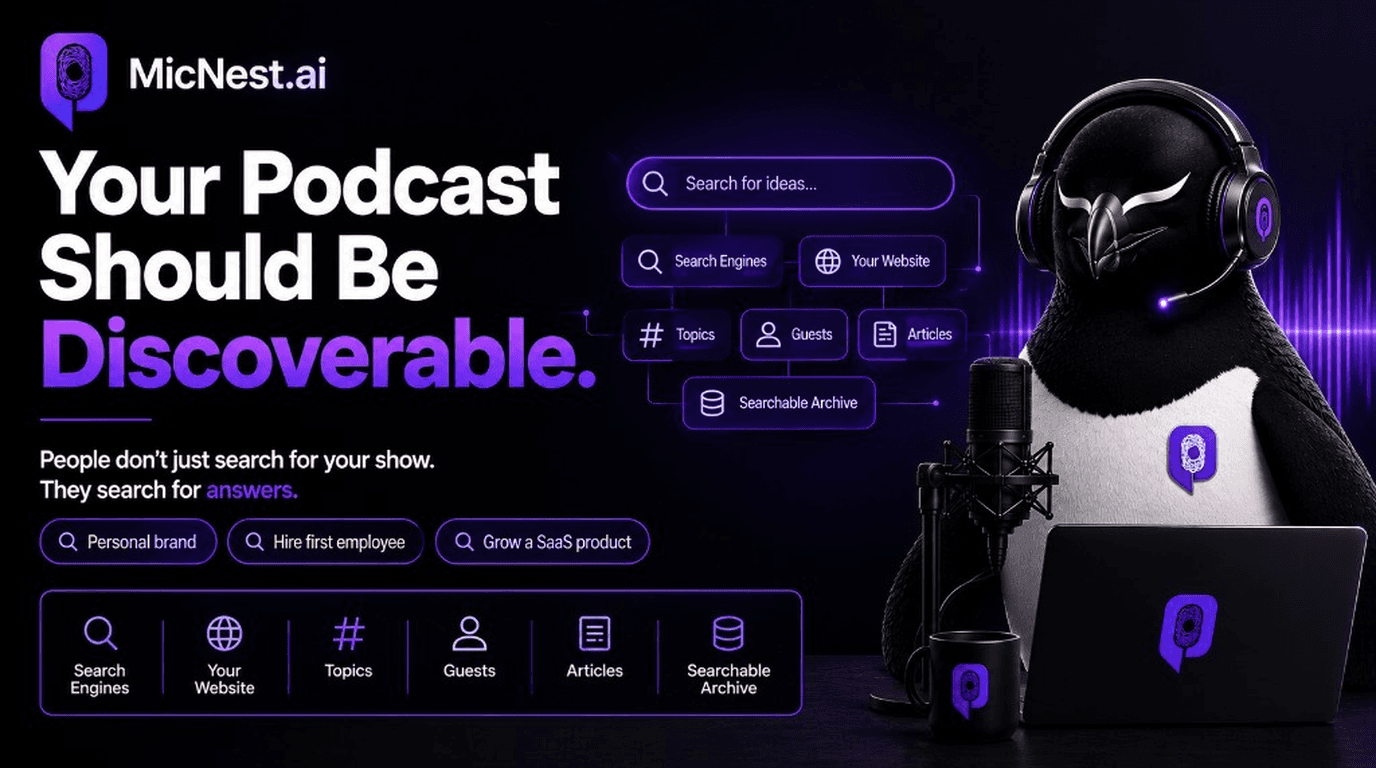
Definition
podcast search: Podcast discoverability is the ability for new and existing audiences to find your podcast, episodes, guests, and the ideas discussed in your conversations — through platforms, search engines, your website, social channels, newsletters, and searchable archives.
In simple terms: Podcast discoverability is the ability for new and existing audiences to find your podcast, episodes, guests, and the ideas discussed in your conversations — through platforms, search engines, your website, social channels, newsletters, and searchable archives.
Quick Answer
Build multiple entry points: dedicated episode pages, transcripts, SEO articles, topic and guest pages, website search, related content, social and YouTube clips, and a newsletter
Build multiple entry points: dedicated episode pages, transcripts, SEO articles, topic and guest pages, website search, related content, social and YouTube clips, and a newsletter — then measure how people actually find you.
MicNest helps podcasters improve discoverability — websites, SEO articles, searchable archives, transcripts, topics, guest profiles, and audience tools. Start at https://app.micnest.ai/auth/signup.
Key Takeaways
- ➔ People rarely search for a show they don't know — they search for answers.
- ➔ Your conversations already contain questions people are looking for.
- ➔ Discoverability needs multiple channels, not one algorithm.
- ➔ Your website can become a discovery engine, not just an episode list.
- ➔ Podcast SEO creates paths through topics and questions, not only your show name.
- ➔ Transcripts, articles, guests, and topics expand the discovery surface.
- ➔ Search by meaning and timestamps removes friction for visitors.
- ➔ Your back catalog can keep attracting new listeners.
- ➔ Measure traffic sources, queries, and conversions to see what works.
- ➔ MicNest helps make the ideas inside conversations easier to find.
Creating a great podcast is hard — conversations, guests, questions, consistency, production. But another challenge gets less attention: getting the right people to discover those conversations. Your podcast doesn't only need to be discoverable as a show. The ideas inside it need to be discoverable too. That's where podcast search and broader discoverability matter.
You might have 100 excellent episodes, remarkable guests, and hundreds of useful answers. But if people can't find those conversations, the value remains hidden. And that's the fundamental problem with podcast discoverability — especially if you only search podcasts by title and never by the ideas inside.
What Is Podcast Discoverability?
Podcast discoverability is the ability for new and existing audiences to find your podcast, episodes, guests, and the ideas discussed in your conversations.
People can discover podcasts through:
- Spotify
- Apple Podcasts
- YouTube
- Google Search
- Social media
- Recommendations
- Your podcast website
- Newsletters
- Podcast guests
- A searchable podcast archive
The strongest strategies for how to grow a podcast don't depend on just one discovery channel. They combine distribution, podcast marketing, and owned search paths into the content.
The Problem With Searching for a Podcast by Name
Imagine someone has never heard of your podcast. They're unlikely to search "Your Podcast Name" because they don't know it exists.
Instead, when people look for how to find podcasts that solve a problem, they might search:
- How do startup founders find their first customers?
- How to hire your first engineer
- Best SaaS pricing strategy
These are problem-based searches. The person isn't trying to search podcasts by brand. They're looking for an answer. That's the opportunity.
Your Podcast Contains Answers People Are Already Searching For
Think about what happens during a typical interview. The host asks how the guest got their first 100 customers. The guest answers. Then: what mistakes did you make? Another answer. Then: what would you do differently today? Another answer.
One conversation could contain dozens of questions and answers. Those questions are potential discovery points. The challenge is making them accessible outside the original audio file.
Podcast Discovery Has Changed
Podcast discovery used to happen primarily inside podcast applications — browse categories, search a show, follow a recommendation, discover a new episode.
Those channels are still important. But podcast content now exists across much more of the internet. A person can discover a podcast through Google, YouTube, LinkedIn, a newsletter, an article, a guest, a social post, or an AI search experience.
This means your podcast can have many more entry points.
Your Website Can Become a Discovery Engine
A podcast website shouldn't only say "here are our latest episodes." It can become a destination for discovery.
Someone might arrive through an article, then discover an episode, then the guest, then a topic, then subscribe to your newsletter.
For example:
Google Search → Article → Episode → Guest → Related Episode → Newsletter
One search query can lead someone into your entire podcast ecosystem. That's why a podcast website matters for growth.
Podcast SEO and Discoverability
SEO for podcasts is one of the most important pieces of podcast discoverability.
Search engines primarily need accessible content to understand what your website is about. An audio file alone doesn't provide the same amount of searchable context as a properly structured web page.
That's why podcast SEO often involves:
- Dedicated episode pages
- A podcast transcript on each episode
- SEO-friendly titles
- Structured headings
- Topic pages
- Guest pages
- Internal links
- Articles
- Structured data
For more detail, see our Podcast SEO Guide.
Don't Optimize Only for Your Podcast Name
A common mistake is optimizing your website around your podcast name. That's useful for people who already know you. But it doesn't necessarily help you reach people who don't.
Instead, think about the topics your podcast covers. Suppose your podcast is called The Founder Show. You could create content around startup fundraising, hiring startup employees, product-market fit, SaaS pricing, and founder productivity.
Now someone searching for one of those topics has a chance to discover your content without knowing your show exists.
Search the Ideas, Not Just the Episodes
Consider these two approaches.
Approach 1
Search: Episode 87 — not very useful.
Approach 2
Search: How do startups find product-market fit? — much more useful.
The second approach focuses on what the audience actually wants. That's why building a searchable podcast — searchable by questions, topics, guests, concepts, keywords, and meaning — can dramatically improve the discovery experience. See how to make your podcast searchable.
Transcripts Make Conversations Discoverable
A podcast transcript converts your conversation into text. That creates several opportunities. Visitors can read, search, quote, reference, share, and navigate.
But a podcast transcript can also become the raw material for other content. One transcript can help generate articles, summaries, social posts, quotes, topic pages, and newsletter content.
This connects podcast discoverability with content repurposing.
Articles Create New Discovery Paths
Imagine your episode discusses how founders should hire their first employee. The episode itself might only be discovered by existing podcast listeners.
But an article titled How to Hire Your First Employee as a Startup Founder can target people actively searching for that information — a practical layer of podcast marketing beyond posting "new episode out now."
The journey becomes: Search → Article → Podcast episode → Related conversations → Subscribe
Your podcast becomes part of the answer.
Guests Can Expand Your Discovery Surface
Podcast guests are also a discovery channel. A guest might have their own audience, website, social followers, email subscribers, and search demand around their name.
Create a useful guest page with bio, episode, topics, quotes, related articles, and other appearances. Now someone searching for that guest can potentially discover your podcast.
Topic Pages Create Another Discovery Layer
Suppose you've published 300 episodes and 50 discuss AI. Instead of keeping those episodes scattered across the archive, create an AI topic page with AI episodes, articles, guests, related questions, and popular conversations.
Now someone interested in AI has a clear place to explore. This is especially valuable as your archive grows — the same idea as a searchable podcast archive. A searchable podcast with topic pages helps people explore without scrolling hundreds of titles.
Your Back Catalog Is a Discovery Asset
Your newest episode isn't the only episode capable of attracting new listeners. An older episode can still be relevant — especially when it contains evergreen content.
Imagine someone searches how to build a remote team. Your podcast published a great conversation about it three years ago. If that conversation is properly organized and discoverable, it can still bring someone into your ecosystem today.
Your back catalog becomes an acquisition asset. That's why we explored how to unlock your podcast back catalog.
Make Your Podcast Searchable
Internal podcast search is another important discovery mechanism. A visitor might already be on your podcast website but still not know where to start.
Give them a search box. They can type AI agents, startup hiring, SaaS pricing, leadership, or customer acquisition — then show relevant episodes, articles, guests, topics, and conversation moments.
Instead of making people browse your archive — or forcing them to search podcasts only by episode number — let them ask for what they want.
Search by Meaning, Not Just Keywords
Exact keyword matching has limitations.
Consider "How can I get my first customers?" and "What's the best way to acquire initial users?" Different words. Similar meaning.
A modern podcast search system can use semantic understanding to connect related concepts. This makes the archive more useful because people don't always use the exact words spoken by the guest.
Give People the Exact Moment They Need
Finding the correct episode is good. Finding the correct moment is better.
Imagine someone searches how the founder got their first customer. Instead of returning only Episode 94, your search could return Episode 94 · 27:42 — guest explains how they landed their first customer.
Now the listener can jump directly to the relevant moment. That removes friction from discovery.
Discovery Doesn't End With the First Episode
Getting someone to discover one episode is only the beginning. What happens next?
You can guide them toward related episode → related topic → guest profile → article → newsletter. This creates a deeper experience. One discovery can lead to another — the foundation of a podcast platform.
The Podcast Discovery Flywheel
A strong system can look like:
Conversation → Episode → Transcript → Article → Search → Website visitor → Episode → Related content → Subscriber → Returning audience → New discovery
Every new piece of content creates another possible entry point.
Social Media Is Discovery, Too
Don't ignore social platforms. Your podcast contains ideas that can become LinkedIn posts, X posts, Instagram content, short videos, quote cards, and discussion questions.
But don't think of social media only as promotion. A strong social post can introduce someone to an idea, then send them deeper: Social post → Article → Episode → Website
Now social becomes another discovery layer.
YouTube Can Be a Discovery Engine
Video podcasts have another major opportunity. YouTube can help people discover conversations through search, recommendations, clips, Shorts, and long-form episodes.
But again, the opportunity isn't only to publish the full episode. Extract useful moments. Answer specific questions. Create content around the ideas people care about.
The goal is the same: make the conversation easier to discover.
Your Podcast Should Have Multiple Entry Points
A strong podcast ecosystem might have:
- Search — people search for an answer
- Articles — people discover an idea
- Guest pages — people discover an expert
- Topic pages — people explore a subject
- Episodes — people listen to the conversation
- Social — people discover your ideas
- Newsletter — people return
Each channel supports the others. That also helps you own your podcast audience.
Don't Make Discovery Dependent on the Algorithm
Algorithms can be powerful. But they can also change.
Your podcast shouldn't depend entirely on "hopefully the platform recommends our episode." If your goal is how to grow a podcast sustainably, build discovery you control.
Build additional channels: your podcast website, your content, your search presence, your newsletter, your guest network, your archive, your brand.
The more independent discovery paths you create, the less dependent you become on any single platform. That's lasting podcast marketing — not only launch-week promotion.
Measure How People Discover You
Once you've built multiple discovery channels, measure them.
Look at:
- Search traffic
- Website visitors
- Episode page views
- Search queries
- Article traffic
- Guest page traffic
- Referral sources
- Newsletter signups
- Returning visitors
You may discover that one article brings more new listeners than ten social posts. Or one guest page becomes a major source of organic traffic.
Podcast analytics can reveal what's actually working.
What MicNest Is Building
At MicNest, we think podcast discoverability should start with the conversation itself.
Your podcast already contains the ideas. Our goal is to help make those ideas easier to discover through:
- Podcast websites
- SEO articles
- Searchable episode archives
- Transcripts
- Topic organization
- Guest profiles
- Related content
- Audience tools
The idea is simple: don't make people discover your podcast only by searching for your podcast. Let them discover it by searching for the ideas inside it.
A Practical Podcast Discoverability Checklist
If you're trying to improve your podcast's discoverability — or figuring out how to grow a podcast beyond downloads — start here.
- Episode pages — Make every episode available on your podcast website.
- Podcast transcript — Make conversations readable and searchable.
- SEO for podcasts — Turn valuable discussions into useful articles.
- Topics — Group related episodes together as evergreen content hubs.
- Podcast guests — Create dedicated pages for your guests.
- Podcast search — Let visitors search your archive (and help people search podcasts by idea, not only by title).
- Related content — Connect episodes, articles, topics, and guests into a searchable podcast.
- Newsletter — Give visitors a reason to return.
- Social content — Turn useful ideas into podcast marketing discovery points.
- Analytics — Measure how people find you when they look for how to find podcasts like yours.
Frequently Asked Questions
How can I make my podcast more discoverable?
Use multiple discovery channels including podcast platforms, search engines, social media, your website, guest networks, articles, and newsletters.
Does podcast SEO really matter?
SEO can create opportunities for people to discover your podcast through topics and questions rather than searching specifically for your podcast name.
Should every podcast have a website?
A dedicated website can give your podcast an owned destination for episodes, articles, transcripts, guests, search, and audience growth.
How do transcripts help podcast discovery?
Transcripts make conversations available as text, which can improve internal search, content repurposing, accessibility, and the amount of context available on episode pages.
How do I make my podcast searchable?
Start with accurate transcripts, structured episode pages, topics, guest profiles, and a website search system that can search the content inside your episodes.
Can old episodes help attract new listeners?
Yes. Evergreen episodes can continue to attract people when the ideas inside them are made discoverable through search, articles, topic pages, and other content.
What's the best podcast discovery strategy?
There isn't one channel that works for every podcast. The strongest approach is usually a combination of distribution platforms, search, useful content, social discovery, guest promotion, and an owned website.
Your Podcast Doesn't Have a Content Problem
You may already have hundreds of hours of content. The problem might simply be that people can't find it.
Your best conversations are filled with questions, answers, ideas, stories, and expertise. Those shouldn't disappear into an episode feed. They can become discovery points.
Someone searches for a problem. They find your article. They discover your episode. They explore another conversation. They find a guest. They subscribe. They come back.
That's how a podcast becomes more than a show. It becomes a destination for knowledge.
Make Every Conversation Discoverable
MicNest helps turn podcast conversations into a searchable content ecosystem with a website, SEO articles, transcripts, guest profiles, topic discovery, and audience tools.
Related Reading
Before vs after
Before
- — Discovery depends on searching for the show name
- — Ideas trapped inside audio files
- — One platform algorithm controls reach
After
- + People find answers → articles → episodes → related content
- + Questions, topics, guests, and transcripts are discoverable
- + Multiple owned discovery paths beyond any single platform
Who is this for?
Podcasters
Creators who want more ways for people to find their conversations.
Growth marketers
Teams building SEO, social, and owned discovery around podcast content.
Interview hosts
Hosts turning guests and topics into discovery entry points.
Make every conversation discoverable
People shouldn't have to know your show name to find your ideas. MicNest helps turn conversations into searchable websites, articles, topics, guests, and audience growth paths.
Explore MicNest or start freeSources
Quick Comparison
| People must know your podcast name | People find answers to their questions |
|---|---|
| Ideas trapped in audio | Articles, search, topics, guests |
| Depends on platform algorithms | Multiple owned entry points |
| Latest episode focus | Back catalog stays discoverable |
Pros & Cons
| ✅ Pros | ❌ Cons |
|---|---|
| ✔ Creates discovery paths for people who don't know your show | ✖ Requires transcripts and structured website content |
| ✔ Turns conversations into SEO and website entry points | ✖ Multiple channels need measurement to prioritize |
| ✔ Guests, topics, and archives expand reach | ✖ Thin SEO pages without useful answers don't help |
| ✔ Reduces dependence on any single platform algorithm | ✖ Compounding discovery takes consistent connection work |
Frequently Asked Questions
How can I make my podcast more discoverable? +
Use multiple discovery channels including podcast platforms, search engines, social media, your website, guest networks, articles, and newsletters.
Does podcast SEO really matter? +
SEO can create opportunities for people to discover your podcast through topics and questions rather than searching specifically for your podcast name.
Should every podcast have a website? +
A dedicated website can give your podcast an owned destination for episodes, articles, transcripts, guests, search, and audience growth.
How do transcripts help podcast discovery? +
Transcripts make conversations available as text, which can improve internal search, content repurposing, accessibility, and the amount of context available on episode pages.
How do I make my podcast searchable? +
Start with accurate transcripts, structured episode pages, topics, guest profiles, and a website search system that can search the content inside your episodes.
Can old episodes help attract new listeners? +
Yes. Evergreen episodes can continue to attract people when the ideas inside them are made discoverable through search, articles, topic pages, and other content.
What's the best podcast discovery strategy? +
There isn't one channel that works for every podcast. The strongest approach is usually a combination of distribution platforms, search, useful content, social discovery, guest promotion, and an owned website.

