
Definition
podcast description: Podcast season planning means deciding how many episodes belong in a run, what holds them together, when you publish, and when you pause. Seasons can be narrative arcs or simple batches with a trailer and an off-ramp.
In simple terms: Podcast season planning means deciding how many episodes belong in a run, what holds them together, when you publish, and when you pause. Seasons can be narrative arcs or simple batches with a trailer and an off-ramp.
Quick Answer
Choose a season length you can finish (often 6–12 episodes). Write one sentence for the season promise. Draft titles before you record. Batch guests and research. Set publish dates
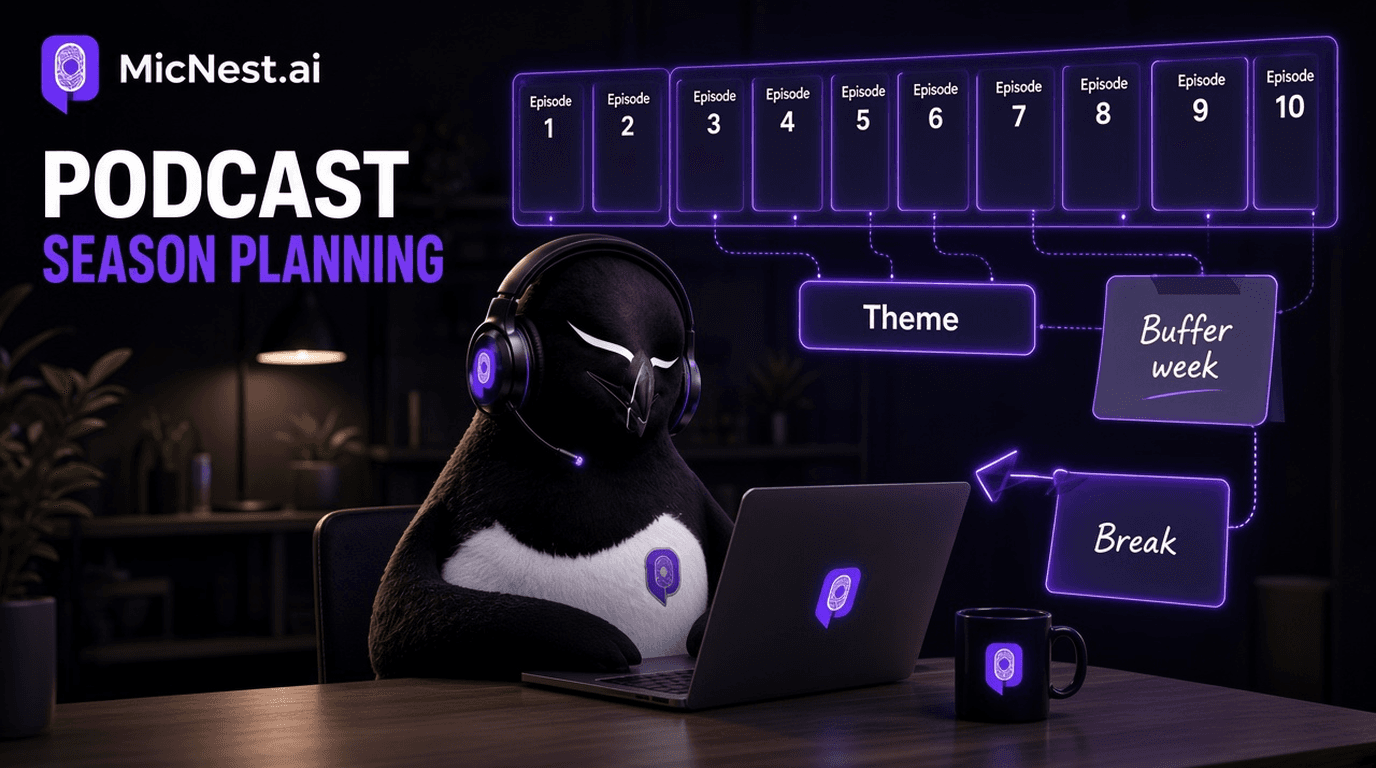
Choose a season length you can finish (often 6–12 episodes). Write one sentence for the season promise. Draft titles before you record. Batch guests and research. Set publish dates plus one buffer week. Add a short trailer and a clear season finale signal. Schedule a break, then open the next season with a start-here episode.
MicNest turns clear show promises into searchable episode pages and a destination that matches your description. Start at https://app.micnest.ai/auth/signup.
Key Takeaways
- ➔ Seasons are a production tool, not only a prestige format.
- ➔ Finishable length beats ambitious forever calendars.
- ➔ One season promise keeps titles and guests coherent.
- ➔ Draft the episode map before you book the hardest guest.
- ➔ Build buffer weeks; life will use them.
- ➔ Trailers and finales help listeners orient.
- ➔ Breaks are part of the plan, not failure.
- ➔ Searchable episode pages keep the season working after it ends.
Endless weekly publishing sounds noble until week 40 hits and you have no guests, no topics, and no rest. That is usually when people quit, not when the mic breaks.
Podcast season planning is the quieter alternative. You pick a bounded run of episodes, a theme or arc, a publish rhythm, and a real break. Listeners get a clear "start here." You get a finish line you can see.
You do not need a TV network. You need a calendar that matches your energy and your niche.
1. When Seasons Help (And When They Do Not)
Seasons help when:
- You want a clear start and end for listeners
- Topics cluster naturally (a course-like arc, a reporting run, a theme month)
- You need permission to rest without ghosting the feed
- Guests and research benefit from a batch
Skip hard seasons when:
- Your show is a durable weekly habit with no natural arcs
- You already ship reliably and listeners expect continuity
- "Season" would just mean renaming burnout as prestige
Some shows stay continuous and still plan in internal batches. Call it a season publicly only if it helps discovery and expectation-setting.
2. Pick a Length You Can Actually Finish
Common ranges:
| Length | Fits |
|---|---|
| 4–6 | Tight theme, experiment, limited research window |
| 8–12 | Standard indie season |
| 12–20 | Heavier reporting or teaching arcs |
Rule of thumb: if you cannot name every episode topic in one sitting, the season is too big or the promise is too vague.
Count production reality, not wishful weekly math. One interview episode can mean outreach, prep, edit, notes, and clips. Plan for the full stack, not only record day.
3. Write the Season Promise First
Same discipline as a show niche, scoped to this run:
> This season helps [listener] with [outcome] through [format/angle] across [N] episodes.
Weak: "More interviews about business."
Stronger: "Eight episodes for first-time managers who need blunt hiring lessons from operators who already failed publicly."
That sentence drives episode titles, guest criteria, and the trailer. If a proposed episode does not serve the promise, cut it or save it for later.
4. Build the Episode Map Before You Record
Open a simple table:
- Episode number
- Working title
- Guest / solo
- Core question
- Status (idea / booked / recorded / edited / live)
Fill titles first. Titles force specificity. "Chat with Sam" is not a plan. "How Sam rebuilt a sales team after a bad hire" is.
Leave one flex slot. Guests cancel. News happens. A flex episode keeps the season from collapsing.
If you use chapters and show notes, draft the outline shape early so post-production is not improvisation every week.
5. Calendar, Cadence, and Buffer
Decide:
- Publish day(s)
- Record batch windows
- Edit deadline relative to publish
- One buffer week mid-season
- Break length after the finale
Example for a 10-episode weekly show: 12 calendar weeks (10 publish + 1 buffer + 1 catch-up), then 3–6 weeks off.
Put the dates where your co-host and editor can see them. A season plan that lives only in your head is a hope, not a plan.
Front-load hard guests. Late-season scrambling is how finales get thin.
6. Open and Close the Season on Purpose
Trailer / cold open
- State who it is for
- Name the season promise
- Point to episode 1 as the start
- Keep it short
Finale
- Resolve the arc or summarize the toolkit
- Tell listeners the break length
- Tease Season 2 only if you mean it
- Offer a start-here link for new people who arrive late
Missing finales make feeds feel abandoned. A clear pause is different from silence.
Update your show description if the season shift is big enough that the old copy misleads.
7. Plan Discovery Inside the Season
A season is easier to market when each episode leaves a trail:
- Episode pages with clear titles
- Notes and chapters that match the map
- 1–2 clips per episode aimed at that episode, not "my podcast"
- One mid-season reminder of the arc ("episodes 1–4 covered X; next is Y")
If growth is a goal, align season themes with questions people already search. That is how podcast SEO and season planning meet.
8. Breaks Without Losing the Audience
Tell people:
- The finale date
- How long you are off
- Where to binge or start
- How you will announce the return (newsletter, social, trailer)
Use the break for real recovery and light prep for the next promise. Do not spend the whole break rebuilding your entire brand unless you already decided on a rebrand.
Owned paths matter here. An email list or site beats hoping the algorithm reminds everyone you exist.
9. Common Mistakes
Season as vibes, not a list. If you cannot count episodes, you do not have a season.
Copying prestige TV lengths. Your capacity is the constraint.
No buffer. One illness then cascades into missed weeks and guilt.
Themes so wide the titles feel random. Listeners should feel a through-line.
Announcing Season 2 before Season 1 is done. Finish first.
Treating the break as optional. Unplanned gaps train listeners to stop checking.
Ignoring the archive. Old seasons still need clear titles and pages so late arrivals can enter.
10. A One-Afternoon Season Workshop
- Write the season promise sentence.
- Choose episode count and publish day.
- Draft every working title.
- Mark guest vs solo.
- Book or request the hardest three guests first.
- Place buffer and break on a calendar.
- Write a 60–90 second trailer script.
- Decide the finale format.
- List the pages/notes template you will reuse each week.
- Ship episode 1 only when the map exists.
That is enough structure for most indie shows.
11. How MicNest Fits
A planned season still disappears if episodes live only inside an app row. Pages, notes, and searchable titles keep each episode useful after the season ends, and they give new listeners a way in without scrolling blindly.
MicNest helps turn the season map into owned episode pages so the plan you made keeps working in search and on your site.
Frequently Asked Questions
Do I need seasons for my podcast?
No. Use seasons when a bounded run helps production or listener expectations. Continuous shows can still plan in private batches.
How many episodes should a podcast season have?
Whatever you can finish well. Many indie seasons land between 6 and 12. Start smaller if you are unsure.
Should every season have a story arc?
Not required. A theme, a skill ladder, or a consistent format can hold a season together without narrative cliffhangers.
How long should a break between seasons be?
Long enough to recover and prep the next map. Commonly a few weeks to a couple of months. Tell listeners the plan.
Can I publish bonus episodes during a break?
Yes if they are clearly labeled. Do not pretend the season never ended.
What if I miss a week mid-season?
Use the buffer week. If you have no buffer, skip cleanly and resume. Avoid three apologies and a vague return date.
Should Season 2 continue the same niche?
Usually yes, with a sharper or adjacent promise. Big pivots are a rebrand conversation, not a quiet episode 1 swap.
How do seasons help growth?
They create a clear start-here path, marketing windows around launches and finales, and tighter topical clusters that are easier to title and share.
Final Takeaway
Podcast season planning is how you trade an infinite checklist for a finishable run.
Write the promise. Map the titles. Calendar the publish days and the break. Open and close on purpose. Leave pages that still work when Season 1 is old news.
A season you finish beats a forever schedule you abandon.
Related reading
Before vs after
Before
- - Lead with biography and adjectives
- - Stuff keywords at the bottom of the description
- - Reuse one vague blurb on every episode
After
- + Lead with audience and outcome in the first lines
- + Write specific episode descriptions with guest and topic
- + Keep description, name, and titles saying the same thing
Who is this for?
Hosts rewriting vague show bios
Creators whose feed copy does not match the show.
New shows before launch
Hosts writing the first show description and trailer package.
Episode publishers
Hosts who paste the same blurb under every episode.
Make the first lines earn the play
Write a show and episode description strangers can skim in seconds, then keep titles and pages aligned with the same promise.
Explore MicNest or start freeFrequently Asked Questions
Do I need seasons for my podcast? +
No. Use seasons when a bounded run helps production or listener expectations. Continuous shows can still plan in private batches.
How many episodes should a podcast season have? +
Whatever you can finish well. Many indie seasons land between 6 and 12. Start smaller if you are unsure.
Should every season have a story arc? +
Not required. A theme, a skill ladder, or a consistent format can hold a season together without narrative cliffhangers.
How long should a break between seasons be? +
Long enough to recover and prep the next map. Commonly a few weeks to a couple of months. Tell listeners the plan.
Can I publish bonus episodes during a break? +
Yes if they are clearly labeled. Do not pretend the season never ended.
What if I miss a week mid-season? +
Use the buffer week. If you have no buffer, skip cleanly and resume. Avoid three apologies and a vague return date.
Should Season 2 continue the same niche? +
Usually yes, with a sharper or adjacent promise. Big pivots are a rebrand conversation, not a quiet episode 1 swap.
How do seasons help growth? +
They create a clear start-here path, marketing windows around launches and finales, and tighter topical clusters that are easier to title and share.

