
Definition
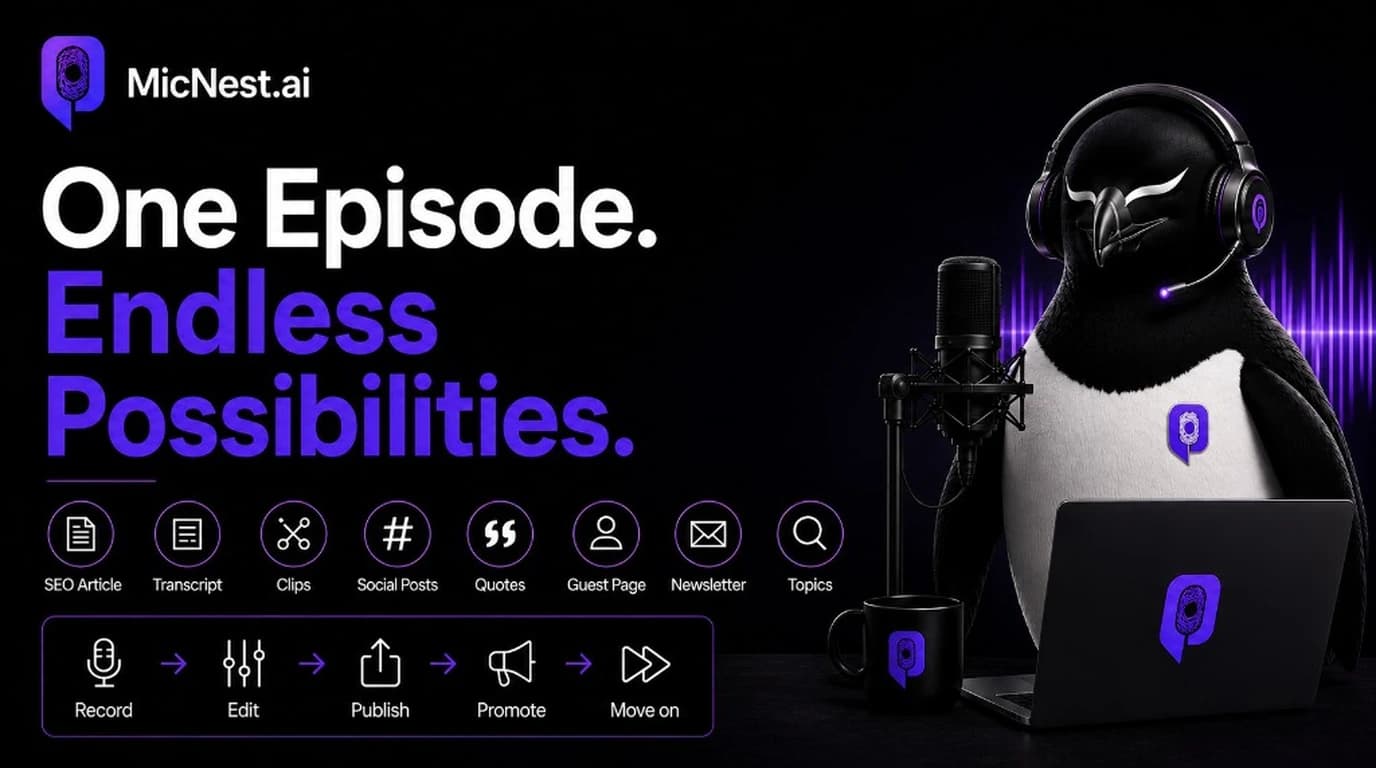
podcast content repurposing: Podcast content repurposing means taking one original podcast conversation and transforming it into multiple useful content formats — such as SEO articles, transcripts, short clips, social posts, newsletters, guest pages, and topic pages — while keeping the original episode as the source.
In simple terms: Podcast content repurposing means taking one original podcast conversation and transforming it into multiple useful content formats — such as SEO articles, transcripts, short clips, social posts, newsletters, guest pages, and topic pages — while keeping the original episode as the source.
Quick Answer
Record → Transcribe → Identify major topics → Find the strongest ideas → Create a long-form asset (usually an article) → Create short-form posts, quotes, and clips → Write newslett
Record → Transcribe → Identify major topics → Find the strongest ideas → Create a long-form asset (usually an article) → Create short-form posts, quotes, and clips → Write newsletter content → Connect related episodes, guests, and topics → Publish everything on your website → Measure what people use. One valuable conversation can become multiple genuinely useful assets — not dozens of thin posts.
MicNest helps creators turn one podcast conversation into episode pages, SEO articles, transcripts, guest profiles, newsletters, and a searchable content library. Start at https://app.micnest.ai/auth/signup.
Key Takeaways
- ➔ One episode can contain ideas, stories, quotes, answers, insights, and guest expertise worth multiple formats.
- ➔ Repurposing extends the life of an episode: Episode → Content → Discovery → Website → Audience.
- ➔ Different people discover the same conversation through audio, video, articles, LinkedIn, Google, or your newsletter.
- ➔ A transcript is raw material; an article organizes the strongest ideas for readers and search.
- ➔ Quality beats quantity — prioritize a strong article, useful clips, social posts, a newsletter, guest page, and topic links.
- ➔ The 80/20 rule: find the few major ideas worth building around, then expand those.
- ➔ Connecting assets into a content ecosystem matters more than creating isolated pieces.
- ➔ Podcast SEO and repurposing overlap when ideas become crawlable web content.
- ➔ MicNest helps turn conversations into episode pages, searchable content, articles, transcripts, guest profiles, and newsletters.
You spent an hour recording a great conversation. Then you edited it, published it, shared it on social media — and moved on to the next episode. For many podcasters, that's where the content lifecycle ends. Podcast content repurposing is how you extract more value from the conversation you've already created.
What is podcast content repurposing?
Podcast content repurposing means taking one original podcast conversation and transforming it into multiple useful content formats.
For example, one podcast episode can become:
- An SEO article
- A transcript
- Short-form videos
- Social posts
- Quote graphics
- Newsletter content
- Episode highlights
- Guest content
- Topic pages
- Searchable content
The original conversation remains the source.
Instead of creating every piece from scratch, you build different formats around the same underlying ideas.
Why podcasters should repurpose their content
Creating a podcast takes significant effort.
You have to find a topic, find a guest, prepare questions, record, edit, publish, and promote.
If you only publish the final episode, you're using a small portion of the potential value inside that conversation.
Repurposing lets you extend the life of the episode.
Instead of:
Episode → Promotion → Done
you can build:
Episode → Content → Discovery → Website → Audience
That's a much more powerful system — and it's the same philosophy behind why we built MicNest.
One conversation can reach different audiences
Not everyone consumes podcasts in the same way.
Someone might prefer audio. Another person might prefer video. Another might prefer reading an article. Someone else might discover your idea through LinkedIn. Another person might find you through Google Search. Another might subscribe after reading your newsletter.
The conversation stays the same.
The format changes.
That's why repurposing is so useful.
10 ways to repurpose a podcast episode
Let's take a single episode and turn it into multiple content assets.
1. Create an SEO blog article
Your episode probably contains answers to questions people are searching for.
Those answers can become an article.
For example, suppose your episode is about how founders should hire their first employees.
The episode could become: How to Hire Your First Employees: A Practical Guide for Founders.
The article can organize the conversation around the most useful ideas instead of simply copying the transcript.
This creates another way for people to discover your podcast.
For a deeper look at this workflow, see our guide on turning a podcast into a blog.
2. Publish the transcript
A transcript gives people another way to consume the conversation.
It can also make the content easier to search, reference, and reuse.
But there's an important distinction:
A transcript isn't necessarily a finished article.
A transcript is raw material. It contains the conversation.
An article should organize that conversation into something useful for a reader.
The two can work together.
3. Extract short clips
Long-form conversations contain smaller moments that can stand alone.
For example:
60-minute episode → 8 useful moments → 8 short clips
Each clip can focus on one idea.
You might have a surprising answer, a strong opinion, a useful tip, a personal story, a controversial question, or a memorable quote.
Now one recording session produces multiple opportunities for discovery.
4. Create social media posts
You don't always need to write completely new social content.
Your episode already contains ideas worth discussing.
You can extract:
- A key lesson — One of the biggest mistakes founders make when hiring is...
- A question — When should a startup make its first hire?
- A quote
- A takeaway — Three things we learned from this conversation...
- A discussion prompt — Would you hire for experience or potential?
Each can become a separate social post.
5. Turn quotes into content
Great conversations often contain memorable sentences.
Those quotes can become LinkedIn posts, quote graphics, Instagram posts, short videos, newsletter sections, and website highlights.
The key is selecting quotes that communicate a useful idea independently.
Not every sentence from a conversation deserves to become a post.
6. Create newsletter content
Your podcast can also become a newsletter engine.
Instead of writing an entirely separate newsletter every week, you can extract the strongest idea from your latest conversation.
For example: this week's idea, a short explanation of the episode's most useful insight, then a link to listen to the full conversation.
The newsletter becomes another distribution channel for your podcast.
7. Create guest content
Your guest is another potential distribution channel.
From one interview, you can create a guest page containing a guest bio, the episode, key topics, quotes, related articles, resources, and social links.
Now your guest has a page they can share with their own audience.
That's useful for both the guest and the podcast.
8. Build topic pages
Imagine you've published 100 episodes.
Several of them might discuss the same topic.
Instead of leaving those episodes disconnected, you can create a topic page — for example, AI in Marketing with Episodes 12, 27, 41, 68, and 94.
Now visitors can explore multiple conversations around one subject.
Your archive becomes a knowledge library instead of simply a chronological list — the same idea behind a searchable podcast archive.
9. Create searchable content
Search can make repurposed podcast content useful long after the original episode was published.
Someone might search "How do I build a personal brand?"
They don't necessarily know your podcast exists.
If your episode has been transformed into useful, searchable web content, that person may discover your website.
That's one of the reasons podcast SEO matters.
Your podcast doesn't have to wait for someone to search for its name.
Your ideas can become the discovery mechanism.
10. Connect everything together
The most powerful part isn't creating individual pieces.
It's connecting them.
Imagine an episode about building a startup team.
The ecosystem could look like:
Episode → Transcript → SEO article → Topic page → Guest profile → Newsletter → Social posts → Search → Website visitor → Subscriber
Now the original conversation has become a small content ecosystem — ideally living on a strong podcast website.
The podcast repurposing flywheel
A useful way to think about this is:
Conversation → Episode → Transcript → Insights → Articles → Social content → Search & discovery → Website visitors → Subscribers → Returning audience → More conversations
The cycle continues with every new episode.
Your content library becomes increasingly valuable over time.
Don't just copy the transcript into a blog
This is one of the biggest mistakes in podcast repurposing.
A transcript is designed for conversation.
An article is designed for reading.
They're different formats.
A transcript might say: "Yeah, so I think one of the things we learned..."
An article should instead communicate: The first hiring decision most startups make can shape their team for years.
The goal isn't to make the transcript look like an article.
The goal is to extract the useful ideas and present them in the best format for the reader.
Quality matters more than quantity
Repurposing doesn't mean turning every sentence into a social post.
More content isn't automatically better.
The goal should be: one valuable conversation → multiple genuinely useful assets.
For example, instead of creating 30 weak posts from one episode, create:
- 1 strong article
- 5 useful social posts
- 3 short clips
- 1 newsletter
- 1 guest page
- 1 topic page
That's already a substantial content system.
The 80/20 rule of podcast repurposing
Some parts of an episode will be much more valuable than others.
A one-hour conversation might contain only five major ideas worth building around.
Find those ideas first.
Ask:
- What questions did we answer?
- What insights were most useful?
- What stories were memorable?
- What topics appeared repeatedly?
- What would someone search for?
- What would make a useful article?
- What would make a strong short clip?
Then build around those.
A practical podcast repurposing workflow
Here's a simple process you can repeat for every episode.
Step 1: Record the conversation
Start with a genuinely useful conversation.
Everything else depends on this.
Step 2: Transcribe it
Create a searchable text version of the episode.
Step 3: Identify the major topics
Extract the core subjects discussed.
Step 4: Find the strongest ideas
Look for answers, insights, stories, and useful explanations.
Step 5: Create the long-form asset
Usually an article, guide, or detailed episode page.
Step 6: Create short-form content
Turn individual ideas into posts, quotes, and clips.
Step 7: Create newsletter content
Choose the strongest idea and provide additional context.
Step 8: Connect related content
Link the episode to related episodes, topics, guests, and articles.
Step 9: Publish everything on your website
Create a central home for the content.
Step 10: Measure what people actually use
Look at search activity, traffic, clicks, subscriptions, and engagement.
Then improve the system.
What one episode could look like
Here's a simple example.
Original episode: 60-minute interview with a SaaS founder.
From that one episode:
- Full episode page
- Transcript
- SEO article
- Three short clips
- Five LinkedIn posts
- Five quote snippets
- One newsletter
- Guest profile
- Topic page
- Related episode links
One conversation.
Ten different content opportunities.
And the process can become increasingly efficient as your workflow improves.
Why this matters for SEO
Search engines need content they can understand.
Audio is valuable to humans, but a podcast that exists only inside audio platforms has limited opportunities to appear for the thousands of questions discussed inside its episodes.
Written content gives those ideas another surface.
For example, your episode discusses how to price a SaaS product.
That conversation could become content around SaaS pricing strategy, how to price SaaS, SaaS pricing models, startup pricing, and value-based pricing.
Now the ideas inside your conversation have opportunities to become search entry points.
This is where podcast content repurposing and podcast SEO overlap.
Repurposing also extends the life of old episodes
The content doesn't have to disappear after launch week.
An episode published six months ago can still become a new article, a new clip, a newsletter feature, a topic collection, a social post, or a search result.
This creates a second life for your back catalog.
Instead of constantly asking "What should we create next?" you can also ask "What valuable content have we already created that people haven't discovered yet?"
That's how a searchable podcast archive keeps working long after publish day.
The real goal isn't more content
This is perhaps the most important point.
Podcast creators don't necessarily need to produce more.
They need to extract more value from each conversation.
You already invested time, research, guest preparation, recording, editing, and production.
Repurposing helps that investment work harder.
One conversation can continue generating discovery long after the original episode was published.
How MicNest approaches podcast content repurposing
This is one of the ideas behind MicNest.
A podcast episode shouldn't be treated as a single file.
It can be the starting point for an entire content ecosystem.
MicNest is designed to help turn podcast conversations into:
- Dedicated episode pages
- Searchable content
- SEO articles
- Transcripts
- Guest profiles
- Newsletter content
- Content libraries
- Related topics
The goal is simple:
Create the conversation once.
Give it more ways to be discovered and consumed.
Frequently asked questions
What is podcast content repurposing?
Podcast content repurposing is the process of turning a podcast episode into multiple content formats such as articles, clips, social posts, newsletters, transcripts, and topic pages.
How many pieces of content can one podcast episode create?
There's no fixed number. A single episode can potentially produce several useful assets depending on its length, depth, and subject matter.
Should I publish the entire podcast transcript?
You can, but a transcript and an article serve different purposes. A transcript preserves the conversation, while an article can organize the strongest ideas for readers and search.
Does podcast repurposing help SEO?
It can. Turning useful podcast discussions into crawlable web content gives search engines additional text-based pages that can target relevant topics and questions.
Should every podcast episode become a blog?
Not necessarily. Focus on episodes with strong, evergreen, educational, or search-worthy topics.
How often should I repurpose old episodes?
You can continuously revisit your back catalog. Prioritize evergreen episodes with useful information that remains relevant.
Can AI help with podcast repurposing?
Yes. AI can help with transcription, topic extraction, summaries, drafts, quotes, and content organization. Human review remains important to ensure accuracy, context, and quality.
Your podcast already contains the content
Every episode starts with a conversation.
Inside that conversation are ideas.
Inside those ideas are potential articles, clips, posts, newsletters, guest pages, and search opportunities.
The opportunity isn't to create a completely new piece of content every time.
It's to build a system that gets more value from the conversations you're already having.
One conversation.
Many useful formats.
More opportunities to be discovered.
That's what podcast content repurposing should really mean.
Turn every episode into more
MicNest helps podcasters turn their conversations into a website, searchable archive, SEO content, guest pages, newsletters, and more.
Explore MicNest or start free.
Related Reading
Before vs after
Before
- — Episode → Promotion → Done
- — Ideas trapped in one audio file
- — Back catalog ignored after launch week
After
- + Episode → Content → Discovery → Website → Audience
- + Articles, clips, newsletters, and guest pages from one conversation
- + Old episodes keep generating search and subscribers
Who is this for?
Podcasters
Creators who want each episode to fuel a full content ecosystem.
Interview hosts
Hosts turning guest conversations into clips, articles, and guest pages.
Content marketers
Teams building discovery systems around podcast conversations.
Turn every episode into more
One conversation can become a website, searchable archive, SEO content, guest pages, and newsletters. MicNest helps podcasters extract more value from episodes they already record.
Explore MicNest or start freeSources
Reviewed by Alex Rivera, Co-Founder & CEO, MicNest
Quick Comparison
| Episode → Promotion → Done | Episode → Content → Discovery → Website → Audience |
|---|---|
| One audio or video file | Articles, clips, posts, newsletters, guest pages, topics |
| Value peaks in launch week | Back catalog keeps generating discovery |
| Formats stay disconnected | Assets connect into a content ecosystem |
Pros & Cons
| ✅ Pros | ❌ Cons |
|---|---|
| ✔ Extends the life of conversations you already recorded | ✖ Raw transcripts alone make weak articles |
| ✔ Reaches audiences who prefer reading, search, or short-form | ✖ More content is not automatically better |
| ✔ Creates searchable entry points into episodes | ✖ Needs editorial judgment to pick the strongest ideas |
| ✔ Gives guests shareable pages and compounds with SEO | ✖ Weak source conversations still produce weak assets |
Frequently Asked Questions
What is podcast content repurposing? +
Podcast content repurposing is the process of turning a podcast episode into multiple content formats such as articles, clips, social posts, newsletters, transcripts, and topic pages.
How many pieces of content can one podcast episode create? +
There's no fixed number. A single episode can potentially produce several useful assets depending on its length, depth, and subject matter.
Should I publish the entire podcast transcript? +
You can, but a transcript and an article serve different purposes. A transcript preserves the conversation, while an article can organize the strongest ideas for readers and search.
Does podcast repurposing help SEO? +
It can. Turning useful podcast discussions into crawlable web content gives search engines additional text-based pages that can target relevant topics and questions.
Should every podcast episode become a blog? +
Not necessarily. Focus on episodes with strong, evergreen, educational, or search-worthy topics.
How often should I repurpose old episodes? +
You can continuously revisit your back catalog. Prioritize evergreen episodes with useful information that remains relevant.
Can AI help with podcast repurposing? +
Yes. AI can help with transcription, topic extraction, summaries, drafts, quotes, and content organization. Human review remains important to ensure accuracy, context, and quality.

