
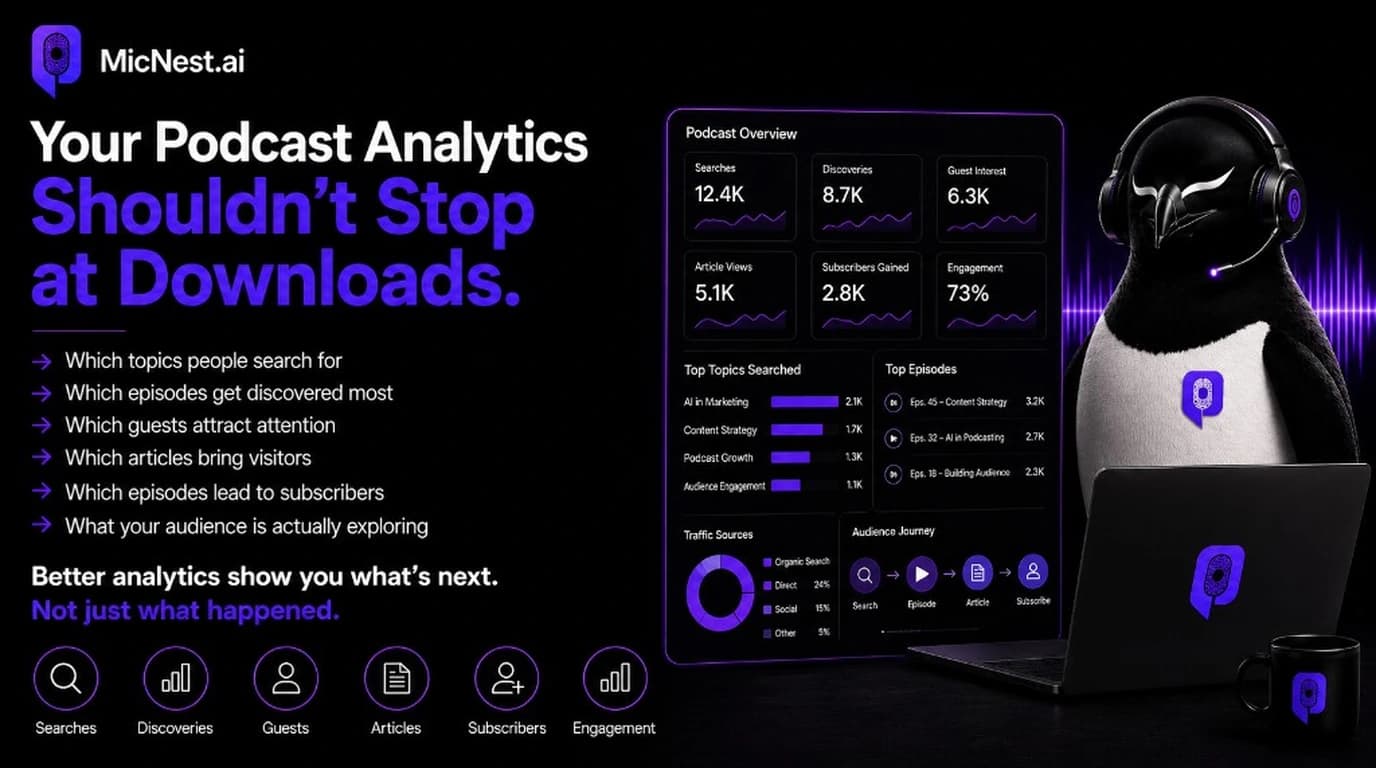
Definition
podcast analytics: Podcast analytics is the collection and analysis of data about how people discover, consume, and interact with your podcast — including downloads, website traffic, search queries, episode performance, conversions, and retention.
In simple terms: Podcast analytics is the collection and analysis of data about how people discover, consume, and interact with your podcast — including downloads, website traffic, search queries, episode performance, conversions, and retention.
Quick Answer
Track discovery (search queries, traffic sources), consumption (downloads, episode page views), engagement (articles, topics, guest pages), conversion (newsletter signups, subscrib
Track discovery (search queries, traffic sources), consumption (downloads, episode page views), engagement (articles, topics, guest pages), conversion (newsletter signups, subscriber rate by page), and retention (returning visitors). Use those signals to decide what to create next.
MicNest helps podcasters connect episodes, searchable content, SEO articles, guest pages, newsletters, and analytics into one content ecosystem. Start at https://app.micnest.ai/auth/signup.
Key Takeaways
- ➔ Downloads measure consumption — not necessarily growth, retention, or relationship.
- ➔ Group metrics into discovery, consumption, engagement, conversion, retention, and content performance.
- ➔ Episode page views, search queries, and popular topics reveal what your audience cares about.
- ➔ Traffic and audience-building are not the same: high visits can produce fewer subscribers than a smaller, better page.
- ➔ Newsletter signups and returning visitors are among the strongest owned-audience signals.
- ➔ Measure the content ecosystem around episodes — articles, guest pages, topic pages, newsletters.
- ➔ Analytics should answer: what should we create next?
- ➔ Your back catalog contains useful data too — evergreen episodes can suddenly spike.
- ➔ SEO brings people in; analytics tell you what they do after they arrive.
- ➔ MicNest connects episodes, search, articles, guests, subscribers, and analytics into one ecosystem.
Podcast analytics can tell you a lot. But they can also leave you with more questions than answers. Downloads are useful — they're just one piece of the picture. If your podcast is becoming a serious content business, you need to understand what your audience is doing.
You might open your dashboard and see 10,000 downloads — then ask: Is that good? Which episodes actually performed best? What topics does my audience care about? Where are new listeners coming from? Which episodes lead people to discover the rest of the show? Are listeners becoming subscribers?
Downloads are useful. But they're only one piece of the picture. Once you have a podcast website and content ecosystem, you can understand much more than how many times an episode was downloaded.
What Is Podcast Analytics?
Podcast analytics is the collection and analysis of data about how people discover, consume, and interact with your podcast.
Traditional podcast analytics might include:
- Downloads
- Listens
- Followers
- Subscribers
- Listening platforms
- Geographic data
- Device information
But a modern podcast can generate much more useful data. Once you have a podcast website and content ecosystem, you can also understand:
- Website traffic
- Search queries
- Popular topics
- Episode page views
- Article performance
- Guest page visits
- Newsletter signups
- Subscriber conversions
- Content discovery paths
This creates a much clearer picture of your audience.
Downloads Are Not the Same as Audience Growth
Imagine two podcasts.
Podcast A
100,000 downloads
500 email subscribers
Podcast B
30,000 downloads
5,000 email subscribers
Which podcast has built the stronger direct audience?
There's no universal answer. Downloads and subscribers measure different things.
Downloads help you understand consumption.
Subscribers can help you understand relationship and retention.
That's why looking at only one metric can be misleading.
The Podcast Metrics That Actually Matter
There isn't one perfect podcast metric. Instead, think about your metrics in categories.
- Discovery — How are people finding you?
- Consumption — Are people listening?
- Engagement — What are they interacting with?
- Conversion — Are visitors becoming subscribers?
- Retention — Do people come back?
- Content performance — Which topics and episodes are creating the most interest?
This framework is more useful than simply watching the download number go up.
1. Downloads
Downloads remain an important metric. They provide a basic indication of episode consumption.
You can use downloads to compare:
- New episodes
- Older episodes
- Different topics
- Guest episodes
- Formats
- Publishing periods
But avoid treating downloads as the complete definition of success. A download doesn't necessarily tell you why someone listened, what they liked, whether they returned, whether they discovered another episode, or whether they became part of your audience.
That's where other metrics become useful.
2. Episode Page Views
If you have a podcast website, monitor which episode pages receive the most traffic.
Suppose your most visited episodes are:
- How to Hire Your First Employee
- How to Build a Personal Brand
- The Future of AI
You now have a signal. Your audience may be particularly interested in those subjects. That information can influence what you create next.
3. Search Queries
Search data can be especially valuable.
Imagine visitors search your podcast website for:
- AI agents
- Startup fundraising
- Hiring
- SaaS pricing
- Personal branding
Now you have direct evidence of what your audience is looking for. Instead of guessing what topics to cover, you can use audience behavior to inform your content strategy.
This is one of the reasons we think a searchable podcast archive is more powerful than a simple episode list.
4. Popular Topics
Your podcast might have hundreds of episodes. But perhaps 20 topics consistently attract the most attention.
You can group your episodes around those topics. For example:
Marketing
15 episodes
AI
23 episodes
Leadership
18 episodes
Startups
31 episodes
Now you can see where audience interest is concentrated. That can influence:
- Future episodes
- Articles
- Newsletters
- Guest selection
- Topic pages
- Content campaigns
Your archive becomes a source of strategic information.
5. Guest Performance
Guests can introduce new audiences to your podcast. It's useful to understand which guest episodes attract attention.
You might discover:
Guest A → High traffic → High engagement → High subscriber conversion
while:
Guest B → High initial traffic → Low engagement
The goal isn't to rank guests purely by numbers. The data simply gives you another signal when deciding which formats and topics resonate.
6. Website Traffic Sources
Your podcast website can receive visitors from many places. For example:
- YouTube
- Newsletter
- Podcast platforms
- Direct traffic
Understanding these sources helps you see which channels are actually bringing people to your content.
You may discover that Google → Article → Episode → Subscribe is one of your strongest journeys. Or LinkedIn → Article → Newsletter may perform particularly well.
Now you're not just measuring traffic. You're understanding the journey.
7. Newsletter Signups
This is one of the most important metrics for building a direct audience.
Imagine: 10,000 website visitors produce 600 subscribers. Your conversion rate is roughly 6%.
Now compare that with another article: 10,000 visitors produce 100 subscribers.
That's a significant difference. The traffic numbers are identical. The audience-building result isn't. This is why measuring conversions matters.
8. Subscriber Conversion by Episode
You can take this one step further. Which episodes produce subscribers?
| Episode | Visitors | Subscribers |
|---|---|---|
| Episode A | 2,000 | 80 |
| Episode B | 1,200 | 110 |
| Episode C | 5,000 | 70 |
Episode C gets the most traffic. But Episode B produces more subscribers.
That's a useful insight. It tells you that traffic and audience-building aren't necessarily the same thing.
9. Returning Visitors
A visitor who comes once is useful. A visitor who returns is even more interesting.
Returning visitors can indicate that your website provides enough value for people to come back. You can create reasons for them to return through:
- New episodes
- New articles
- Newsletters
- Topic collections
- Guest content
- Events
- Searchable archives
The goal is to turn a one-time visit into an ongoing relationship.
10. Content Performance
Don't only measure episodes. Measure the content surrounding them.
For example:
- Episode
- Article
- Guest page
- Topic page
- Newsletter
You might discover that your articles generate significantly more organic traffic than your episode pages. That's useful. It doesn't mean the articles replace the podcast. It means the articles are helping people discover the podcast.
Your Podcast Can Become a Content Intelligence System
This is where things get interesting.
Your podcast isn't just producing content. It's producing signals.
Every interaction can teach you something. Someone searches for "How to hire a CTO" — that's a signal. Someone reads your startup hiring article — that's a signal. Someone then listens to your hiring episode — that's another signal. They subscribe to your newsletter — that's another.
Over time, these signals help you understand what your audience actually cares about.
The Podcast Analytics Flywheel
Think of it like this:
Create → Publish → Measure → Learn → Improve → Create better content → Measure again
The more consistently you run this cycle, the more useful your data becomes.
Don't Chase Vanity Metrics
A vanity metric is a number that looks impressive but doesn't necessarily help you make better decisions.
For example, total downloads can look great. But ask: what did those downloads lead to?
Did listeners:
- Discover another episode?
- Visit your website?
- Read an article?
- Subscribe?
- Return?
- Share the content?
The answer gives you much more context.
Build a Simple Podcast Analytics Dashboard
You don't need dozens of charts. Start with a few core metrics.
Reach
- Downloads
- Website visitors
Discovery
- Search queries
- Traffic sources
Engagement
- Episode views
- Article views
- Search interactions
Conversion
- Newsletter signups
- Subscriber conversion rate
Retention
- Returning visitors
- Repeat listeners
The exact metrics will depend on your podcast and goals.
Connect Your Analytics to Your Goals
Different podcasts have different goals.
Goal: More listeners
Focus on:
- Downloads
- Reach
- Discovery sources
- Episode performance
Goal: More website traffic
Focus on:
- Organic traffic
- Search queries
- Episode page views
- Article traffic
Goal: Build an email audience
Focus on:
- Signup rate
- Subscriber growth
- Conversion by page
- Newsletter engagement
Goal: Build a business
You may also care about:
- Leads
- Event registrations
- Product interest
- Customer conversions
The right metric depends on what you're trying to accomplish.
Use Analytics to Decide What to Create Next
This is perhaps the biggest benefit.
Analytics shouldn't just tell you what happened. They should help you decide: What should we do next?
Suppose your data shows strong interest in AI. You could:
- Interview more AI experts
- Create an AI topic page
- Publish AI-focused articles
- Build a newsletter around AI
- Connect older AI episodes
- Create clips from your best AI conversations
Now your analytics are driving your content strategy.
Your Back Catalog Contains Data Too
Don't only analyze your newest episodes. Look at your entire archive.
You might discover that an episode from two years ago is suddenly receiving significant traffic. Why? Maybe the topic became more relevant. Maybe search demand increased. Maybe another episode linked to it. Maybe a guest shared it.
Whatever the reason, the data gives you an opportunity. You can:
- Update the article
- Add related episodes
- Improve the episode page
- Create a new newsletter
- Link newer episodes to it
- Create additional content around the topic
Your back catalog can continue teaching you what your audience wants.
Analytics + Podcast SEO
These two systems work together.
SEO brings people in. Analytics tells you what they do.
For example:
Google Search → SEO article → Episode page → Listen → Related episode → Newsletter signup
Now you can measure the entire journey. That's much more valuable than knowing only: "This episode received 2,000 downloads."
Learn more in our Podcast SEO Guide.
How MicNest Approaches Podcast Analytics
MicNest is designed around the idea that a podcast is more than an audio feed.
Your podcast can have:
- Episodes
- Articles
- Topics
- Guests
- Search
- Website visitors
- Subscribers
These pieces are connected. Analytics can therefore become more useful when they are connected too.
Instead of looking at isolated numbers, the goal is to understand how people move through your podcast ecosystem:
Discovery → Content → Episode → Engagement → Subscriber
That's the bigger picture we're building toward with MicNest.
A Practical Weekly Podcast Analytics Routine
You don't need to stare at your dashboard every day. Once a week, ask:
1. What was discovered?
Which episodes, articles, and topics attracted visitors?
2. What did people search for?
Look at the questions and keywords people used.
3. What received engagement?
Which content did people actually interact with?
4. What converted?
Which pages or episodes produced subscribers?
5. What should we create next?
Use those insights to inform your next episode and content.
That's enough to start.
Frequently Asked Questions
What is the most important podcast metric?
There isn't one universal metric. Downloads, listeners, engagement, subscribers, retention, and conversions all measure different parts of podcast performance.
Are downloads a vanity metric?
Not necessarily. Downloads are useful. They become limiting when they're treated as the only measurement of podcast success.
Why should I track podcast website analytics?
Website analytics can show you how people discover your podcast, which content they consume, and whether visitors become subscribers.
What should podcasters track besides downloads?
Useful metrics include website traffic, search queries, episode page views, traffic sources, newsletter signups, subscriber conversion, returning visitors, and content performance.
How can podcast analytics improve content strategy?
Analytics can reveal which topics, guests, questions, and content formats attract the most interest. You can use those signals to guide future episodes and content.
Should I analyze old podcast episodes?
Yes. Older episodes can reveal evergreen topics and unexpected audience interest, especially when connected to website and search data.
The Goal Isn't More Data
It's better decisions.
You don't need a dashboard filled with 50 metrics. You need enough information to answer useful questions:
- What are people interested in?
- How are they discovering us?
- Which content brings them in?
- What makes them stay?
- What turns them into subscribers?
- What should we create next?
That's when podcast analytics become genuinely valuable.
Your podcast isn't just producing episodes. It's producing data about what your audience cares about. The more effectively you connect those signals, the better you can build the next episode, article, newsletter, and audience experience.
Your Podcast Data Should Tell You What to Do Next
MicNest helps turn your podcast into a connected content platform with episodes, searchable content, SEO articles, guest pages, newsletters, and analytics.
Related Reading
Before vs after
Before
- — Total downloads as the only success metric
- — Isolated numbers with no journey context
- — Guessing what topics to create next
After
- + Discovery → Content → Episode → Engagement → Subscriber
- + Website, search, and conversion metrics connected
- + Analytics that drive the next episode and content
Who is this for?
Podcasters
Creators who want more than download counts to guide their show.
Podcast marketers
Teams measuring discovery, conversion, and content performance.
Content strategists
People using website and search signals to decide what to create next.
Your podcast data should tell you what to do next
Downloads are useful, but discovery, engagement, conversion, and retention tell you what your audience cares about. MicNest helps turn your podcast into a connected content platform with analytics that drive better decisions.
Explore MicNest or start freeSources
Quick Comparison
| Consumption count | Discovery → Content → Episode → Subscriber |
|---|---|
| Hard to know what to create next | Search, topics, and conversion guide strategy |
| Isolated platform numbers | Website, SEO, and owned-audience signals |
| Looks impressive in isolation | Answers useful decision questions |
Pros & Cons
| ✅ Pros | ❌ Cons |
|---|---|
| ✔ Reveals what topics and episodes actually attract interest | ✖ Requires a website and content ecosystem to unlock richer signals |
| ✔ Connects SEO discovery to listening and signup behavior | ✖ Too many metrics can create noise without clear goals |
| ✔ Helps prioritize content that builds an owned audience | ✖ Platform download data alone still won't explain visitor journeys |
| ✔ Turns the back catalog into ongoing strategic data | ✖ Conversion insights need consistent tracking and enough traffic |
Frequently Asked Questions
What is the most important podcast metric? +
There isn't one universal metric. Downloads, listeners, engagement, subscribers, retention, and conversions all measure different parts of podcast performance.
Are downloads a vanity metric? +
Not necessarily. Downloads are useful. They become limiting when they're treated as the only measurement of podcast success.
Why should I track podcast website analytics? +
Website analytics can show you how people discover your podcast, which content they consume, and whether visitors become subscribers.
What should podcasters track besides downloads? +
Useful metrics include website traffic, search queries, episode page views, traffic sources, newsletter signups, subscriber conversion, returning visitors, and content performance.
How can podcast analytics improve content strategy? +
Analytics can reveal which topics, guests, questions, and content formats attract the most interest. You can use those signals to guide future episodes and content.
Should I analyze old podcast episodes? +
Yes. Older episodes can reveal evergreen topics and unexpected audience interest, especially when connected to website and search data.

