
Definition
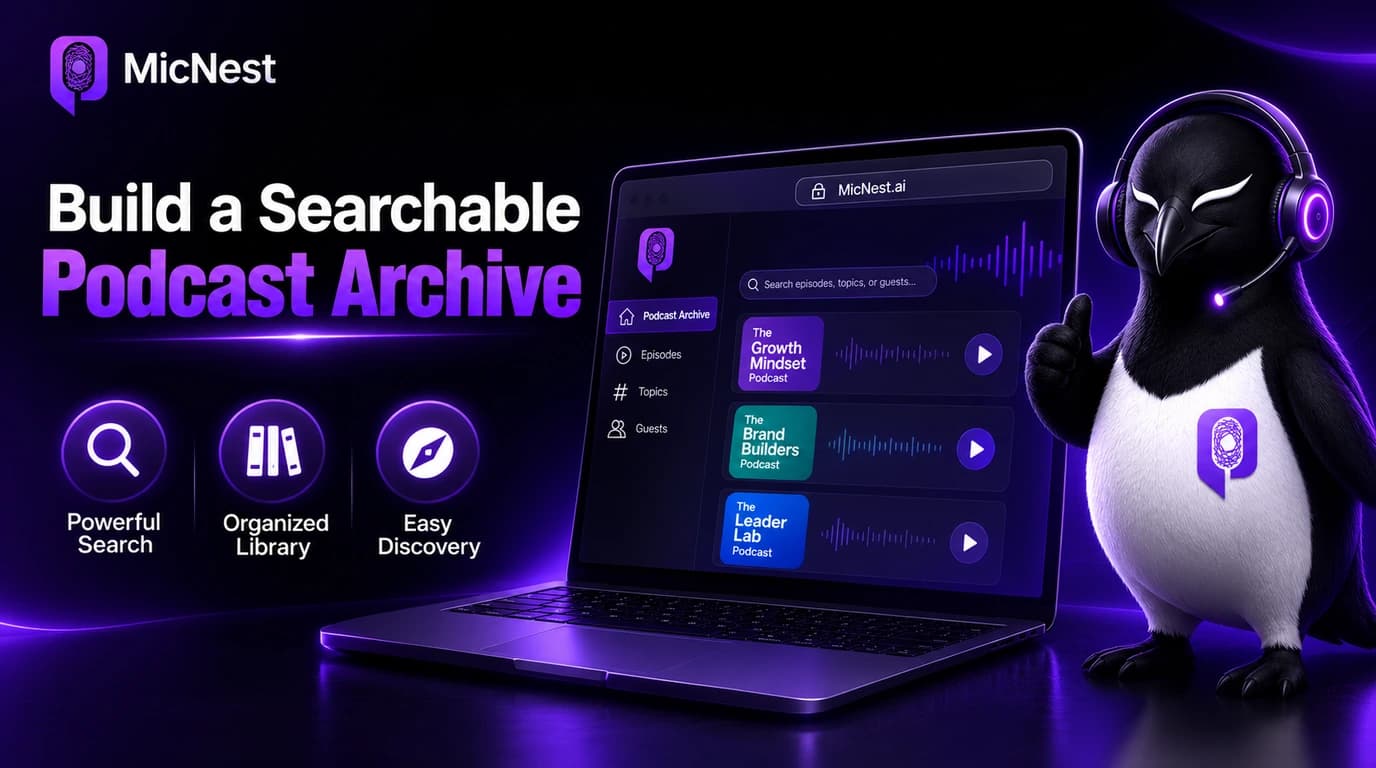
searchable podcast archive: A searchable podcast archive is a podcast library that allows visitors to discover episodes based on more than episode titles and dates — using topics, guests, keywords, questions, categories, articles, and episode content.
In simple terms: A searchable podcast archive is a podcast library that allows visitors to discover episodes based on more than episode titles and dates — using topics, guests, keywords, questions, categories, articles, and episode content.
Quick Answer
A searchable podcast archive lets people find conversations through topics, guests, keywords, and questions — not by scrolling chronologically through episode numbers. The goal is
A searchable podcast archive lets people find conversations through topics, guests, keywords, and questions — not by scrolling chronologically through episode numbers. The goal is to help someone find the conversation they need, even if they don't know which episode contains it.
MicNest helps podcasters build a searchable home for their conversations — episode pages, articles, guest profiles, topics, and search. Start at https://app.micnest.ai/auth/signup.
Key Takeaways
- ➔ Your podcast archive is a library of conversations — not just a list of old episodes.
- ➔ People search for questions and problems, not episode numbers.
- ➔ A chronological feed buries your most valuable back-catalog content.
- ➔ Searchable archives combine keyword search, topic pages, guest profiles, categories, and related episodes.
- ➔ Transcripts make conversations searchable; articles and internal links make them discoverable.
- ➔ Evergreen episodes can stay valuable for years when organized by knowledge, not publish date.
- ➔ Large catalogs need multiple discovery paths — browsing alone stops working at scale.
- ➔ A searchable archive supports podcast SEO by connecting episodes, topics, guests, and written content.
- ➔ MicNest helps your library grow with every new episode instead of burying the last one.
Your podcast may have 20 episodes. Or 200. Or 1,000. Every episode represents time — research, recording, editing, guest coordination, publishing, and promotion. But once a new episode goes live, what happens to the previous ones? For many podcasts, they get buried. This guide explains how to turn years of conversations into a searchable podcast archive people can actually explore.
Your podcast archive is more valuable than you think
Imagine you've published 250 episodes. That's potentially hundreds of hours of conversations. Your guests have discussed marketing, leadership, startups, AI, sales, business, personal development, technology, and career growth. That's a huge amount of knowledge.
But your audience doesn't necessarily want to browse 250 episode titles. They have questions.
For example:
> How do I build my first sales team?
They don't necessarily care that the answer is inside Episode 187: The Future of B2B Growth with John Smith. They care about the answer.
That's why podcast discovery needs to move beyond episode titles.
The problem with a traditional podcast archive
A traditional archive often looks like this:
Latest Episode
Episode 250
Previous Episodes
Episode 249
Episode 248
Episode 247
Episode 246
And so on.
This works if someone wants your latest episode. It becomes less useful when someone wants specific knowledge.
Imagine arriving at a podcast with 500 episodes. You want to find conversations about AI for small businesses.
Would you rather scroll through 500 titles? Or search AI small business and immediately see relevant episodes?
The second experience turns your archive from a list into a library.
A podcast archive should answer questions
This is one of the most important principles behind podcast search.
People rarely think:
> "I wonder what Episode 143 was about."
They think:
> "How can I solve this problem?"
For example:
Question: How do I grow my newsletter?
Your archive might contain five relevant conversations. Instead of forcing someone to discover those episodes individually, your website can surface them together.
The visitor gets:
Relevant Conversations
How to Build Your First 10,000 Subscribers
The Newsletter Growth Playbook
Why Most Email Lists Stop Growing
Now your archive is helping someone solve a problem.
From episode archive to knowledge library
There is a major difference between these two models.
Episode Archive
Episode → Date → Player
Knowledge Library
Topic → Question → Episode → Guest → Related Content
The first model organizes your publishing history. The second organizes your knowledge. That's the shift.
What should a searchable podcast archive include?
A useful archive can combine several discovery methods.
1. Keyword search
Let visitors search terms such as:
- AI
- marketing
- fundraising
- leadership
- SEO
- startups
The system can surface relevant episodes and content.
2. Topic pages
Group episodes around broader subjects. For example:
Marketing — content marketing, SEO, social media, email marketing, brand strategy
A visitor interested in marketing can explore the entire collection.
3. Guest discovery
Guests are another powerful way to explore a podcast. Someone may arrive looking for a specific expert. A guest page can show:
- Guest biography
- Episodes
- Topics discussed
- Related articles
- Links
One guest can therefore become an entry point into your podcast library.
4. Categories
Categories provide another layer of organization: Business, Technology, Leadership, Marketing, Entrepreneurship. Categories make large archives easier to navigate.
5. Related episodes
Suppose someone finishes an episode about startup fundraising. Your website could recommend:
You may also like:
- How Founders Should Prepare for Investors
- Common Fundraising Mistakes
- Building a Sustainable Startup
This keeps people inside your ecosystem.
Search should connect episodes, not just find them
Search shouldn't simply return an episode title. The real opportunity is connecting related content.
For example, search: "podcast SEO" could return:
Episodes
5 relevant conversations
Articles
3 guides
Guests
2 experts
Topics
Podcast SEO
Now the visitor can explore the subject from multiple directions. That's much more useful than a basic episode search.
Your old episodes can still be valuable
One of the biggest mistakes podcast creators make is assuming that only new episodes matter.
Some conversations are evergreen. A five-year-old episode about How to Build a Personal Brand could still be useful today. A three-year-old conversation about a timeless business principle may be more valuable than a new episode about a temporary trend.
Your archive contains accumulated knowledge. Don't let publishing dates determine whether people can discover it.
Evergreen vs time-sensitive episodes
Not every episode should be treated the same.
Evergreen
Examples: leadership principles, interview techniques, business fundamentals, productivity, marketing fundamentals. These can remain useful for years.
Time-sensitive
Examples: news, product launches, market updates, current events, temporary trends. These may lose relevance more quickly.
A searchable archive should make both available while helping users understand context.
Podcast search and SEO
Searchable archives can also support your broader podcast SEO strategy. Search engines need understandable pages. An audio file alone provides limited context.
A well-structured episode page can provide:
- Episode title
- Description
- Guest
- Topics
- Transcript
- Key takeaways
- Related articles
- Internal links
This creates a richer page around the conversation. Instead of audio file, you have audio + context + text + relationships. That gives both humans and search engines more information.
For a deeper look at this topic, see our Podcast SEO Guide.
Transcripts make archives more useful
A transcript can dramatically increase the amount of information available from an episode.
Imagine an episode discussing How to Build a Remote Team. The transcript might contain dozens of useful concepts: hiring, communication, management, culture, tools, remote onboarding. Those concepts can help categorize and connect the episode.
But remember: a transcript is not necessarily the final product. It can be the raw material that helps make the conversation searchable. For the full workflow from transcript to written pages, see how to turn a podcast into a blog.
Searchable doesn't mean "put a search box on the page"
This distinction matters. Adding a search box isn't enough. A useful search system should help users discover meaningful results.
For example, search: "customer acquisition" could return:
Episodes
12 conversations
Articles
4 articles
Guests
6 guests
Related topics
Growth, Marketing, Sales
Now search becomes navigation. It helps someone understand the knowledge inside the podcast.
Build connections between episodes
Your episodes shouldn't exist as isolated pages. They should connect.
For example, Episode A "How to Build a Startup" links to Episode B "Finding Product-Market Fit", which links to Episode C "Getting Your First Customers", which links to Article "How to Find Your First 10 Customers".
Now your podcast becomes a network of related knowledge. A visitor can keep exploring.
The podcast content graph
You can think of your podcast as a network:
Podcast → Episodes → Topics → Guests → Articles → Questions → Related Episodes
The more relationships you create, the easier it becomes for people to discover something relevant. This is especially powerful for podcasts with large back catalogs — the same philosophy behind a podcast content library.
Why search is important for large podcasts
- 20 episodes — Browsing is easy.
- 100 episodes — Browsing starts becoming harder.
- 500 episodes — Search becomes increasingly important.
- 1,000+ episodes — A chronological list is no longer enough.
The larger your archive becomes, the more important organization and discovery become. Your success can create a new problem: too much content. Search solves part of that problem.
Don't make visitors know your podcast first
This is a major opportunity. Your website shouldn't only serve existing listeners. It should also serve people who have never heard of you.
Someone might discover:
Article about startup growth → Podcast episode → Guest profile → Related episode → Newsletter
They didn't arrive because they searched your podcast name. They arrived because you had an answer. That's how a content library can create discovery.
Search can create new entry points
Think about your podcast as having two types of visitors.
Existing listener
"I want the newest episode."
New visitor
"I'm looking for an answer."
Your website should serve both. The first person needs a great listening experience. The second needs discovery. A searchable archive helps bridge those two audiences.
How a searchable archive supports your content strategy
Your archive can become the foundation for your content strategy. For every episode, identify:
Guest → Topics → Questions → Insights → Articles → Related episodes
Over time, those relationships become more valuable. A podcast with 300 episodes can potentially become a deep knowledge resource around its core subjects.
Don't let your best conversations disappear
Think about your favorite episode — the one where the guest shared an insight you still remember. Now imagine nobody could find that conversation unless they already knew the episode title.
That's the problem with a buried archive. The content exists. The value exists. But the discovery path doesn't. A searchable archive creates that path.
Searchable podcast archive vs traditional archive
| Traditional Archive | Searchable Archive |
|---|---|
| Organized by date | Organized by knowledge |
| Episode titles | Topics + questions + episodes |
| Mostly chronological | Multiple discovery paths |
| New episodes dominate | Old episodes remain discoverable |
| Limited exploration | Related content |
| Guest mentioned in episode | Guest profile |
| Audio-focused | Audio + written content |
| Harder to explore large catalogs | Designed for large libraries |
The difference isn't simply technology. It's how you think about your content.
How to build a searchable podcast archive
A practical workflow looks like this:
- Organize your episodes — Make sure every episode has consistent metadata.
- Add transcripts — Turn conversations into searchable text.
- Identify topics — Tag episodes based on the subjects discussed.
- Create guest profiles — Give important guests their own pages.
- Connect related episodes — Create relationships between conversations.
- Create useful articles — Turn strong ideas into search-focused content.
- Add website search — Give visitors a way to explore the library.
- Add internal links — Connect articles, episodes, guests, and topics.
- Track behavior — Understand what visitors are searching for.
- Keep improving — Your archive becomes more valuable as it becomes better organized.
If you're evaluating platforms, see our guide to the best podcast website builder.
What should you do with your existing back catalog?
You don't need to rebuild everything overnight. Start with your most valuable episodes. Look for:
- Most listened-to episodes
- Evergreen episodes
- Most useful guests
- Frequently discussed topics
- Episodes with strong search potential
- Conversations that still receive questions
Then organize those first. Over time, work through the rest of the archive.
The most valuable episodes may not be your newest
This is worth repeating. A podcast's most valuable content isn't necessarily its latest content. Your audience may discover a three-year-old conversation because it answers exactly what they're looking for.
That's why your archive should not be treated as a graveyard. It should behave like a library. Libraries don't throw away useful books simply because a new book arrived. They organize them so people can find them. Your podcast archive deserves the same thinking.
How MicNest approaches searchable podcast archives
This is one of the ideas behind MicNest. We believe podcast creators shouldn't have to choose between great conversations and great discoverability.
Your conversations are the source. MicNest is designed to help organize what comes from those conversations:
Episodes · Articles · Topics · Guests · Search · Subscribers · Related content
The goal is to make your podcast library useful long after each episode is published. Instead of new episode → old episode disappears, think new episode → library grows. That's the model we're building toward.
A podcast should become more valuable over time
The longer you publish, the larger your knowledge library becomes. That's a good thing — but only if people can find it.
A 500-episode podcast with no organization can feel overwhelming. A 500-episode podcast organized by topics, guests, questions, articles, and related conversations can feel like a knowledge resource. That's the opportunity.
Your archive isn't the leftovers of your podcast. It's the accumulated value of your podcast.
Frequently asked questions
What is a searchable podcast archive?
A searchable podcast archive allows visitors to discover podcast episodes using keywords, topics, guests, questions, categories, and other content rather than browsing episodes chronologically.
Why should I make my podcast archive searchable?
As your podcast grows, older episodes become harder to discover. Search gives visitors another way to find relevant conversations and helps your back catalog continue generating value.
Can old podcast episodes still generate traffic?
Yes. Evergreen episodes can remain relevant long after publication. Searchable episode pages and supporting written content can give older conversations additional discovery opportunities.
Should podcast episodes have transcripts?
Transcripts can make podcast content more accessible and provide searchable text around conversations. They can also serve as raw material for articles and other content.
Is podcast search the same as Google search?
No. Podcast search can refer to searching your own podcast library, while Google search is external web discovery. A strong podcast website can support both.
How do I organize a large podcast archive?
Use consistent episode metadata, topics, categories, guest profiles, transcripts, related episodes, articles, and search functionality.
Should I create an article for every podcast episode?
Not necessarily. Focus on episodes containing useful, evergreen, or search-relevant knowledge. One strong article is better than dozens of thin pages.
Can a searchable archive help podcast SEO?
It can support podcast SEO by creating structured, connected pages around episodes, topics, guests, and written content. Rankings still depend on overall content quality and SEO factors.
Your back catalog is an asset
You've already done the hard part. You've recorded the conversations. You've interviewed the guests. You've built the library.
Now the question is whether people can actually find what you've created.
A podcast should not become less useful every time a new episode is published. It should become more valuable.
Every new conversation adds another piece to the library. Every article creates another discovery path. Every guest adds another connection. Every topic makes the archive easier to explore. And every new visitor gives your old episodes another chance to be heard.
Don't let your podcast archive become a graveyard. Turn it into a library.
Make your podcast searchable
MicNest helps podcasters build a searchable home for their conversations with episode pages, articles, guest profiles, content organization, and audience tools.
Explore MicNest or start free.
Related Reading
Frameworks
Practical framework
Index transcripts and moments so listeners can find exact answers across your catalog.
- Audit your current discovery channels
- Publish indexable episode pages
- Compound with blogs and email
Creator use case
An independent podcaster wants search traffic and an owned list.
- ✓Episode pages
- ✓SEO blogs
- ✓Newsletter capture
Before vs after
Before
- — New episode → old episode disappears
- — Chronological list of episode titles
- — Visitors must already know your show
After
- + New episode → library grows
- + Search by topic, guest, question, and keyword
- + New visitors find answers without knowing episode numbers
Who is this for?
Podcasters
Creators with large back catalogs who want old episodes discoverable.
Interview show hosts
Hosts whose guests and topics are buried in chronological feeds.
Content teams
Teams building searchable podcast websites and content libraries.
Make your podcast searchable
Your back catalog is an asset. MicNest helps you build a searchable podcast archive with episode pages, articles, guest profiles, and content organization so old conversations stay discoverable.
Explore MicNest or start freeSources
Quick Comparison
| Organized by date | Organized by knowledge |
|---|---|
| Episode titles | Topics + questions + episodes |
| Mostly chronological | Multiple discovery paths |
| New episodes dominate | Old episodes remain discoverable |
| Limited exploration | Related content |
| Guest mentioned in episode | Guest profile |
| Audio-focused | Audio + written content |
| Harder to explore large catalogs | Designed for large libraries |
Pros & Cons
| ✅ Pros | ❌ Cons |
|---|---|
| ✔ Old episodes stay discoverable as the catalog grows | ✖ Requires consistent metadata and organization over time |
| ✔ Multiple entry points: topics, guests, questions, and search | ✖ A search box alone is not enough without structure |
| ✔ Supports podcast SEO with structured, connected pages | ✖ Large archives need ongoing curation and internal linking |
| ✔ Turns a back catalog into a compounding content asset | ✖ Weak episodes still make weak pages — quality matters |
Frequently Asked Questions
What is a searchable podcast archive? +
A searchable podcast archive allows visitors to discover podcast episodes using keywords, topics, guests, questions, categories, and other content rather than browsing episodes chronologically.
Why should I make my podcast archive searchable? +
As your podcast grows, older episodes become harder to discover. Search gives visitors another way to find relevant conversations and helps your back catalog continue generating value.
Can old podcast episodes still generate traffic? +
Yes. Evergreen episodes can remain relevant long after publication. Searchable episode pages and supporting written content can give older conversations additional discovery opportunities.
Should podcast episodes have transcripts? +
Transcripts can make podcast content more accessible and provide searchable text around conversations. They can also serve as raw material for articles and other content.
Is podcast search the same as Google search? +
No. Podcast search can refer to searching your own podcast library, while Google search is external web discovery. A strong podcast website can support both.
How do I organize a large podcast archive? +
Use consistent episode metadata, topics, categories, guest profiles, transcripts, related episodes, articles, and search functionality.
Should I create an article for every podcast episode? +
Not necessarily. Focus on episodes containing useful, evergreen, or search-relevant knowledge. One strong article is better than dozens of thin pages.
Can a searchable archive help podcast SEO? +
It can support podcast SEO by creating structured, connected pages around episodes, topics, guests, and written content. Rankings still depend on overall content quality and SEO factors.

