
Definition
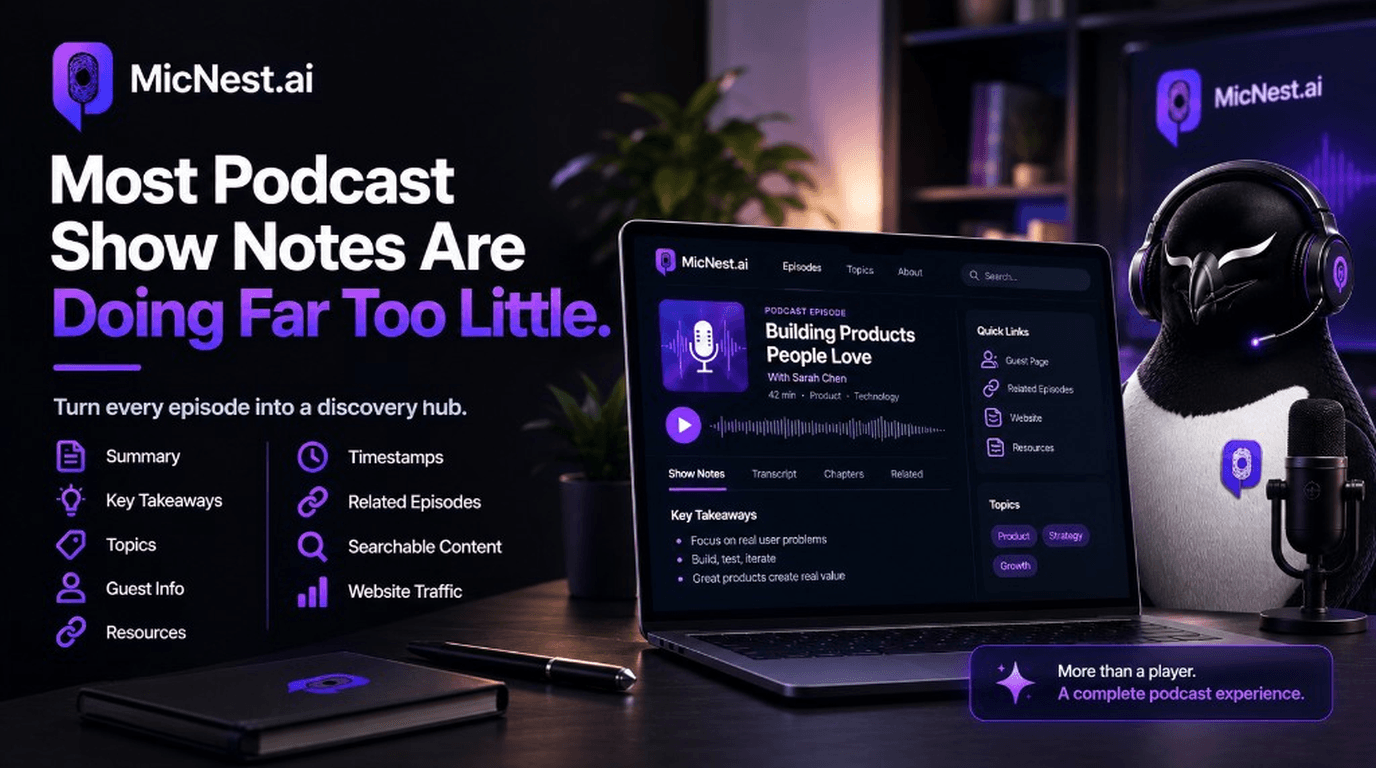
podcast show notes: Podcast show notes are the written content that accompanies a podcast episode — including a summary, guest information, key takeaways, topics, timestamps, resources, links, quotes, a podcast transcript, and related episodes — so people can understand and explore the conversation without listening first.
In simple terms: Podcast show notes are the written content that accompanies a podcast episode — including a summary, guest information, key takeaways, topics, timestamps, resources, links, quotes, a podcast transcript, and related episodes — so people can understand and explore the conversation without listening first.
Quick Answer
Write a clear value proposition, introduce the guest, list key takeaways, add useful timestamps, capture resources, include a structured podcast transcript, link related episodes a
Write a clear value proposition, introduce the guest, list key takeaways, add useful timestamps, capture resources, include a structured podcast transcript, link related episodes and topics, and add a newsletter CTA on your podcast website. Treat every podcast episode page as a destination — not just a player.
MicNest helps podcasters build richer episode pages — show notes, transcripts, topics, guest profiles, related episodes, searchable archives, and audience tools. Start at https://app.micnest.ai/auth/signup.
Key Takeaways
- ➔ Podcast show notes are part of the listening experience, not an afterthought.
- ➔ A podcast episode page should help people decide, navigate, search, and subscribe.
- ➔ Start with why the episode matters — not a generic in-this-episode line.
- ➔ Podcast episode notes work best with takeaways, topics, timestamps, and resources.
- ➔ A podcast transcript captures the conversation; show notes explain and organize it.
- ➔ Podcast SEO improves when episode pages have clear headings, guests, and internal links.
- ➔ Related episodes, topics, and a newsletter turn one visit into ongoing discovery.
- ➔ MicNest connects episode pages with summaries, transcripts, search, topics, guests, articles, and audience tools.
You published a new podcast episode. The audio is ready. The video is ready. The episode is live. Then you add a short description: "In this episode, we talk about business, marketing, and the future of technology." Done. Technically, yes — but you've just missed an opportunity. Strong podcast show notes turn that page into something people can understand, navigate, and search.
Your podcast episode page can do much more than tell someone where to press play. It can help them understand the conversation, decide whether the episode is relevant, find specific topics, discover the guest, jump to important moments, read key insights, find resources, discover related episodes, search your content, and subscribe.
Your show notes are not just supporting text. They're part of the podcast experience.
What Are Podcast Show Notes?
Podcast show notes are the written content that accompanies a podcast episode. They can include:
- Episode summary / podcast episode summary
- Guest information
- Key takeaways
- Topics discussed
- Timestamps
- Resources and links
- Quotes
- Podcast transcript
- Related episodes
The exact structure depends on the podcast. The goal should stay the same: help people understand and explore the conversation without requiring them to listen to the entire episode first.
People also search for podcast notes, podcast episode notes, and show notes for podcast templates. Whatever you call them, the job is the same — make the episode useful on the page.
Why Podcast Show Notes Matter
Imagine someone discovers your episode through Google and lands on your podcast website.
If they only see title + player + two sentences, they have very little context.
If the page includes what they'll learn, key takeaways, topics, guest information, timestamps, and resources, they can immediately understand the value of the conversation.
That's a better experience — and better experiences create more opportunities for people to keep exploring your podcast.
Your Episode Page Has Multiple Jobs
A good podcast episode page can serve several purposes at once:
- Discovery — Help people find the episode.
- Context — Explain what's inside.
- Consumption — Give multiple ways to experience the conversation (listen, skim, read).
- Navigation — Help them find specific moments.
- SEO — Make the content understandable to search engines (podcast SEO / seo for podcasts).
- Conversion — Give visitors a reason to subscribe.
That's a lot of responsibility for one page. Structure matters.
What Should Podcast Show Notes Include?
A strong episode page can include:
- Episode title — Make the subject clear.
- Short introduction — Explain why the episode matters.
- Guest information — Tell visitors who they're hearing from.
- Key takeaways — Highlight the most useful ideas.
- Topics — Organize the major subjects.
- Timestamps — Help people navigate the conversation.
- Resources — Link to things mentioned in the episode.
- Transcript — Provide the full conversation in text.
- Related episodes — Give visitors somewhere else to go.
- Newsletter signup — Turn visitors into subscribers.
You don't need every element on every episode. These components provide a strong foundation for podcast episode notes that people actually use.
Start With the Value Proposition
Don't begin your show notes with generic information. Start by answering: why should someone care?
Instead of:
"In today's episode, we speak with John about his career."
Try:
"John explains how he built his first SaaS company, found his initial customers, and avoided the hiring mistakes that nearly stalled the business."
Now the visitor immediately understands the value — and your podcast episode summary does real work.
Write for Someone Who Has Never Heard of Your Podcast
Your regular listeners already understand your show. A new visitor doesn't.
They need context. Explain:
- Who the guest is
- What the conversation is about
- Why the topic matters
- What they will learn
- Why they should continue
Your episode page should make sense even if someone discovers it completely out of context — which is how most podcast marketing discovery actually works.
Highlight the Best Ideas
You don't need to summarize every minute. Identify the strongest ideas.
Key Takeaways
- Your first customers don't always come from paid acquisition.
- Early founders should talk to customers before building features.
- Hiring too early can create unnecessary complexity.
Now someone can understand the core value of the episode in seconds — even if they never press play.
Add Timestamps
Timestamps are one of the simplest ways to improve an episode page.
For example:
- 00:00 Introduction
- 04:32 How the company got its first customer
- 12:18 The biggest early mistake
- 21:45 Hiring the first employee
- 34:10 Building the sales process
- 48:27 Advice for new founders
This gives visitors control. They don't have to listen to the entire episode to find the section they care about.
Make Timestamps Useful
Don't use vague labels like "12:18 - Discussion."
Instead: "12:18 - How they found their first 100 customers."
The second version communicates value. It also makes the content easier to understand and navigate — and easier for site search to surface later.
Add the Guest's Expertise
A guest isn't just a name. Explain why they are worth listening to.
For example: Sarah Chen is the founder of XYZ and has spent more than a decade building SaaS products. In this conversation, she shares how her team approached product-market fit and early customer acquisition.
Then link to their guest profile where appropriate. Podcast guests pages give visitors another discovery path across your archive.
Turn Show Notes Into Searchable Content
Your episode page can also become a search asset.
Think about the questions discussed during the conversation:
- How do you find your first customers?
- When should you hire your first employee?
- How do you validate a SaaS idea?
Those questions can naturally appear in your episode page. Now the page isn't just describing the episode — it's describing the knowledge inside the episode.
That's much more useful for both people and podcast SEO.
Show Notes and Podcast SEO
Podcast SEO isn't about stuffing keywords into a page. It's about making your content understandable and useful.
A strong episode page can include:
- Clear title
- Descriptive introduction
- Relevant headings
- Topics
- Guest information
- Podcast transcript
- Internal links
- Related episodes
- Useful resources
This creates a richer page around the conversation — the kind of surface seo for podcasts actually needs.
For a broader strategy, see our Podcast SEO Guide.
Your Transcript Is More Than Show Notes
A transcript and show notes serve different purposes.
| Format | Job |
|---|---|
| Podcast transcript | Captures the conversation |
| Podcast show notes | Explain and organize the conversation |
| Article | Turns the strongest ideas into a focused reading experience |
You can use all three:
Episode → Show notes → Transcript → Article
Each format serves a different purpose. Learn more in How to Turn a Podcast Into a Blog and Podcast Content Repurposing.
Don't Just Paste the Transcript
A transcript can be long. That's fine. But putting a 60-minute podcast transcript underneath a player doesn't automatically create great podcast show notes.
Readers need structure. Give them:
- Summary
- Key takeaways
- Topics
- Timestamps
- Resources
Then offer: Read the full transcript.
Add Resources Mentioned in the Episode
Guests frequently mention books, companies, tools, websites, research, people, products, and articles. Capture those resources.
Resources Mentioned
- Book: Example Book
- Tool: Example Tool
- Website: Example.com
Now the episode page becomes useful even for someone who doesn't listen immediately.
Link Related Episodes
Don't let an episode page become a dead end.
At the bottom, recommend related conversations:
- How to Build Your First Sales Team
- Finding Product-Market Fit
- The Future of SaaS
One episode can lead to another. This increases content discovery across your podcast archive.
Connect Topics
Topics create another layer. Suppose this episode discusses SaaS, hiring, and customer acquisition. Visitors should be able to explore those subjects — for example, "Explore all conversations about SaaS."
Now your episode page connects to a larger knowledge library, not just a single player.
Add a Newsletter CTA
Someone visiting your episode page may not listen immediately. That's okay. Give them another option:
Want more conversations like this? Get our latest episodes and insights delivered every week. Subscribe.
Now the visitor has a way to stay connected. This turns your episode page into an audience-building asset — the same idea behind owning your podcast audience.
Show Notes Can Serve Different Types of Visitors
Think about three visitors:
- "I want to listen." — Give them the player.
- "I don't have time to listen." — Give them the summary and key takeaways.
- "I want one specific answer." — Give them search, topics, timestamps, and transcript.
One page. Three different needs. That's what a good podcast episode page should support.
The Ideal Podcast Episode Page
A strong structure might look like this:
- Episode title — clear and descriptive
- Introduction — why this conversation matters
- Guest — who they are and why their expertise matters
- Listen / Watch — the main episode
- Key takeaways — the most important ideas
- Topics — major subjects discussed
- Timestamps — important moments
- Resources — things mentioned in the conversation
- Transcript — full searchable conversation
- Related content — articles and episodes
- Newsletter — a reason to stay connected
This turns an episode page into much more than a player.
Show Notes Can Become a Content Engine
Think about the relationship:
Conversation → Episode → Show notes → Transcript → Article → Social content → Search → Website visitor → Subscriber
One conversation can power an entire content ecosystem. That's the larger opportunity behind podcast content systems — and why a searchable podcast archive compounds over time.
Don't Make Every Episode Page Identical
A template provides consistency. But your content should still reflect the episode.
- A technical interview might need tools, concepts, technical terms, and resources.
- A founder interview might need company story, lessons, milestones, and advice.
- A news discussion might need context, key events, sources, and a timeline.
Use a consistent structure. Let the content determine the details.
Update Your Old Episode Pages
This is another opportunity hiding in your podcast archive.
You don't need to start with your newest episodes. Choose your best older conversations and improve their pages with:
- Better summaries
- Key takeaways
- Timestamps
- Guest information
- Topics
- Related episodes
- Searchable transcripts
- Relevant articles
Now old episodes have a better chance of being useful to both new and existing visitors. See Your Podcast Back Catalog.
Show Notes Should Help People Decide
Ultimately, a visitor should be able to answer "Is this episode relevant to me?" within a few seconds.
A good page makes that easy. It tells them who, what, why, when, where — and most importantly: what will I get from this conversation?
How MicNest Approaches Episode Content
MicNest treats the episode page as a central part of the podcast platform.
Instead of only displaying an audio player, the goal is to connect the episode with:
- Summaries and podcast show notes
- Transcripts
- Search
- Topics
- Guests
- Articles
- Related episodes
- Newsletter
- Audience tools
The episode becomes an entry point into the wider podcast ecosystem — not a dead-end player page.
Podcast Show Notes Checklist
Before publishing an episode, ask:
Content
- Is the episode clearly explained?
- Is the guest introduced?
- Are the key takeaways included?
- Are important topics identified?
Navigation
- Are timestamps available?
- Can visitors find specific moments?
- Are related episodes linked?
Discovery
- Is the page searchable?
- Are important topics clearly represented?
- Does the page have useful headings?
Audience
- Is there a newsletter CTA?
- Can visitors discover more content?
SEO
- Is the title descriptive?
- Does the page contain useful supporting content?
- Are relevant internal links included?
If the answer is yes, your episode page is doing much more than simply hosting audio.
Frequently Asked Questions
What are podcast show notes?
Podcast show notes are written content that accompanies an episode and helps listeners understand, navigate, and discover the conversation — from summary and takeaways to timestamps, guests, resources, and often a podcast transcript.
How long should podcast show notes be?
There is no universal ideal length. They should be long enough to provide useful context without adding unnecessary information. Focus on clarity, takeaways, and navigation.
Should podcast show notes include a transcript?
A podcast transcript can be valuable for accessibility and search. It works best alongside a concise summary and structured show notes, not as a substitute for them.
Are podcast show notes good for SEO?
They can help by providing search-friendly context around an episode — especially when combined with transcripts, clear headings, topics, internal links, and useful content on your podcast website.
Should every podcast episode have show notes?
For most podcasts with a website, useful episode pages are worthwhile. The depth can vary depending on the importance and complexity of the episode.
Should I use AI to write podcast show notes?
AI can help generate summaries, extract takeaways, identify topics, and organize transcripts. Human review is still important for accuracy, context, and quality.
Your Episode Page Should Do More Than Say "Listen Here"
Your podcast already contains the conversation. Don't make visitors work to understand it.
Give them the context, the key ideas, the guest, the topics, the important moments, the resources, the related conversations — and a clear reason to come back.
Because your episode page isn't just where your podcast lives. It's where discovery can begin.
Make Every Episode More Useful
MicNest helps podcasters turn every episode into a richer content experience with dedicated pages, searchable conversations, transcripts, articles, guest profiles, topics, newsletters, and more.
Related Reading
Before vs after
Before
- — Episode page is just a player plus two sentences
- — Visitors can't tell if the episode is relevant
- — Transcript dumped without structure
After
- + Clear takeaways, timestamps, guests, and resources
- + Visitors decide quickly and keep exploring
- + Show notes + transcript + related content work together
Who is this for?
Podcasters
Creators who want episode pages people actually read and use.
Show producers
Teams turning conversations into takeaways, timestamps, and resources.
Interview hosts
Hosts connecting guests, topics, and related episodes on every page.
Make every episode page more useful
Episode pages should do more than say listen here. MicNest helps turn conversations into useful show notes, transcripts, topics, guests, related episodes, and audience growth paths.
Explore MicNest or start freeSources
- MicNest product — MicNest connects episode pages with show notes, transcripts, search, topics, guests, articles, and audience tools.
Frequently Asked Questions
What are podcast show notes? +
Podcast show notes are written content that accompanies an episode and helps listeners understand, navigate, and discover the conversation — from summary and takeaways to timestamps, guests, resources, and often a podcast transcript.
How long should podcast show notes be? +
There is no universal ideal length. They should be long enough to provide useful context without adding unnecessary information. Focus on clarity, takeaways, and navigation.
Should podcast show notes include a transcript? +
A podcast transcript can be valuable for accessibility and search. It works best alongside a concise summary and structured show notes, not as a substitute for them.
Are podcast show notes good for SEO? +
They can help by providing search-friendly context around an episode — especially when combined with transcripts, clear headings, topics, internal links, and useful content on your podcast website.
Should every podcast episode have show notes? +
For most podcasts with a website, useful episode pages are worthwhile. The depth can vary depending on the importance and complexity of the episode.
Should I use AI to write podcast show notes? +
AI can help generate summaries, extract takeaways, identify topics, and organize transcripts. Human review is still important for accuracy, context, and quality.

