
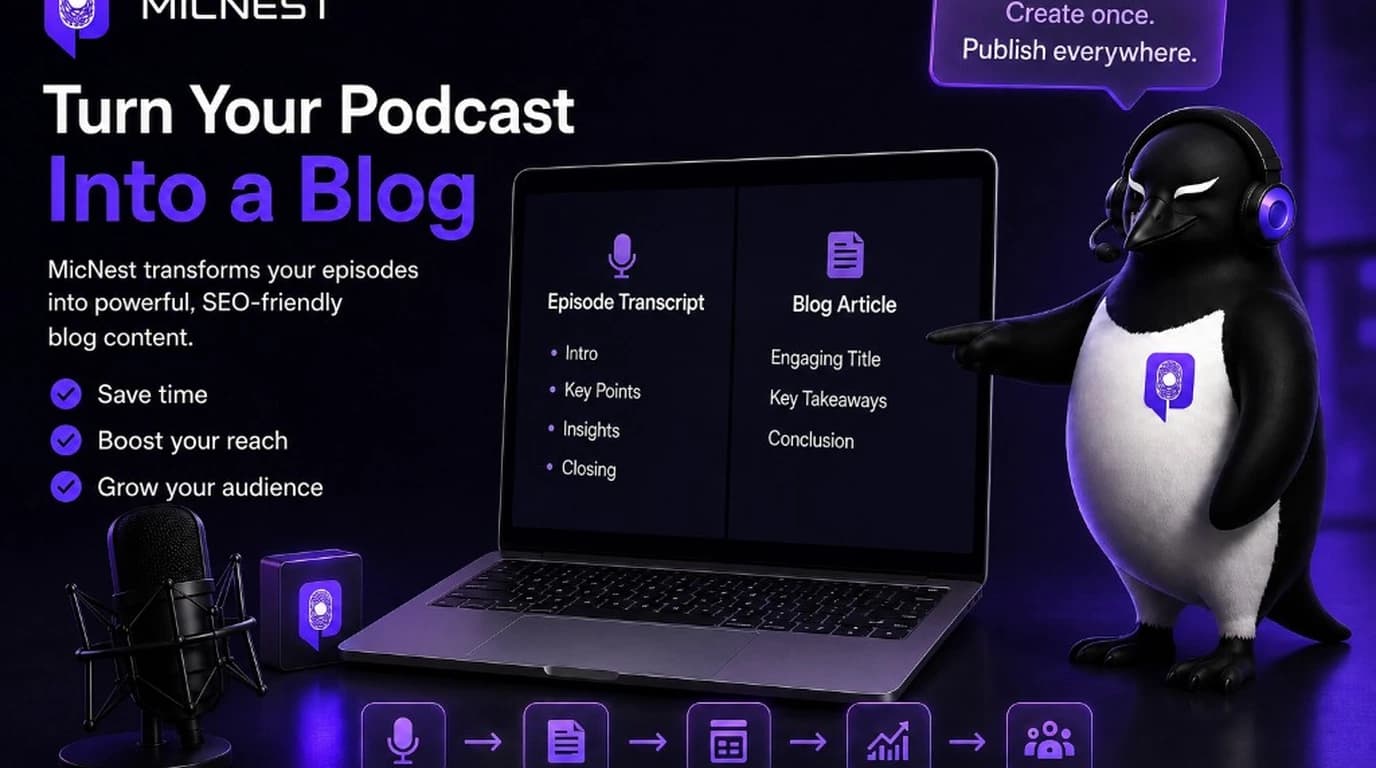
Definition
podcast to blog: Turning a podcast into a blog means taking the knowledge inside an episode — stories, frameworks, answers, and examples — and restructuring it into a written article organized around a reader's question or need, while linking back to the original conversation.
In simple terms: Turning a podcast into a blog means taking the knowledge inside an episode — stories, frameworks, answers, and examples — and restructuring it into a written article organized around a reader's question or need, while linking back to the original conversation.
Quick Answer
Podcast episode → Transcript → Identify key ideas → Choose a reader/search intent → Structure the article → Write and edit → Add links → Publish. Use the transcript as raw material
Podcast episode → Transcript → Identify key ideas → Choose a reader/search intent → Structure the article → Write and edit → Add links → Publish. Use the transcript as raw material, not the finished article. Find the strongest ideas, remove repetition, answer a specific question, and connect the piece back to the original episode so it helps someone who has never listened.
MicNest helps creators turn podcast conversations into searchable articles on an owned website — transcript to content to audience. Start at https://app.micnest.ai/auth/signup.
Key Takeaways
- ➔ A transcript records what was said; a blog organizes information around what a reader needs.
- ➔ One episode can support multiple articles when it covers several searchable topics.
- ➔ Start with evergreen, practical, or expert-rich episodes — not every recording needs a post.
- ➔ Write for the reader and preserve the guest's voice, stories, and frameworks.
- ➔ Always link the article back to the original episode and related content on your podcast website.
- ➔ Show notes support listeners who already opened the episode; a blog can attract people who have never heard of your show.
- ➔ Podcast SEO compounds when articles create new entry points into your catalog.
A podcast episode can take hours to create — and still end up as one more row in your archive. Learning how to turn a podcast to blog article means extracting the strongest ideas from the conversation and structuring them for readers, not pasting a raw transcript.
Why turn a podcast into a blog?
A podcast episode can take hours to create.
You research the topic.
You prepare questions.
You invite a guest.
You record the conversation.
You edit the episode.
You publish it.
And then, after all that work, the episode often becomes one more item in your podcast archive.
But your conversation probably contains much more value than one audio file.
A single episode can contain stories, frameworks, lessons, opinions, answers, examples, and ideas that can be useful long after the episode is published.
One of the best ways to extend that value is to turn your podcast into a blog article.
But there is an important distinction:
Turning a podcast into a blog does not mean copying and pasting the transcript.
A good article takes the strongest ideas from the conversation and restructures them around something a reader actually wants to learn.
Podcasts are excellent for conversations.
Blogs are excellent for discovery, reading, sharing, and reference.
Someone might happily listen to a 60-minute interview while driving.
Another person might want the answer to one specific question in two minutes.
Both people can benefit from the same conversation.
For example, imagine an episode titled "Building a Startup From Zero with Sarah Chen."
During the conversation, Sarah discusses finding the first customers, hiring, product-market fit, pricing, content marketing, and fundraising.
The audio episode is one piece of content.
But those topics can potentially become several useful articles — how to find your first 10 customers, when a startup should hire, how to think about pricing, and more.
The conversation was already recorded.
You're simply giving its ideas more places to live — the same idea behind treating your show as a podcast content library.
A podcast is a content source
This is the most important mindset shift.
Don't think: "I need to create a blog post."
Think: "I already have a conversation containing valuable information. What useful content can I extract from it?"
Your podcast becomes the source.
From that source, you can create articles, guides, FAQs, quotes, social posts, newsletter sections, guest profiles, topic pages, and search-focused content.
The goal isn't necessarily to publish more.
The goal is to get more value from the work you've already done — which is also why we built MicNest.
Podcast to blog vs podcast transcript
These are not the same thing.
A podcast transcript records what people said.
A blog article organizes information for someone who wants to learn something.
Consider a typical conversation.
A guest might say: "Well, when we started the company, there were actually a few things we tried…"
They may tell a story, go on a tangent, then return to the original topic.
That's natural in conversation.
It isn't necessarily good article structure.
A blog should remove the conversational noise and preserve the useful information.
| Transcript | Blog |
|---|---|
| Conversation in chronological order | Information organized around the reader's needs |
| Includes tangents and filler | Focuses on the answer |
| Useful as raw material | Useful as a finished reading experience |
That's why simply publishing the transcript usually isn't enough — podcast transcription is the starting point, not the finish line.
Step 1: Choose the right podcast episode
Not every episode needs to become a blog post.
Start with episodes that contain evergreen information, strong opinions, practical advice, frequently asked questions, expert knowledge, useful frameworks, original stories, specific examples, or searchable topics.
An episode that is mostly personal updates may not make a strong evergreen article.
An episode explaining how a founder acquired their first customers might.
Ask: Would someone still find this useful six months from now?
If yes, it's a strong candidate.
Step 2: Transcribe the episode
The first practical step is to create a podcast transcript.
The transcript gives you the complete conversation in written form.
You can then search it for important statements, questions, examples, stories, statistics, frameworks, advice, interesting quotes, and repeated themes.
You don't have to manually listen to the entire episode again while taking notes.
The transcript becomes your working document.
However, don't immediately publish it.
First, understand what is inside it.
Step 3: Find the main ideas
Read through the transcript and identify the strongest ideas.
For example, suppose your episode is about how to build an audience.
You might discover five major themes: why most creators struggle to get their first audience, choosing one specific audience, creating useful content consistently, building an email list, and turning an audience into a community.
Now you have the foundation for an article.
Instead of reproducing 60 minutes of conversation, you can organize the article around those five ideas.
Step 4: Choose one main topic
One of the biggest mistakes is trying to put the entire podcast episode into one article.
Don't.
If an episode covers ten different topics, you don't necessarily need one enormous article covering all ten.
Instead, identify the strongest subject.
A 60-minute conversation about growing a SaaS company might support separate articles on first customers, pricing mistakes, hiring, and building an audience.
One conversation can therefore support multiple pieces of useful content.
Step 5: Understand search intent
If you're creating content for search, don't start by asking: "What keywords can I put into this article?"
Start by asking: "What question is someone trying to answer?"
Someone searching "how to get podcast guests" probably wants practical advice.
Someone searching "best podcast website builder" is probably evaluating tools.
Someone searching "what is podcast SEO" is looking for an explanation.
Your article should satisfy the reason behind the search.
That's what makes content useful — and what podcast SEO actually depends on.
Step 6: Create the article structure
Once you understand the topic, create an outline with a clear introduction, definition, benefits, numbered steps, FAQ, and conclusion that points back to the original podcast.
This structure is much easier to read than a 60-minute conversation copied onto a page.
Step 7: Write for the reader, not the transcript
This is where the transformation actually happens.
Imagine the guest said: "There are a few things that I think are important, and one of those is really understanding who your customer is…"
Don't preserve every conversational phrase.
Instead, turn it into a clear heading and explanation — for example, "Understand your customer before scaling" — with the same idea in a better format.
The article should preserve the knowledge, not necessarily the exact wording.
Step 8: Keep the guest's expertise
Repurposing doesn't mean removing the personality of the conversation.
The guest is often the reason the episode exists.
Keep their unique perspective, relevant stories, original examples, important quotes, frameworks, experiences, and contrarian opinions.
For example: According to Sarah, the biggest mistake founders make is scaling acquisition before understanding retention.
Then explain the idea.
This keeps the article connected to the original conversation.
Step 9: Add the original episode
The article should always make it easy for readers to discover the original conversation.
Include the guest, episode title, topics, and a clear path to listen.
This creates a natural connection: search visitor → article → episode → podcast.
Someone who discovers the article through search can become a listener.
Step 10: Add internal links
Don't let the article become an isolated page.
Connect it to other relevant content — podcast SEO, a searchable podcast archive, podcast website guides, and related episodes.
Internal links help readers continue exploring.
They also help search engines understand the relationship between your content.
Step 11: Add a clear CTA
A blog should have a next step.
For podcast content, it could be: listen to the full conversation, subscribe to the podcast, get new episodes by email, or explore related conversations.
For a podcast creator platform, you can also introduce the product naturally: Want to build a searchable home for your podcast? Explore MicNest.
The CTA should match the reader's journey.
Step 12: Edit the article
AI can help with the first draft.
But editing matters.
Remove repetition, filler, conversational fragments, unnecessary tangents, unsupported claims, and generic statements.
Add context, examples, clear explanations, strong transitions, useful formatting, and relevant links.
The final article should feel like something written for a reader, not something exported from a transcription tool.
How long should a podcast blog be?
There is no magic word count.
A useful article might be 800, 1,500, 2,500, or 4,000 words.
The correct length depends on the topic.
Don't turn a simple answer into a 4,000-word article just because longer articles exist.
Instead: cover the topic completely.
That's the better rule.
Can one podcast episode create multiple blog posts?
Absolutely.
In fact, this is where podcast content becomes especially powerful.
Imagine a 60-minute episode about podcast growth covering guests, podcast SEO, social promotion, email marketing, building a website, and measuring growth.
Instead of one generic article titled "Everything About Podcast Growth," create focused articles that each target a different question — and all link back to the original episode.
The content repurposing flywheel
The workflow can become:
Podcast conversation → Episode → Transcript → Key ideas → Blog articles → Search traffic → New listeners → Subscribers → More conversations
The important part is that you're not constantly starting from zero.
Each conversation becomes a source for additional content — a durable podcast marketing asset, not a one-week promo cycle.
Podcast blog vs show notes
A blog article and podcast show notes serve different purposes.
| Show notes | Blog article |
|---|---|
| Help someone who already knows about the episode | Can attract someone who doesn't know the episode exists |
| Guest, summary, topics, links, timestamps | Answers a specific question |
| Souvenir for listeners | Discovery path for new readers |
For example, show notes might say: In this episode, Sarah discusses startup growth, hiring, and fundraising.
A blog article might be: How to Get Your First 10 Startup Customers.
The second can potentially attract someone who has never heard of your podcast.
That's the difference.
How podcast blogs help podcast SEO
A strong article creates another entry point into your podcast.
Someone may never search "Sarah's podcast Episode 47."
But they might search "How do I get my first 10 customers?"
If your article answers that question and connects back to the episode, you've created a bridge between search and your podcast.
This is one reason podcast SEO should not be limited to optimizing episode titles.
Your entire content ecosystem matters.
Common mistakes when turning podcasts into blogs
- Publishing the raw transcript — A transcript is useful source material. It isn't necessarily a finished article.
- Trying to include everything — Choose one primary topic.
- Removing the guest's voice — Keep useful stories and opinions.
- Adding keywords everywhere — Write naturally.
- Ignoring search intent — Know what question the article answers.
- Forgetting the original episode — Always give readers a path back to the conversation.
- Creating disconnected articles — Use internal links.
- Publishing without editing — AI and transcription tools accelerate production, but human review still matters.
- Creating articles from weak conversations — Repurposing doesn't magically create expertise. Start with valuable source material.
A practical podcast-to-blog checklist
Before publishing, check:
- Is the episode worth repurposing?
- Is there a complete transcript?
- Did you identify the main topic?
- Does the article answer a specific question?
- Is the title clear?
- Is the article structured with useful headings?
- Did you remove conversational filler?
- Did you preserve important guest insights?
- Did you add relevant examples?
- Did you link to the original episode?
- Did you add internal links?
- Is there a clear CTA?
- Did a human review the article?
- Does the article provide value even without listening to the episode?
If the answer is yes, you're no longer simply publishing a transcript.
You're creating a useful piece of content from your podcast.
How MicNest helps with this workflow
This is exactly the type of workflow we believe should be easier for podcasters.
Your conversation is already the source.
You shouldn't have to manually move it through a dozen disconnected tools just to turn it into something useful.
MicNest is designed to bring the pieces together:
Podcast → Transcript → Content → Website → Search → Audience
The goal is not to replace your podcast.
It's to help the conversation continue working after you publish it.
Instead of treating every episode as something you publish and forget, you can build a growing content library around the show.
Your podcast has more content than you think
The next time you finish recording an episode, don't ask: "What should I post about this?"
Ask: "What useful knowledge is already inside this conversation?"
You may find a complete article, several smaller articles, a useful FAQ, strong quotes, a guest profile, newsletter content, social posts, new topic pages, and links to older episodes.
The content already exists.
Your job is to structure it.
Frequently asked questions
Can I turn any podcast episode into a blog?
Not necessarily. The best episodes contain useful, focused, or evergreen information. Personal updates or highly conversational episodes may require more editorial work.
Should I publish the podcast transcript as a blog?
A transcript can be published as supporting content, but it shouldn't automatically be treated as the final article. A well-structured article usually provides a better reading experience.
How many blog posts can I create from one podcast?
It depends on the conversation. A focused episode might produce one strong article, while a broad expert interview could provide several articles around different topics.
Should the blog article include the full podcast?
The article should summarize and explain the relevant knowledge while linking readers to the full episode. Don't force readers to read the entire article before they can listen.
Does turning podcasts into blogs help SEO?
It can create additional indexable, useful content around the topics discussed in your podcast. The value depends on content quality, relevance, search intent, technical SEO, and competition.
Should AI write my podcast blog?
AI can help with transcription, organization, outlining, and drafting. Human review is important for accuracy, context, voice, and quality.
How do I turn a podcast transcript into an article?
Start by identifying the main question or topic, extract the strongest ideas, create an outline, rewrite the relevant sections for readers, add context and links, then edit the final article.
Is a podcast blog the same as podcast show notes?
No. Show notes primarily support an existing episode. A blog article is usually designed around a specific topic or question and can reach people who don't already know the podcast.
From one conversation to a content library
Your podcast shouldn't have to produce only one thing.
A single conversation can become an episode, an article, a search result, a newsletter section, a guest profile, and a doorway into your older content.
That's not creating more work.
That's getting more value from the work you've already done.
The conversation is the source.
The content is the extension.
The website is the home.
And search is one of the ways people discover it.
Your next blog post might already be sitting inside your next podcast episode.
Turn your podcast into more
MicNest helps podcast creators build an owned content ecosystem around their conversations, including podcast websites, searchable content, articles, guest profiles, newsletters, and more.
Frameworks
Practical framework
Convert episodes into SEO blog posts so every conversation becomes durable, searchable content.
- Audit your current discovery channels
- Publish indexable episode pages
- Compound with blogs and email
Creator use case
An independent podcaster wants search traffic and an owned list.
- ✓Episode pages
- ✓SEO blogs
- ✓Newsletter capture
Before vs after
Before
- — Episode → Publish → Archive
- — Transcript pasted as a blog
- — Ideas stay trapped in audio
After
- + Episode → Transcript → Structured article
- + Search intent + guest voice preserved
- + Article → Episode → Subscribers
Who is this for?
Podcasters
Creators who want episodes to become written, searchable content.
Interview hosts
Hosts extracting articles from guest conversations.
Content marketers
Teams repurposing audio into blogs without starting from scratch.
Turn your podcast into more
Your next blog post might already be inside your next episode. MicNest helps you build the content layer — website, articles, searchable episodes, and newsletters — around conversations you already record.
Explore MicNest or start freeSources
Reviewed by Alex Rivera, Co-Founder & CEO, MicNest
Quick Comparison
| Chronological conversation or episode souvenir | Information organized around the reader's need |
|---|---|
| Includes tangents and filler | Focuses on a clear answer |
| Helps people who already opened the episode | Can attract people who have never heard of the show |
| Useful raw material | Finished reading experience that links back to audio |
Pros & Cons
| ✅ Pros | ❌ Cons |
|---|---|
| ✔ Extends the value of conversations you already recorded | ✖ Raw transcripts alone make weak articles |
| ✔ Creates searchable entry points into episodes | ✖ Requires choosing a clear topic and search intent |
| ✔ One interview can support multiple focused articles | ✖ Needs human editing for voice and accuracy |
| ✔ Compounds with podcast SEO, website, and email | ✖ Weak source conversations still make weak posts |
Frequently Asked Questions
Can I turn any podcast episode into a blog? +
Not necessarily. The best episodes contain useful, focused, or evergreen information. Personal updates or highly conversational episodes may require more editorial work.
Should I publish the podcast transcript as a blog? +
A transcript can be published as supporting content, but it shouldn't automatically be treated as the final article. A well-structured article usually provides a better reading experience.
How many blog posts can I create from one podcast? +
It depends on the conversation. A focused episode might produce one strong article, while a broad expert interview could provide several articles around different topics.
Should the blog article include the full podcast? +
The article should summarize and explain the relevant knowledge while linking readers to the full episode. Don't force readers to read the entire article before they can listen.
Does turning podcasts into blogs help SEO? +
It can create additional indexable, useful content around the topics discussed in your podcast. The value depends on content quality, relevance, search intent, technical SEO, and competition.
Should AI write my podcast blog? +
AI can help with transcription, organization, outlining, and drafting. Human review is important for accuracy, context, voice, and quality.
How do I turn a podcast transcript into an article? +
Start by identifying the main question or topic, extract the strongest ideas, create an outline, rewrite the relevant sections for readers, add context and links, then edit the final article.
Is a podcast blog the same as podcast show notes? +
No. Show notes primarily support an existing episode. A blog article is usually designed around a specific topic or question and can reach people who don't already know the podcast.

