
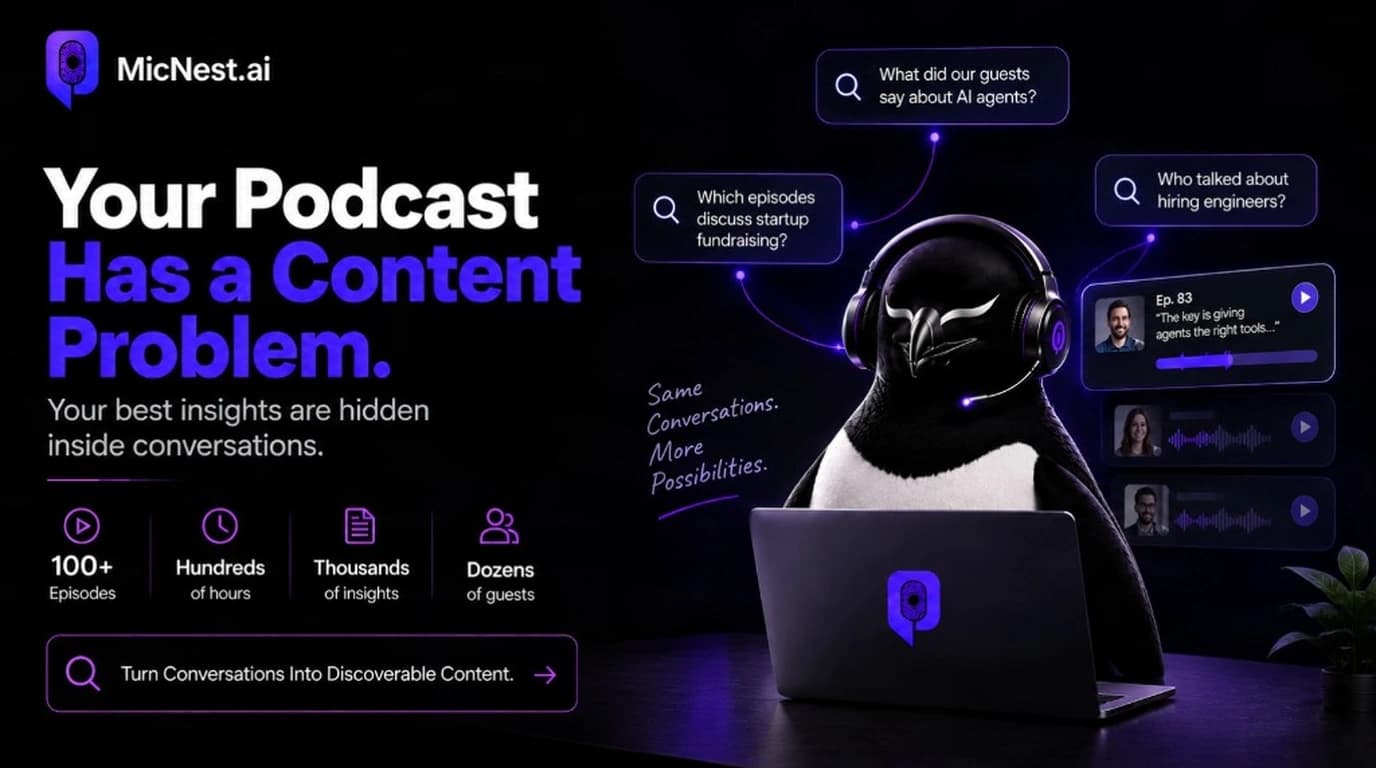
Definition
searchable podcast: A searchable podcast lets people discover conversations from the content inside episodes — keywords, questions, topics, guests, concepts, and moments — not only from episode titles and dates.
In simple terms: A searchable podcast lets people discover conversations from the content inside episodes — keywords, questions, topics, guests, concepts, and moments — not only from episode titles and dates.
Quick Answer
Create accurate transcripts → structure episode pages (guest, topics, key moments) → organize topics and guest profiles → add website search that covers conversation content → supp
Create accurate transcripts → structure episode pages (guest, topics, key moments) → organize topics and guest profiles → add website search that covers conversation content → support natural-language questions → surface relevant timestamps → connect related episodes and articles.
MicNest helps podcasters make conversations searchable — transcripts, episode pages, topics, guest profiles, articles, and knowledge discovery. Start at https://app.micnest.ai/auth/signup.
Key Takeaways
- ➔ An archive you can browse is not the same as a searchable knowledge base.
- ➔ Search the conversation content — not only titles and dates.
- ➔ Transcripts are the foundation; structured topics and guests add context.
- ➔ Keyword search finds words; semantic search finds meaning across similar questions.
- ➔ Search by question, topic, guest, and exact moment transforms discovery.
- ➔ Old episodes stay valuable when ideas inside them remain findable.
- ➔ A content graph connects episodes, guests, articles, and topics.
- ➔ Strong search results include guest, topic, moment, and context — not just a title.
- ➔ Search helps listeners and your team use the archive as a research tool.
- ➔ MicNest connects transcripts, topics, guests, articles, and search into one knowledge layer.
Imagine you've published 200 podcast episodes — hundreds of conversations, thousands of questions and answers. If finding one specific idea still means scrolling episode titles, you have an archive, not yet a searchable podcast knowledge base. Here's how to make your podcast searchable.
Someone asks: "Which of our guests talked about building an AI startup?" Can you find the answer in 10 seconds? What about hiring the first engineer, or raising the first $1 million?
If the answer is "I'd have to search through the episodes," you have an archive. But you don't yet have a searchable knowledge base. And that's a significant difference.
Your Podcast Is Already a Knowledge Base
Every podcast conversation contains information. Guests answer questions, share experiences, explain processes, discuss industries, tell stories, and make predictions.
Over time, these conversations form a valuable collection of knowledge. The problem is accessibility.
A traditional podcast archive organizes content primarily by episode number, date, and title. That's useful for browsing. But it isn't necessarily useful for finding a specific answer.
A searchable podcast changes the experience. Instead of Browse → Scroll → Open episode → Search manually, you can create Search → Find idea → Open relevant moment.
This builds on the idea of a searchable podcast archive — going deeper into questions, topics, guests, and exact ideas.
What Does a Searchable Podcast Mean?
A searchable podcast allows people to discover conversations based on the content inside the episodes, rather than only the episode titles.
Visitors could search for:
- Keywords
- Questions
- Topics
- Guests
- Concepts
- Names
- Phrases
- Related ideas
For example, search AI agents and results could show:
- Episode 82 — Guest discusses how AI agents are changing SaaS.
- Episode 114 — Founder explains building an AI agent startup.
- Episode 137 — Conversation about AI automation.
Now the visitor doesn't need to know which episode contains the answer. The search does that work.
Why Episode Titles Aren't Enough
Consider these episode titles:
- Episode 42: The Future of Work
- Episode 57: Building Something Different
- Episode 83: Lessons From 20 Years in Business
They might sound interesting. But what information is actually inside them?
Maybe Episode 83 contains a 10-minute discussion about how to hire your first employee. Someone searching for that phrase wouldn't necessarily know Episode 83 contains the answer.
This is why podcast discovery shouldn't depend entirely on titles. The content inside the conversation matters too.
Search the Conversation, Not Just the Episode
This is the fundamental idea.
Traditional search: Search episode titles
Better search: Search episode descriptions
Even better: Search transcripts and conversation content
The more context your search system understands, the easier it becomes to find useful information. A transcript gives you the words. A structured knowledge layer can give those words context.
Transcripts Are the Foundation
A searchable podcast needs text. That's where transcripts come in.
A transcript converts audio into searchable text. Now every sentence in the conversation becomes discoverable. Someone can search "pricing strategy" and find episodes where that phrase appears.
But there's another challenge. Simply searching for exact words isn't always enough.
Keyword Search vs Meaning-Based Search
Consider these two questions:
- How do startups get their first customers?
- What's the best way to acquire initial users?
They're asking similar things. But they use different words.
A basic keyword search might treat them as unrelated. A more intelligent search system can understand that both are about early customer acquisition.
That's where semantic or AI-powered search becomes useful. Instead of matching only exact words, it can look for meaning and context.
Search by Questions
People naturally ask questions. Your podcast likely answers hundreds of them.
For example:
- How do you raise funding?
- How do you hire a CTO?
- How do you build a personal brand?
- How do you price a SaaS product?
- How do you find your first customers?
A good podcast search experience should make those questions searchable. The user shouldn't have to know your internal category structure. They should be able to ask naturally.
Search by Topic
Topics are another powerful way to navigate a podcast.
Imagine your archive contains 500 episodes. You could organize them around:
AI
87 episodes
Startups
124 episodes
Marketing
96 episodes
Leadership
72 episodes
Sales
61 episodes
Now someone interested in marketing can explore the relevant part of your archive without going through all 500 episodes.
Search by Guest
Guests are often one of the strongest discovery mechanisms for podcasts.
Someone may search "John Smith podcast" or simply browse your guest directory.
A guest page could show:
- Guest bio
- Episodes
- Topics discussed
- Articles
- Quotes
- Related conversations
Now your podcast becomes easier to navigate through people as well as topics.
Search by Exact Moment
This is where podcast search becomes especially powerful.
Imagine someone searches "pricing mistakes". Instead of showing only Episode 72, you can show the relevant section:
Episode 72 · 32:14 — Guest explains the biggest pricing mistake they made when launching their SaaS.
Now the listener can jump directly to the relevant moment. They don't have to listen to 60 minutes to find one answer.
Your Podcast Can Become a Question-and-Answer Library
Think about the knowledge inside your archive. Every episode contains questions → answers → ideas → stories → examples.
That means your podcast can become a huge library of answers. Someone could search "What should a startup founder do before hiring?" and discover the relevant conversations.
Your podcast becomes less like a playlist — and more like a knowledge engine.
Search Makes Old Episodes More Valuable
This is one of the biggest benefits.
Without search, old episodes often become harder to discover. With search, an episode published two years ago can still appear when someone searches for an idea it contains.
That gives your back catalog another life. Instead of new episode = valuable and old episode = forgotten, you can create new episode + old episode = connected knowledge library.
Your archive becomes more valuable as it grows.
Search Can Connect Different Episodes
Suppose you publish Episode 20: Hiring, then later Episode 84: Building Teams, then Episode 127: Remote Leadership. These episodes might be separated by years. But they could all be connected.
A search system can help surface them together. A visitor interested in team building could discover all three. This creates a network of related conversations.
From Episode List to Content Graph
A traditional podcast looks like Episode 1, Episode 2, Episode 3, Episode 4.
A connected podcast looks more like:
Topic → Episode / Guest / Article → Related Topic
The content is connected. That's a content graph. The more relationships you create, the easier it becomes for visitors to explore your podcast — the same idea as turning your show into a podcast platform.
Search Can Improve Podcast SEO
Search inside your website and search engines are different things. But they can support each other.
When you create dedicated episode pages, transcripts, articles, topic pages, guest pages, and internal links, you create more structured content around your conversations.
That gives search engines more context about what your podcast covers. Your podcast can potentially become discoverable for topics beyond its name.
For a deeper look, see our Podcast SEO Guide.
Searchable Content Creates More Entry Points
Imagine someone searches Google for "How to build a SaaS pricing strategy." They find your article. Inside the article: listen to the full conversation. Now: Search → Article → Podcast.
Another person searches your podcast website for SaaS pricing: Search → Episode → Listen.
Another finds a guest through social media: Guest → Episodes → Topic → Article.
Different entry points. Same knowledge base. Podcast content repurposing helps create those entry points from every conversation.
How to Make a Podcast Searchable
Here's a practical framework.
Step 1: Get accurate transcripts
Every episode should have a reliable text representation.
Step 2: Structure your episode pages
Include title, description, guest, topics, transcript, key moments, and related episodes.
Step 3: Create topic relationships
Connect episodes discussing similar subjects.
Step 4: Create guest profiles
Give visitors another way to explore your archive.
Step 5: Add website search
Allow visitors to search your entire podcast.
Step 6: Support natural-language queries
Let people ask questions instead of forcing exact keywords.
Step 7: Show relevant moments
When possible, point users toward the specific section of the conversation.
Step 8: Connect related content
Recommend relevant episodes, articles, guests, and topics.
What a Good Podcast Search Result Looks Like
A weak search result:
> Episode 143: The Future of AI
A stronger result:
> The Future of AI
> Guest: Sarah
> Relevant topic: AI agents
> Relevant moment: 24:18
> Sarah explains how AI agents could change SaaS workflows.
The second result gives the visitor context. They can immediately decide: that's what I'm looking for.
Don't Make Search a Separate Feature
Search should connect the entire experience.
A visitor searches AI. They should be able to discover episodes, guests, articles, topics, and relevant moments. Then from an episode: related episodes, related articles, guest profile, topic page.
Search becomes the beginning of exploration.
Search + AI Can Make Podcasts Even More Useful
AI can add another layer. Instead of simply searching for "AI agents", a visitor could ask: "What have guests on this podcast said about using AI agents to automate customer support?"
An intelligent system can identify relevant conversations and summarize the common ideas. The important part is that the AI should be grounded in the podcast's actual content. It shouldn't invent an answer.
The system should connect the answer back to episodes, guests, transcripts, timestamps, and relevant sources within the podcast.
Your Podcast Can Become an Internal Knowledge Base Too
Search isn't only for listeners. It can also help podcast teams.
Imagine your team wants to know: "Have we ever discussed this topic before?" Instead of manually checking hundreds of episodes, they can search the archive.
This can help with research, new episode preparation, guest research, content creation, newsletter creation, article writing, and social media planning. Your own archive becomes a research tool.
The Bigger Your Podcast Gets, the More Search Matters
With 10 episodes, browsing isn't difficult. With 50, it becomes less convenient. With 200, finding a specific conversation becomes harder. With 1,000, a chronological list is no longer enough.
The more content you create, the more important organization and discovery become. Your podcast grows from a show into a library — and eventually a knowledge platform.
Use podcast analytics to see which searches and topics people actually explore.
What MicNest Is Building
This is one of the core ideas behind MicNest.
We don't want your podcast archive to simply answer "What's the latest episode?" We want it to answer "What do you want to learn?"
MicNest is designed to connect episodes, transcripts, topics, guests, articles, search, and knowledge — so visitors can explore your podcast based on what they're actually interested in.
A Searchable Podcast Changes the Listener Experience
Without search: "I remember hearing something about this..."
With search: "Let me find it."
That's a major difference. The listener no longer has to remember episode number, title, guest, or publication date. They can simply search for the idea. That makes your entire archive more useful.
Your Old Episodes Shouldn't Disappear
Every episode represents an investment — time, research, preparation, production, guest expertise.
Your archive should become more valuable over time, not less. A searchable system gives your old conversations more opportunities to be discovered.
Instead of letting your back catalog disappear beneath newer episodes, you can turn it into a living knowledge library — and own your podcast audience around that library.
Frequently Asked Questions
How do I make my podcast searchable?
Start by creating accurate transcripts, dedicated episode pages, structured topics and guest information, and a search experience that can search the content inside your episodes.
Can people search podcast transcripts?
Yes. If transcripts are available as text, they can be indexed and searched. More advanced systems can also search by meaning rather than exact keywords.
What is semantic podcast search?
Semantic search attempts to understand the meaning behind a query rather than relying only on exact keyword matches.
Can AI search an entire podcast?
Yes. AI-powered systems can analyze transcripts and other structured podcast data to retrieve relevant conversations, topics, and moments.
Why are timestamps useful?
Timestamps let listeners jump directly to the relevant section instead of searching through an entire episode manually.
Does podcast search help SEO?
A searchable archive can improve content discovery within your website, while transcripts, articles, structured episode pages, and internal links can provide additional crawlable content for search engines.
Should every podcast have a searchable archive?
For a small podcast, basic navigation may be enough. As your archive grows, search becomes increasingly valuable.
Your Podcast Is More Than Its Episode Titles
You have already created the conversations. You don't need to recreate them. You need to make the knowledge inside them easier to discover.
That's the opportunity.
Search the topic. Find the conversation. Jump to the moment. Explore related ideas. Discover another episode.
Your podcast stops being a list of episodes. It becomes a searchable knowledge base. And the more conversations you publish, the more valuable that knowledge base can become.
Turn Your Podcast Into a Searchable Knowledge Platform
MicNest helps podcasters transform their episodes into a searchable content ecosystem with transcripts, articles, topics, guest profiles, episode pages, and audience tools.
Related Reading
Before vs after
Before
- — Browse → Scroll → Open episode → Search manually
- — Titles and dates as the only discovery path
- — Old episodes fade under the feed
After
- + Search → Find idea → Open relevant moment
- + Questions, topics, guests, and transcripts are discoverable
- + Back catalog stays useful as a knowledge library
Who is this for?
Podcasters
Creators with growing archives who need discovery beyond episode titles.
Interview hosts
Hosts organizing guests, topics, and answers across many conversations.
Content teams
Teams using the archive as a research and content knowledge base.
Turn your podcast into a searchable knowledge platform
Transcripts, structured episode pages, topics, guests, and search turn your archive into a knowledge base. MicNest helps people find the conversation — and the moment — they need.
Explore MicNest or start freeSources
Reviewed by Alex Rivera, Co-Founder & CEO, MicNest
Quick Comparison
| Browse → Scroll → Open → Search manually | Search → Find idea → Open relevant moment |
|---|---|
| Titles and dates | Questions, topics, guests, transcripts |
| Old episodes fade | Back catalog stays discoverable |
| Episode list | Content graph of related knowledge |
Pros & Cons
| ✅ Pros | ❌ Cons |
|---|---|
| ✔ Find answers without knowing episode numbers or titles | ✖ Requires accurate transcripts and structured episode data |
| ✔ Timestamps jump listeners to the relevant moment | ✖ Exact keyword search alone misses related phrasing |
| ✔ Old episodes keep working as searchable knowledge | ✖ Value compounds as the archive grows — small shows need less |
| ✔ Supports both listener discovery and internal research | ✖ Search without connected topics/guests stays shallow |
Frequently Asked Questions
How do I make my podcast searchable? +
Start by creating accurate transcripts, dedicated episode pages, structured topics and guest information, and a search experience that can search the content inside your episodes.
Can people search podcast transcripts? +
Yes. If transcripts are available as text, they can be indexed and searched. More advanced systems can also search by meaning rather than exact keywords.
What is semantic podcast search? +
Semantic search attempts to understand the meaning behind a query rather than relying only on exact keyword matches.
Can AI search an entire podcast? +
Yes. AI-powered systems can analyze transcripts and other structured podcast data to retrieve relevant conversations, topics, and moments.
Why are timestamps useful? +
Timestamps let listeners jump directly to the relevant section instead of searching through an entire episode manually.
Does podcast search help SEO? +
A searchable archive can improve content discovery within your website, while transcripts, articles, structured episode pages, and internal links can provide additional crawlable content for search engines.
Should every podcast have a searchable archive? +
For a small podcast, basic navigation may be enough. As your archive grows, search becomes increasingly valuable.

