
Definition
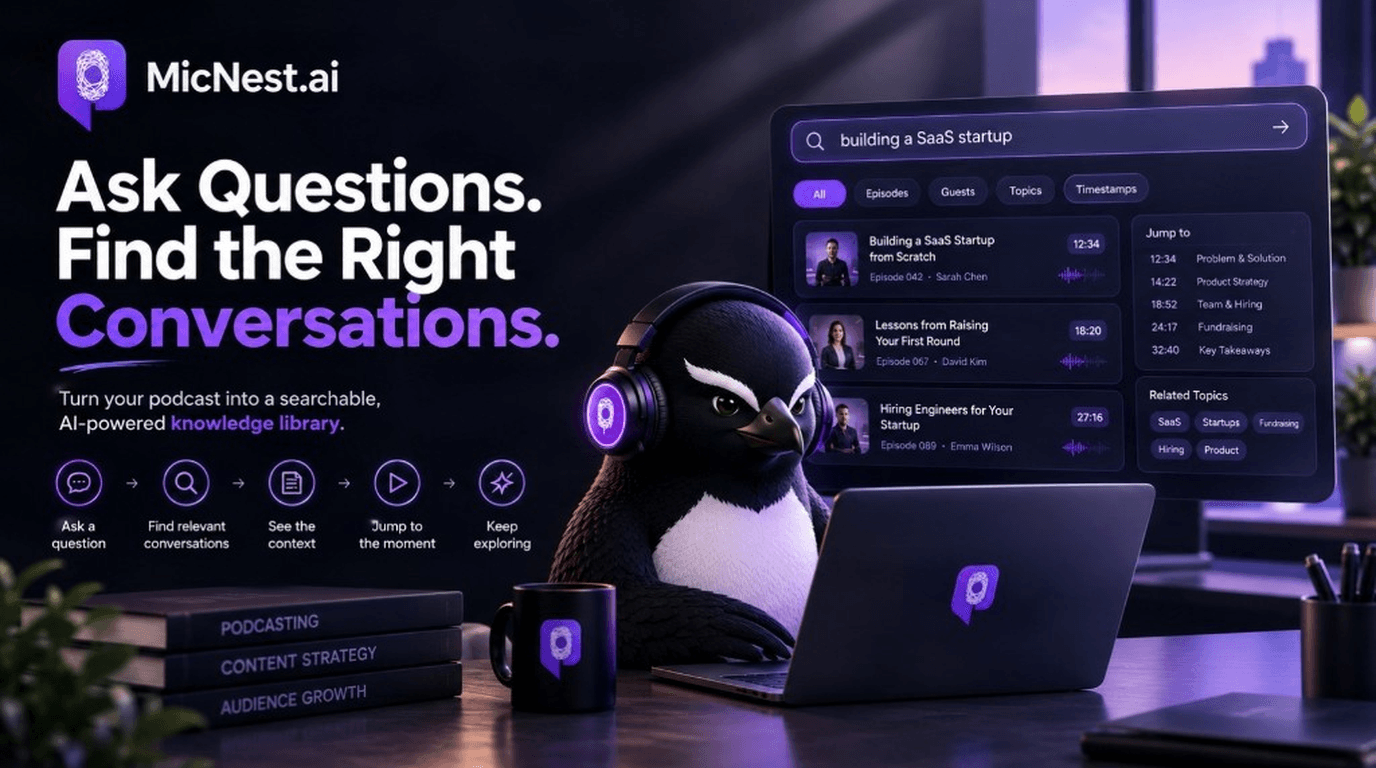
AI podcast search: AI podcast search (also called podcast AI search) uses artificial intelligence to help people discover information inside podcast conversations with natural language. Instead of matching only episode titles or exact keywords, it can retrieve relevant episodes and transcript moments based on meaning and intent.
In simple terms: AI podcast search (also called podcast AI search) uses artificial intelligence to help people discover information inside podcast conversations with natural language. Instead of matching only episode titles or exact keywords, it can retrieve relevant episodes and transcript moments based on meaning and intent.
Quick Answer
It turns your archive into something people can query: ask a question, retrieve relevant episodes and sections from podcast transcripts, then jump to the audio. Pair it with strong
It turns your archive into something people can query: ask a question, retrieve relevant episodes and sections from podcast transcripts, then jump to the audio. Pair it with strong episode pages, topics, guests, and podcast SEO — AI search explores the site after people arrive.
MicNest helps podcasters turn archives into AI podcast search — transcripts, topics, guests, relevant moments, and connected discovery. Start at https://app.micnest.ai/auth/signup.
Key Takeaways
- ➔ Podcast AI search helps people find answers inside episodes — not only episode titles.
- ➔ Chronological archives fail when visitors remember an idea, not a number.
- ➔ Podcast transcripts are the foundation; search makes them navigable.
- ➔ Best results: question → relevant content → episode → specific moment.
- ➔ AI search and podcast SEO work together; one doesn't replace the other.
- ➔ Keep browse navigation — not everyone wants to ask a question.
- ➔ MicNest connects conversations into searchable discovery, not a generic chatbot.
Imagine 300 episodes — hundreds of hours covering AI, startups, marketing, leadership, hiring, and fundraising. You remember an idea, not the episode number. Traditional archives make you scroll. AI podcast search — and podcast AI search more broadly — lets you ask a question, find relevant conversations, and jump to the moment.
That's the shift: from find an episode to find the answer inside an episode — a deeper layer on top of a searchable podcast archive and a growth-focused podcast website.
What Is AI Podcast Search?
AI podcast search helps people discover information inside podcast conversations using natural language.
Traditional podcast search might look for the word "AI" in titles or descriptions.
An AI-powered experience can go further. Someone asks: "Which guests talked about using AI to automate customer support?" The system can use titles, descriptions, transcripts, topics, guest information, semantic meaning, and previously indexed conversations to surface relevant content.
The experience changes from finding a listing to finding the answer inside a conversation.
Why Traditional Podcast Search Has Limitations
Most podcast archives are chronological: Episode 100, 99, 98…
That works when someone knows what they want. It fails when they only remember: "There was an episode where a founder explained how they got their first 100 customers."
Maybe it was Episode 41. Or 72. Or 103. The listener shouldn't have to guess. The knowledge is already inside your show — the challenge is making it accessible.
Podcasts Contain More Information Than Their Titles Reveal
A one-hour interview titled "Building a Startup From Zero With Sarah Khan" might cover hiring, fundraising, product-market fit, pricing, marketing, AI, and leadership.
Someone interested in pricing may never search that title. They're looking for: "How should an early-stage startup price its product?"
The useful information exists. The title alone doesn't expose all of it. Podcast AI search adds another discovery layer.
From Keyword Search to Question Search
Traditional search starts with keywords: "startup pricing."
An AI-powered experience allows natural questions:
- "What did your guests say about pricing an early-stage SaaS product?"
- "Show me conversations about finding the right price before product-market fit."
The system isn't only looking for identical words. It can interpret meaning and intent — especially useful for conversational content, where people remember ideas more than exact phrasing.
How AI Podcast Search Can Work
A simplified system looks like this:
Podcast feed → episodes → transcripts → content processing → topics, entities, metadata → embeddings / search index → user question → relevant retrieval → episode + relevant moment
The transcript provides the underlying conversation. The search layer makes it discoverable. AI helps interpret the question and retrieve relevant sections.
Transcripts Are the Foundation
AI search needs information to search. For podcasts, podcast transcripts provide much of that material.
Episode 82 contains: "When we hired our first engineer, we didn't start by posting a job listing…"
A visitor asks: "How did they hire their first engineer?"
A search system can identify that section as relevant. Transcripts turn audio into text; AI podcast search makes the text easier to navigate.
Search for the Answer, Not Just the Episode
Traditional discovery: Search → Episode
AI-powered discovery: Question → Relevant content → Episode → Specific moment
Question
> "What advice did guests give about hiring remote developers?"
Results
- Episode 47 — Building Remote Teams · moment 32:14
- Episode 81 — Hiring Your First Engineering Team · moment 18:42
- Episode 109 — Scaling a Distributed Company · moment 41:07
Now the visitor chooses which conversation to explore.
Jump Directly to the Relevant Moment
Finding the right episode helps. Finding the right moment helps more.
Ask: "What did they say about raising their first $1M?" Result: Episode 63 · 27:18 — jump straight into the audio instead of scrubbing an hour-long file.
That creates a better relationship between website podcast search and the actual show.
AI Search Can Make Long Episodes Easier to Explore
Long-form episodes are valuable — and hard to navigate. A 90-minute interview may hold dozens of useful sections.
Instead of "listen to the whole thing and see what you find," the experience becomes "tell us what you're looking for." That's a meaningful change for large archives and a practical form of podcast discoverability.
Search Your Entire Podcast, Not Just One Episode
The opportunity grows when search works across the full library.
Ask: "Which episodes discuss AI agents?" across 500 episodes and get Episode 21, 48, 77, 112, 194 — then explore. Your entire podcast archive becomes one searchable knowledge system.
AI Podcast Search Can Surface Connections
Someone reading about building a SaaS company can see related topics (product-market fit, customer acquisition, hiring, pricing), related episodes, and related podcast guests.
Search becomes exploration. One answer can lead to several connected conversations — the same idea behind strong episode pages.
Your Podcast Becomes a Knowledge Graph
Think of the show as a network:
Podcast → Episodes · Guests · Topics → Transcripts · Profiles · Collections → Questions → Answers
Every episode, guest, and topic adds connections. Over time, the archive becomes a structured body of knowledge — not only a chronological list.
Why This Matters for Podcast Discovery
Most people don't wake up wanting "a new podcast." They start with a problem, question, topic, person, or idea:
> "How do founders know when they have product-market fit?"
If your site surfaces that conversation, the visitor may arrive for the answer, discover the show, discover the guest, explore related episodes, then subscribe. That's a different model from competing only inside directories — and it supports how to grow a podcast beyond download counts alone.
AI Search and Podcast SEO Work Together
AI search doesn't replace podcast SEO. They solve different parts of discovery.
Search engines can help people discover your podcast, episode pages, articles, topics, guests, and questions.
AI search can help visitors explore your archive, transcripts, conversations, moments, related topics, and answers.
Together: Search engine → Website → AI search → Conversation
For the broader SEO layer, see our Podcast SEO Guide. Strong seo for podcasts still needs useful pages and links; on-site podcast AI search helps once people arrive.
Don't Use AI Search as a Replacement for Navigation
Visitors still need clear structure: episodes, topics, guests, articles, about, newsletter, and classic search.
Not everyone wants to ask a question. Some people want to browse.
Browse when you want to explore. Search when you know what you're looking for.
What Makes a Good AI Podcast Search Experience?
A useful experience should be:
- Fast — people shouldn't wait unnecessarily.
- Relevant — results should match the question.
- Transparent — show which episode and section produced the result.
- Navigable — move from result into the original conversation.
- Contextual — give enough snippet to understand why it matters.
- Connected — lead to related episodes, topics, guests, and content.
The objective isn't only to generate an AI answer. It's to help people discover your actual content.
AI Answers Should Point Back to the Conversation
If someone asks what guests said about startup fundraising, the system shouldn't end with a generic AI response.
Better flow:
Question → AI-assisted summary → Relevant episodes → Transcript sections → Jump to audio
AI becomes the navigation layer. The podcast stays at the center.
Accuracy Matters
Podcast content requires care. A system shouldn't confidently attribute something to a guest if the transcript doesn't support it.
For important results, show episode, guest, timestamp, and the relevant transcript section — so listeners can verify the original conversation.
What Happens as Your Podcast Gets Bigger?
10 episodes can be browsed. 100 is harder. 500+ makes chronological scrolling painful — while the knowledge inside becomes more valuable.
More episodes → More knowledge → More connections → More to discover
Podcast AI search helps that growing archive stay navigable.
The Podcast Becomes an Answer Engine
A traditional site says: "Here are our episodes."
A more advanced experience asks: "What do you want to learn?"
Visitors don't need the title, guest, or publish date. They describe what they're looking for — and the knowledge base helps them start. That pairs well with content repurposing and structured podcast show notes that summarize without replacing full search.
Practical Example
A business podcast with 200 episodes. Someone asks:
> "I'm starting a SaaS company. Which episodes should I listen to about getting the first customers?"
Results might include:
- Episode 31 — Finding Your First 10 Customers · 14:20
- Episode 68 — From Idea to First Revenue · 26:12
- Episode 94 — What Founders Get Wrong About Customer Acquisition · 09:48
A personalized path through the archive — without knowing where to start. That's also podcast marketing that compounds as the library grows.
How MicNest Approaches AI Podcast Search
The goal isn't simply to bolt a chatbot onto a podcast website. The goal is to make the podcast itself searchable.
Episodes provide conversations. Transcripts provide text. Topics and guests provide structure. Search connects questions to relevant content. The original episode remains what people listen to.
Podcast → Knowledge → Search → Discovery
Instead of treating every episode as isolated media, MicNest helps connect conversations into a larger content system.
From Episode Archive to Interactive Knowledge Library
Traditional archive
> Here are 200 episodes.
Interactive knowledge library
> Ask us what you're looking for.
The second doesn't replace the first — it builds another layer on top. Episodes, guests, and transcripts remain. People gain another way to navigate everything you've created.
The Bigger Opportunity
Podcasters invest research, prep, guests, editing, publishing, and promotion. Inside the recording is accumulated knowledge.
Instead of only asking "How can we create more content?" also ask: "How can we make what we've already created easier to discover?"
That's the opportunity — especially for a back catalog that still holds useful answers.
Final Thoughts
Your podcast doesn't have to be experienced only one episode at a time. It can become a connected library of conversations.
Ask → Discover → Listen → Explore → Learn → Return
That's what makes AI podcast search interesting — not because AI can talk about your podcast, but because it can help people find what's already inside it.
Your podcast already contains the knowledge.
Make it searchable.
Frequently Asked Questions
What is an AI podcast search engine?
An AI podcast search engine helps users find relevant podcast episodes or sections by asking questions in natural language instead of relying only on episode titles or exact keywords.
How does AI search work with podcast transcripts?
The transcript provides text from the conversation. A search system can index that information and retrieve sections relevant to a user's query.
Can AI podcast search find specific moments?
Yes. When transcript sections are associated with timestamps, results can point users to relevant moments in an episode.
Is AI podcast search the same as a podcast chatbot?
Not necessarily. A chatbot focuses on conversation with the user. AI podcast search focuses on helping users find and navigate information contained in the podcast.
Does AI search replace podcast SEO?
No. SEO and AI search serve different purposes. SEO helps people discover your website from search engines; AI search helps visitors explore your podcast once they're there.
Is AI podcast search useful for old episodes?
It can be especially useful for large archives because users can search older conversations without knowing the episode number or publication date.
Your Podcast Already Has the Answers
Every episode adds another conversation. Every conversation contains questions, ideas, stories, and answers.
MicNest is building toward a podcast experience where people don't just browse your episodes — they can search the knowledge inside them.
Related Reading
Before vs after
Before
- — Visitors scroll a chronological archive guessing episode numbers
- — Useful ideas stay buried inside long interviews
- — Old episodes are hard to rediscover
After
- + Natural-language questions surface relevant episodes and moments
- + Results jump people into the original conversation
- + The archive behaves like a searchable knowledge library
Who is this for?
Podcasters
Creators who want visitors to find answers inside the archive, not just episode titles.
SEO & content teams
Teams pairing podcast SEO with on-site AI podcast search and transcripts.
Show producers
Teams connecting questions to moments, guests, topics, and related episodes.
Make your podcast searchable
AI podcast search helps people ask questions and find relevant episodes and moments. MicNest connects transcripts, topics, guests, and discovery around your archive.
Explore MicNest or start freeSources
- MicNest product — MicNest connects conversations into searchable discovery around transcripts, topics, guests, and moments.
Frequently Asked Questions
What is an AI podcast search engine? +
An AI podcast search engine helps users find relevant podcast episodes or sections by asking questions in natural language instead of relying only on episode titles or exact keywords.
How does AI search work with podcast transcripts? +
The transcript provides text from the conversation. A search system can index that information and retrieve sections relevant to a user's query.
Can AI podcast search find specific moments? +
Yes. When transcript sections are associated with timestamps, results can point users to relevant moments in an episode.
Is AI podcast search the same as a podcast chatbot? +
Not necessarily. A chatbot focuses on conversation with the user. AI podcast search focuses on helping users find and navigate information contained in the podcast.
Does AI search replace podcast SEO? +
No. SEO and AI search serve different purposes. SEO helps people discover your website from search engines; AI search helps visitors explore your podcast once they're there.
Is AI podcast search useful for old episodes? +
It can be especially useful for large archives because users can search older conversations without knowing the episode number or publication date.

