
Definition
podcast publishing workflow: A podcast publishing workflow is the sequence of steps that turns a finished audio file into a discoverable episode — upload, titles, descriptions, tags, categories, chapters, guest details, artwork, and publish — ideally by extracting that structure from the conversation instead of filling blank fields from scratch every time.
In simple terms: A podcast publishing workflow is the sequence of steps that turns a finished audio file into a discoverable episode — upload, titles, descriptions, tags, categories, chapters, guest details, artwork, and publish — ideally by extracting that structure from the conversation instead of filling blank fields from scratch every time.
Quick Answer
Transcribe the episode, extract topics, guest details, chapter boundaries, and resources, then review drafts for title, description, tags, and chapters before you publish. Don't re
Transcribe the episode, extract topics, guest details, chapter boundaries, and resources, then review drafts for title, description, tags, and chapters before you publish. Don't recreate metadata the conversation already contains.
MicNest starts with the episode — transcript, topics, chapters, guest info, and related content — so your podcast publishing workflow is extract → review → publish, not blank fields every week. Start at https://app.micnest.ai/auth/signup.
Key Takeaways
- ➔ Editing done ≠ episode published — admin starts after export.
- ➔ Small weekly tasks compound into days across a year of shows.
- ➔ Upload is only the first step of the podcast publishing process.
- ➔ The episode already holds most of its own metadata.
- ➔ Chapters and tags should come from the conversation, then human review.
- ➔ Consistency matters more as the catalog grows.
- ➔ Automate extraction; keep judgment on titles, claims, and guest representation.
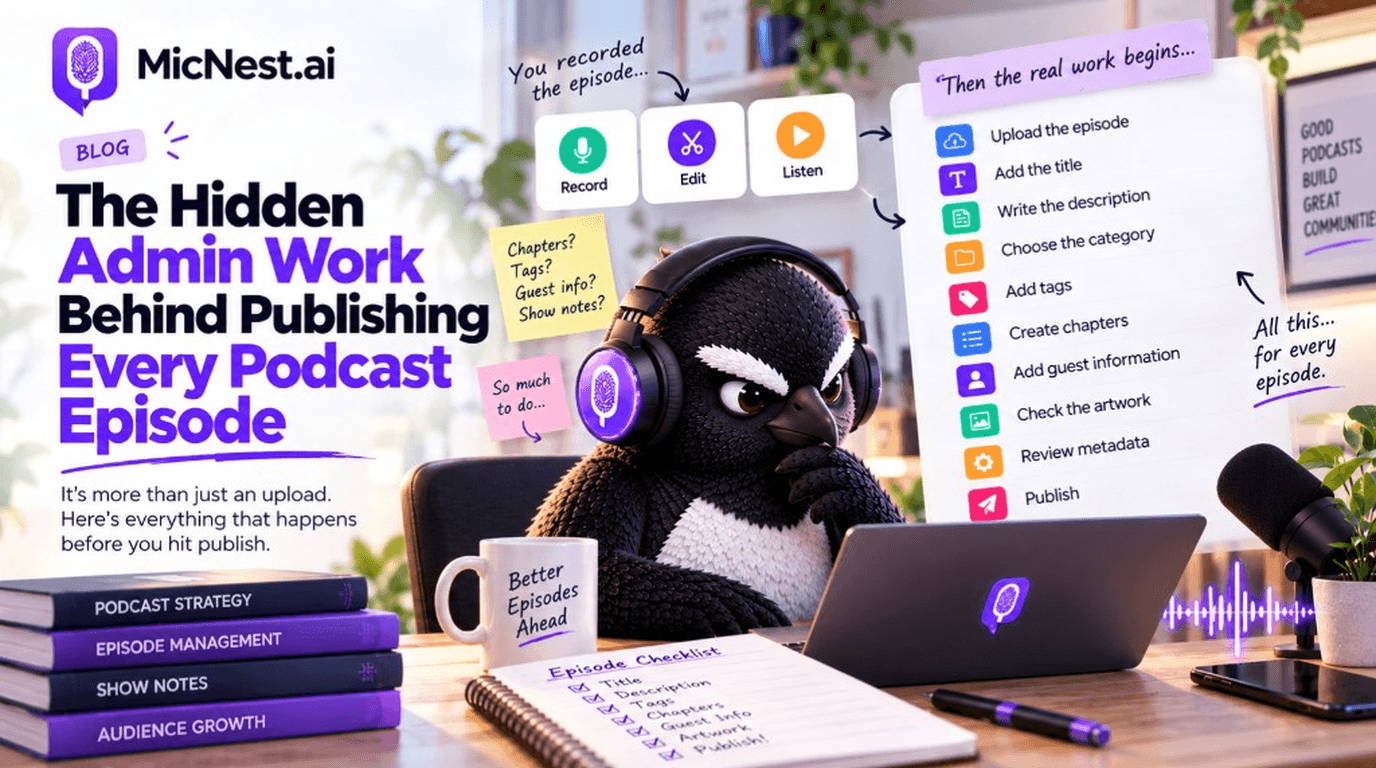
You recorded. Edited. Listened. You have the finished file. Then the administrative work begins: upload, title, description, category, tags, chapters, guest info, artwork, metadata review, publish.
None of that is hard alone. The problem is doing it every week. Creator discussions keep calling out upload, tagging, and chapter management as recurring overhead. Publishing isn't one task — it's a pile of small ones. Sometimes creating the episode feels easier than shipping it. That's what a real podcast publishing workflow has to fix.
The Episode Isn't Finished When Editing Is Finished
It's easy to think: record → edit → publish.
The real path often looks like: record → edit → export → upload → metadata → tags → chapters → description → artwork → website → newsletter → publish.
Every step is another decision. One episode might take a few minutes to prep. Do that 50, 100, 200 times and the cumulative load is the problem — not any single checkbox.
What Counts as Podcast Publishing Admin?
Episode information: title, number, description, publish date, season.
Organization: categories, tags, topics, guest information.
Navigation: chapters, timestamps, key sections.
Supporting content: show notes, links, resources, transcript, guest bio.
Distribution: uploading audio, checking artwork, reviewing metadata, publishing.
Each piece helps the listener. Manually filling every field every week gets repetitive — especially around podcast upload, tags, and chapters.
Why Small Tasks Become a Big Problem
Twenty minutes of prep per episode sounds fine. Four episodes a month → ~80 minutes. Fifty episodes → 16+ hours. A hundred → 33+. Exact minutes vary. The pattern doesn't: admin compounds.
Those hours could go to better interviews, guest research, audience work, strategy, or improving the show. Same theme as marketing becoming a second job.
Uploading Is Only the First Step
Once the file is up you still need a clear title, topics, tags, chapters, guest, resources, related episodes. Those aren't arbitrary. The episode already contains most answers. The challenge is extracting them efficiently — how to publish a podcast without another research project for every field.
Your Episode Already Contains Its Own Metadata
Host introduces the guest. Guest explains who they are. Topics shift. Questions land. Moments hit at specific times. Tools, companies, books get named. Subjects change.
So the problem usually isn't "where do we get this information?" It's "how do we turn what's already inside the episode into structured publishing data?"
Chapters Should Come From the Conversation
A 60-minute episode might hold five natural sections. You can scrub by ear — or read structure from the transcript: intro, building the company, first challenge, hiring, lessons from failure.
The chapter data wasn't invented after recording. It was already there.
Tags Should Describe the Episode, Not Become Research
Tags help organize a catalog. Deciding them from a blank field every week doesn't.
If your show covers startups, marketing, AI, leadership, entrepreneurship, an episode may touch several. Let the system suggest topics from the talk; you review. Better: conversation → suggested topics → human review → published metadata. Worse: conversation → blank tag field → start thinking. Keep a consistent podcast category vocabulary so "AI" and "Artificial Intelligence" don't fragment the library.
Organization Matters More as You Grow
At 10 episodes, structure feels optional. At 100, useful. At 500, essential.
You want to know which episodes discuss a topic, feature a guest, share a category, relate to each other, or should be recommended next. Tags and metadata build those links — only if they're consistent. Same idea behind a connected back catalog and episode pages.
Consistency Is Another Hidden Challenge
One episode tagged AI / Artificial Intelligence / Machine Learning. Another AI / ML. Another only Artificial Intelligence. Another none. Similar ideas, different labels. Scale makes that harder to manage.
A publishing system should help keep naming consistent. Goal isn't maximum tags. Goal is structure that stays understandable as the show grows.
Don't Let Metadata Outrank the Content
Metadata supports the content. It shouldn't delay publish forever while you polish every title, tag, category, chapter, and description.
Aim for useful and accurate, not endless optimization. Reduce admin burden; keep human review where it matters.
The Better Model: Extract, Don't Recreate
- Record — create the conversation.
- Transcribe — searchable text.
- Understand — topics, people, moments, resources, sections.
- Structure — turn findings into metadata.
- Review — you check.
- Publish — approved info across the episode and supporting content.
You're mostly reviewing extracted information, not inventing metadata. That's content automation applied to publish admin.
One Episode Can Power More Than One Destination
Metadata shouldn't live only in the player. Same info can feed your website, episode page, search, newsletter, guest pages, related recommendations, blog content, discovery.
Topics connect episodes. Guest info powers a profile. Transcript makes the talk searchable. Chapters make it navigable. Description explains it to new visitors. One conversation becomes a connected asset.
How MicNest Fits
MicNest treats an episode as more than an audio file: dedicated pages, transcripts, searchable conversations, SEO content, guest information, topic connections, newsletter content.
The workflow starts with the episode, not blank fields. Conversation is the source. Information is extracted and organized. You review. Then it supports multiple parts of the platform.
A Practical Publishing Checklist
Episode: clear title? correct audio? correct artwork? accurate publish info?
Metadata: accurate description? relevant topics? consistent tags? guest identified?
Chapters: major sections represented? accurate timestamps? useful names?
Content: resources linked? transcript available? related episodes connected?
Final review: names checked? links tested? does it represent the conversation?
Then publish.
What to Automate vs Keep Human
Automate well: transcription, topic extraction, chapter suggestions, metadata drafts, guest info extraction, related episode suggestions, formatting.
Keep human: final title, important claims, guest representation, sensitive material, final description, editorial judgment.
Automation handles repetition. Creators handle judgment.
The Real Goal Is a Smaller Publishing Burden
You don't need another system that adds admin. You need the opposite — lighter work as the show grows. Episode 10 and episode 100 shouldn't feel like different processes. The catalog should get more organized, not more chaotic. Each new conversation should make the whole system more useful.
Frequently Asked Questions
What is a podcast publishing workflow?
The steps from a finished audio file to a live episode: upload, title, description, tags, categories, chapters, guest details, artwork, and publish — ideally with structure pulled from the conversation.
Why does podcast publishing take so long?
Because it's many small tasks every week. Upload is only one piece; metadata, chapters, and supporting content add up.
How can I create podcast chapters faster?
Use the transcript to spot topic shifts and draft chapter names and timestamps, then review by ear for accuracy.
Should every podcast episode have tags?
Useful when they stay consistent. Prefer a controlled vocabulary over inventing new labels every week.
What should be automated in podcast publishing?
Transcription, topic and chapter suggestions, metadata drafts, and related-episode ideas. Keep humans on final title, accuracy, and guest representation.
How does MicNest help with publishing admin?
MicNest turns the episode into structured content — pages, transcripts, topics, guests, chapters, and drafts — so you review extracted information instead of starting from blank fields.
Your Podcast Should Organize Itself Around the Conversation
The most important piece is what you already made: the conversation. Everything else should support it.
Topics, guest, moments, chapters, ideas, the information needed to describe the episode — it's all there. Build a workflow that extracts, structures, and reuses it instead of rebuilding after every recording.
Record → Understand → Structure → Review → Publish
Less repetitive administration. More consistent organization. More time for the work that makes the show worth listening to.
Your episode already knows what it's about. Your publishing workflow should be able to use that.
Related Reading
Before vs after
Before
- — Upload then fill blank fields for title, tags, chapters, guest
- — Admin minutes compound into days across a year of episodes
- — Inconsistent tags make the catalog harder to navigate
After
- + Conversation → extract → review → publish
- + Chapters and topics suggested from the transcript
- + Same metadata powers pages, search, and recommendations
Who is this for?
Solo podcasters
Creators whose weekly admin after editing eats more time than the record itself.
Production teams
Teams standardizing upload, tags, chapters, and metadata across many episodes.
Catalog owners
Shows with 50–500+ episodes that need consistent organization.
Your episode already knows what it's about
Publishing admin compounds week after week. Extract structure from the conversation, review it, then publish — so the catalog gets more organized as it grows, not more chaotic.
Explore MicNest or start freeSources
- MicNest product — MicNest turns episodes into structured pages, transcripts, topics, and drafts so publishing admin starts from the conversation.
Frequently Asked Questions
What is a podcast publishing workflow? +
The steps from a finished audio file to a live episode: upload, title, description, tags, categories, chapters, guest details, artwork, and publish — ideally with structure pulled from the conversation.
Why does podcast publishing take so long? +
Because it's many small tasks every week. Upload is only one piece; metadata, chapters, and supporting content add up.
How can I create podcast chapters faster? +
Use the transcript to spot topic shifts and draft chapter names and timestamps, then review by ear for accuracy.
Should every podcast episode have tags? +
Useful when they stay consistent. Prefer a controlled vocabulary over inventing new labels every week.
What should be automated in podcast publishing? +
Transcription, topic and chapter suggestions, metadata drafts, and related-episode ideas. Keep humans on final title, accuracy, and guest representation.
How does MicNest help with publishing admin? +
MicNest turns the episode into structured content — pages, transcripts, topics, guests, chapters, and drafts — so you review extracted information instead of starting from blank fields.

