
Definition
podcast episode titles: Podcast episode titles are the short headlines that name each episode. Learning how to title a podcast episode means naming it for the listener's outcome and topic — not the recording session — so people, search, and your catalog can understand what the conversation offers.
In simple terms: Podcast episode titles are the short headlines that name each episode. Learning how to title a podcast episode means naming it for the listener's outcome and topic — not the recording session — so people, search, and your catalog can understand what the conversation offers.
Quick Answer
Find the main idea, the audience, and the value. Draft a few options using clear formulas. Pick the clearest accurate title, then support it with an episode page, show notes, and t
Find the main idea, the audience, and the value. Draft a few options using clear formulas. Pick the clearest accurate title, then support it with an episode page, show notes, and transcript.
MicNest turns episodes into structured site content — episode pages, transcripts, show notes, and searchable conversations — so a clear title can lead into a page people can find and explore. Start at https://app.micnest.ai/auth/signup.
Key Takeaways
- ➔ Titles should explain listener value, not the recording experience.
- ➔ Identify one main idea before writing the title.
- ➔ Use audience language — not only internal jargon.
- ➔ Reusable formulas speed up consistent podcast titles.
- ➔ Specific beats vague; too long hides the point.
- ➔ Avoid clickbait the episode can't deliver.
- ➔ Pair titles with episode pages, show notes, and transcripts.
You spend hours preparing for an episode.
You research the topic, invite a guest, record, edit, and publish.
Then you give it a title like: *Episode 42: An Interesting Conversation With John*.
A potential listener sees that and has no idea what they'll learn, what problem it addresses, or why they should spend 45 minutes listening.
The problem might not be the episode. It might be how you're presenting it.
Your title is often the first explanation of why the conversation matters. A vague title makes people work to understand the value. A clear one does that work for them.
This guide covers how to title a podcast episode so titles communicate value, support discoverability, and help the right listeners decide what to play.
Why Podcast Episode Titles Matter
A title helps people understand the subject, gives search engines context, distinguishes episodes, and sets expectations before play.
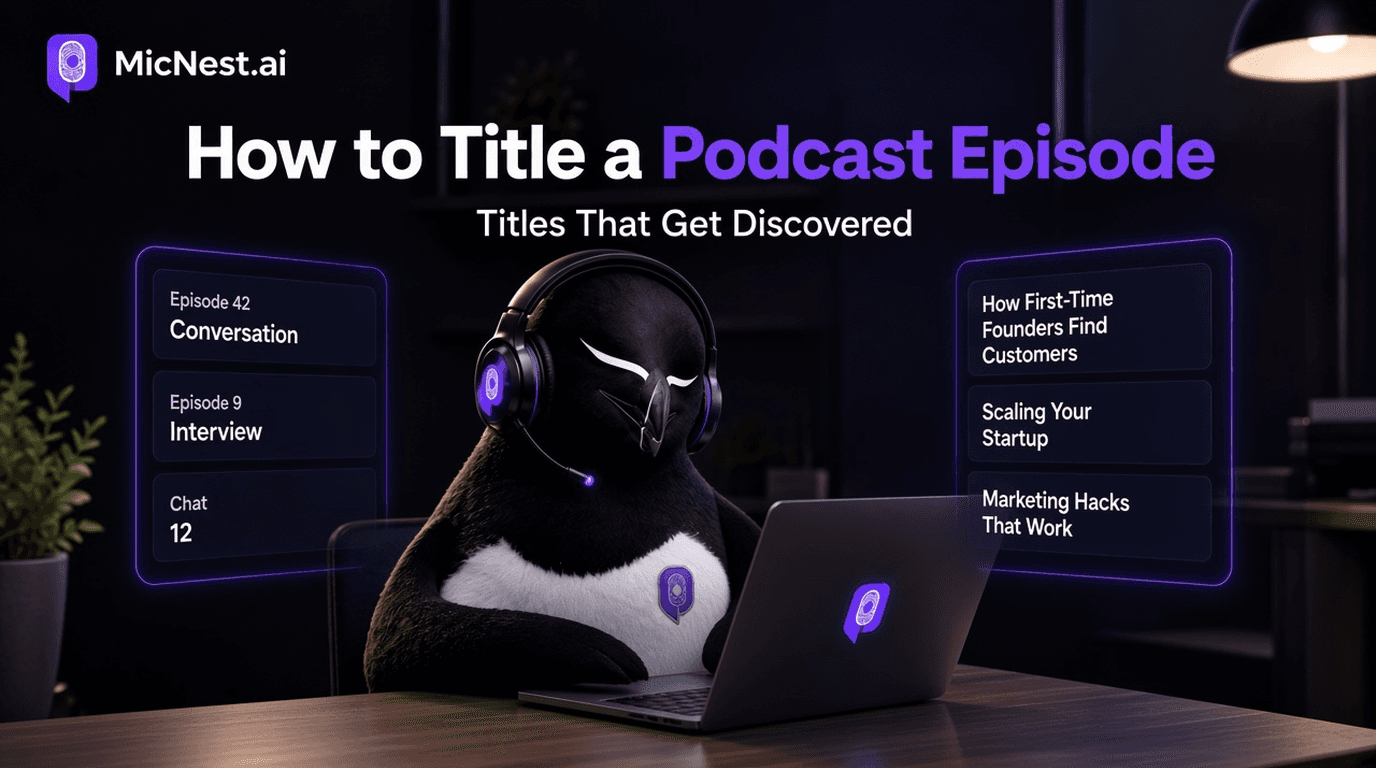
| Vague title | Clearer title |
|---|---|
| Episode 42: The Conversation | How First-Time Founders Find Their First Customers |
| Our Chat With Sarah | How Sarah Built a Business Without Outside Funding |
| Thoughts on Productivity | How to Plan Your Week When You're Overwhelmed |
| A Special Guest Episode | What Independent Creators Need to Know About Pricing |
| Lessons From Experience | Five Hiring Mistakes First-Time Managers Make |
Clearer versions aren't guaranteed more clicks — audience, topic, competition, thumbnail, and distribution still matter. They do remove one obstacle: uncertainty.
Stop Naming Episodes After the Recording Session
Easy mistakes look like: *Chatting With a Founder*, *Catching Up With an Old Friend*, *A Great Conversation About Business*, *Our Latest Interview*, *Another Episode With Mike*.
Those describe the recording. They don't explain the value.
Listeners weren't in the room. Instead of "what happened?", ask: what would make someone want to listen?
Maybe it's how a founder got their first 100 customers, why a business failed, or how someone runs a remote team. That is the podcast headline material.
Find the Main Idea Before Writing the Title
One interview can cover childhood, career, mistakes, routines, and plans. Stuffing all of that into a title creates confusion.
After recording, ask:
- What's the most useful insight?
- What question does the episode answer?
- What problem does it help people understand?
- What makes it different from similar episodes?
- What would a listener tell a friend?
If fundraising, hiring, and acquisition all appear — but the best insight is acquiring the first 100 paying customers — lead with that. A strong title doesn't summarize everything. It communicates the best reason to listen.
Use the Language Your Audience Actually Uses
Creators often write industry jargon. Listeners search simpler phrases.
*Developing a Multichannel Audience Acquisition Framework* vs *How to get more customers from social media*.
You don't need every title to be a literal query. You do need the language your audience uses for its problems: guest FAQs, listener emails, comments, search queries, industry misconceptions, and discussions that stick.
That connection is part of practical podcast SEO and discoverability.
Five Podcast Episode Title Formulas
1. Problem and solution
How to [achieve outcome] without [common obstacle]
- How to Grow a Newsletter Without Posting Every Day
- How to Hire Your First Employee Without Overcomplicating the Process
- How to Prepare for Podcast Interviews Without Spending All Week Researching
2. The question your audience asks
- How Much Should You Charge for Your First Freelance Project?
- Why Do Podcast Clips Get Views but Not Listeners?
- When Should a Founder Hire Their First Salesperson?
3. Lesson from experience
- What a Founder Learned From Losing Their Biggest Customer
- What 100 Podcast Episodes Taught Us About Interviewing
- What Happens When a Small Business Stops Chasing Every Trend
4. Mistakes to avoid
- Five Pricing Mistakes That Hurt New Freelancers
- Seven Interview Questions That Lead to Better Conversations
- Three Website Mistakes That Make Your Business Harder to Trust
Use numbers only when the episode supports the list.
5. Surprising insight
- Why More Website Traffic Doesn't Always Mean More Customers
- Why Experienced Founders Sometimes Make Worse Hiring Decisions
- Why Publishing More Podcast Episodes Doesn't Guarantee Growth
These are starting points. The best title accurately represents the episode and makes its value clear.
Specific Without Too Long
Too vague: Business Lessons
Too detailed: Our Conversation With an Entrepreneur About the Many Different Challenges They Faced While Starting, Funding, Managing, and Growing Their Business Over Several Years
Focused: How One Founder Built a Business Through Three Difficult Growth Stages
There's no universal ideal length. Communicate the main idea, then cut words that don't help. Read it aloud — if you can't hear the point, simplify.
Should You Include Your Guest's Name?
Names help when the guest is known or central. Alone, they rarely explain why to listen.
*Interview With Sarah Mitchell* vs *How Sarah Mitchell Built a Remote Company With 20 Employees*
Or: *How to Build a Remote Team: Lessons From Sarah Mitchell*
Don't hide the guest. Give people a reason to care.
Avoid Clickbait the Episode Can't Deliver
*This One Trick Will Make Your Business Successful Overnight* creates expectations general advice can't meet.
Better: *Three Changes That Helped This Founder Improve Customer Retention*
Before publishing: Does the episode deliver? Is the claim supported? Would a listener feel misled? Clarity builds trust; exaggeration burns it.
Podcast SEO vs Good Titles
Keywords help when they describe the subject. They aren't a full SEO strategy.
*How Freelancers Can Price Their Services Without Undervaluing Their Work* is clear without stuffing "freelance pricing" three times.
Beyond the title, discoverability depends on a dedicated episode page, intro, show notes, transcript, internal links, guest/topic info, and a solid podcast website. See also the podcast SEO guide.
Don't Forget Your Back Catalog
New episodes get attention; older ones often stay as *Episode 18* or guest names without context.
Find episodes with generic titles, jokes, or buried topics. Identify the main idea. Example: *Episode 73: Talking About Growth* → *How Small Businesses Can Grow Without Increasing Overhead* — only if the episode supports it.
Preserve meaning. Check platform rules and redirects before changing page URLs. Start with high-value episodes; don't rename the whole archive in one night. Related: back catalog.
A Repeatable Episode Title Workflow
1. Main topic — one sentence about the conversation.
2. Audience — who benefits most.
3. Value — what they learn.
4. Draft three titles.
5. Compare — clear subject? accurate? relevant? specific reason to listen? distinct from past episodes?
6. Choose the strongest balance of clarity and interest.
7. Align description, intro, show notes, and transcript to the same central topic.
How to Know Whether Titles Are Working
Look at patterns, not one metric:
- Search impressions and clicks on episode pages
- CTR where platforms provide it
- Page visits vs plays after discovery
- Related social engagement
- Queries that bring people to your content
Few clicks on impressions → review title and presentation. Clicks but weak listening → title may overpromise (or the intro needs work). Compare similar episodes over comparable windows.
How MicNest Helps
A clear title is one step. The next is making the episode's ideas accessible beyond audio.
MicNest helps turn episodes into structured site content — episode pages, articles, transcripts, guest information, and searchable conversations — so people can discover what's inside, not only the feed listing.
A better title helps people recognize the conversation. A better content system helps them find everything in it.
Frequently Asked Questions
How do I write a good podcast episode title?
Identify the main idea, audience, and value. Draft a few options, then choose the clearest accurate title.
Should podcast episode titles include keywords?
Include relevant terms naturally when they describe the subject. Don't stuff keywords that don't match the conversation.
How long should a podcast episode title be?
No universal ideal. Long enough to communicate subject and value; short enough that the main idea stays obvious.
Should I put the guest's name in the title?
Yes when identity matters to your audience. For less familiar guests, expertise or topic often communicates more.
Should every episode follow the same title format?
No. Consistency helps workflow; forcing one formula can make titles repetitive. Fit the structure to the conversation.
Can I change titles of older podcast episodes?
Usually, depending on the platform. Keep titles accurate, check restrictions, and consider existing links before changing page URLs.
Do better podcast titles guarantee more downloads?
No. Clear titles help people understand and choose — content, audience, distribution, and competition still matter.
Final Takeaway
Your episodes hold ideas people haven't found yet. They shouldn't have to guess what an episode offers.
Before publishing: if someone knows nothing about this episode, does the title give them a clear reason to listen?
If not, rewrite it. You don't need clickbait or a full summary — you need a clear main idea and understandable value.
Your episode deserves a title that opens the door, not one people walk past.
Related reading
Before vs after
Before
- — Name episodes after the recording session or guest without context
- — Leave older episodes as Episode 18 or vague jokes
- — Stuff keywords without reflecting the conversation
After
- + Lead with the main idea and listener value
- + Use reusable title formulas and a repeatable workflow
- + Support titles with episode pages, show notes, and transcripts
Who is this for?
Growing hosts
Creators whose episodes are strong but titles leave listeners guessing.
SEO-minded producers
Teams connecting titles to episode pages, show notes, and transcripts.
Catalog owners
Shows updating vague back-catalog titles for discoverability.
Your episode deserves a title that opens the door
Clear podcast episode titles communicate the main idea and value without clickbait. Pair them with episode pages, show notes, and transcripts so discoverability goes beyond the feed.
Explore MicNest or start freeSources
- MicNest product — MicNest helps turn episodes into episode pages, transcripts, show notes, and searchable conversations.
Frequently Asked Questions
How do I write a good podcast episode title? +
Identify the main idea, audience, and value. Draft a few options, then choose the clearest accurate title.
Should podcast episode titles include keywords? +
Include relevant terms naturally when they describe the subject. Don't stuff keywords that don't match the conversation.
How long should a podcast episode title be? +
No universal ideal. Long enough to communicate subject and value; short enough that the main idea stays obvious.
Should I put the guest's name in the title? +
Yes when identity matters to your audience. For less familiar guests, expertise or topic often communicates more.
Should every episode follow the same title format? +
No. Consistency helps workflow; forcing one formula can make titles repetitive. Fit the structure to the conversation.
Can I change titles of older podcast episodes? +
Usually, depending on the platform. Keep titles accurate, check restrictions, and consider existing links before changing page URLs.
Do better podcast titles guarantee more downloads? +
No. Clear titles help people understand and choose — content, audience, distribution, and competition still matter.

