
Definition
podcast description: How to determine your podcast niche means choosing a clear listener, a clear problem or interest, and a distinctive angle or format so strangers can recognize the show and search engines can place it.
In simple terms: How to determine your podcast niche means choosing a clear listener, a clear problem or interest, and a distinctive angle or format so strangers can recognize the show and search engines can place it.
Quick Answer
Write one sentence for who, outcome, and angle. Validate that a real community exists. Confirm you can produce for a year. Then align name, description, and cover art, and test wit
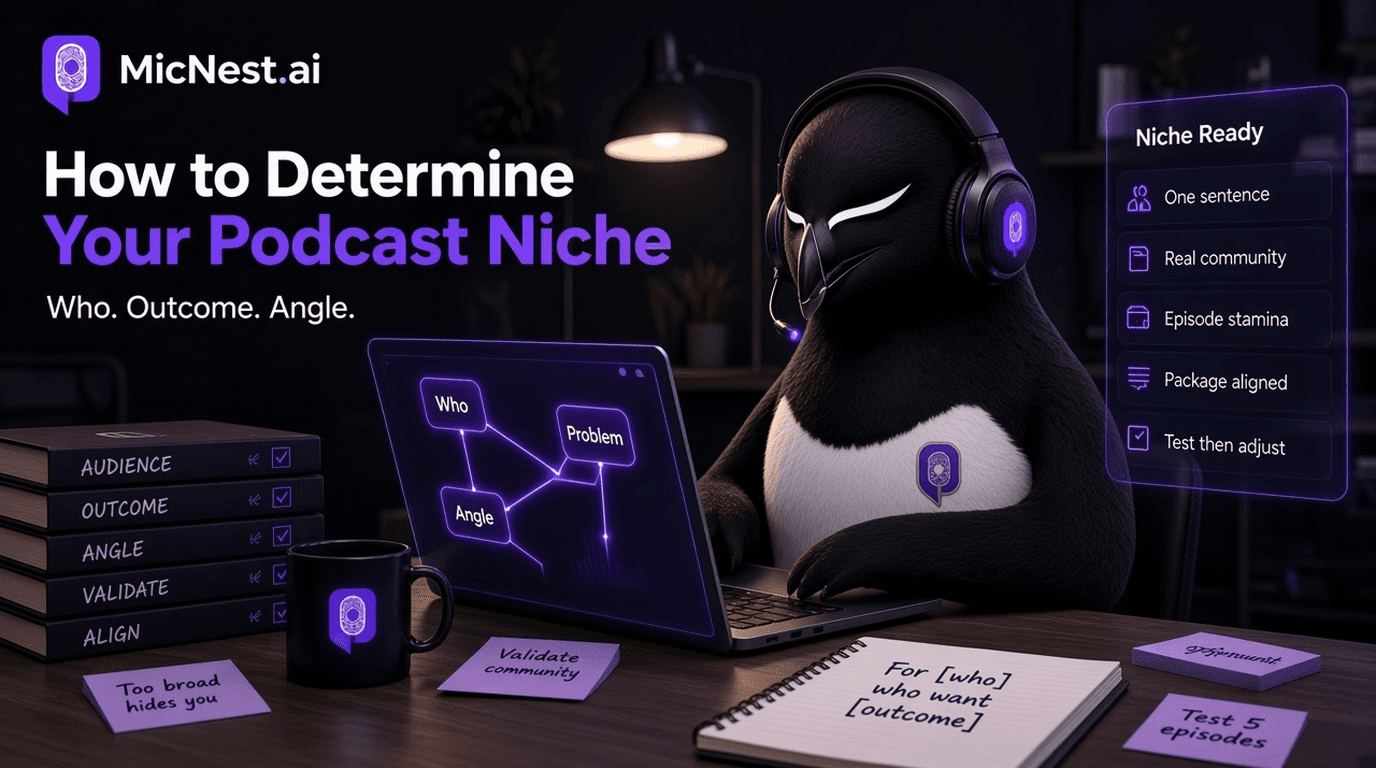
Write one sentence for who, outcome, and angle. Validate that a real community exists. Confirm you can produce for a year. Then align name, description, and cover art, and test with 5 to 10 episodes before a full rebrand.
MicNest turns clear show promises into searchable episode pages and a destination that matches your description. Start at https://app.micnest.ai/auth/signup.
Key Takeaways
- ➔ Niche is definition for discovery, not a lifelong cage.
- ➔ Start with who + problem + angle, not a random topic list.
- ➔ Validate that people and conversations already exist.
- ➔ Too broad hides you. Too narrow can starve you.
- ➔ Hobby niches and B2B niches play by different sponsor rules.
- ➔ Let early episode performance refine the lane.
- ➔ Align name, art, titles, and site with the same promise.
- ➔ You can widen later once a core audience trusts you.
Most people searching how to determine your podcast niche are stuck between two bad options. Go broad and disappear under "comedy podcast" and "business podcast." Niche so hard that only twelve people qualify, then wonder why growth feels dead.
Reddit keeps arguing both sides. Some hosts say start wide and let the audience filter itself. Others say specific shows get found, get guests, and convert better even with smaller numbers. Both can be true. The useful question is not "how tiny can I go." It is "who is this for, what do they need, and can I show up weekly with something they cannot get from a famous generalist."
This guide gives a simple test, a research loop, and a way to tighten or widen without rebranding every month.
1. What "Niche" Actually Means for a Podcast
Niche is not the Apple category alone. "Society & Culture" is a shelf, not a show.
A workable niche answers three questions:
- Who is the primary listener?
- What problem, curiosity, or identity do they bring?
- How is your show different in format, voice, or angle?
Example ladder (from wide to tight):
- Confidence → parents → first-time parents → first-time parents navigating interracial family dynamics
You do not have to live on the bottom rung forever. You do need a rung clear enough that someone can say, "that is for me," in one breath.
If you cannot explain the show without a five-minute apology, the niche is not done.
2. The One-Sentence Niche Test
Fill this in before you buy a mic upgrade:
> For [specific listener] who want [specific outcome or experience], [Show Name] delivers [format/angle] so they can [result].
Weak: "For anyone interested in business and life."
Stronger: "For solo SaaS founders who want practical hiring lessons from operators who already made the expensive mistakes."
Read it out loud. If it sounds like a LinkedIn bio written by a committee, cut until a human would subscribe.
This sentence becomes the spine for positioning, the show description, and how you pitch guests.
3. Research Before You Niche Into a Ghost Town
Niching with no market check is how people burn out.
Quick validation loop:
- Search the topic in Apple, Spotify, YouTube, and Google. Note the top shows and what they leave open.
- Find the community. Subreddits, Discords, Facebook groups, newsletters, local meetups. If nobody gathers there, distribution will be lonely.
- Listen for repeated questions. Those become episode titles.
- Count competitors honestly. Zero competitors can mean opportunity or mean no demand. Ten giants can mean room for a sharper angle.
- Check your stamina. Can you talk about this weekly for a year without faking enthusiasm?
Hobby niches can be wonderful and still hard to monetize with sponsors. B2B niches with buyers often convert with smaller download counts. Decide what "success" means before you chase a vanity lane.
4. How Narrow Is Too Narrow?
Use these checks:
| Signal | Too broad | About right | Too narrow |
|---|---|---|---|
| Description | "Everything about X" | Clear who + outcome | Needs three asterisks to qualify |
| Episode ideas | Infinite, random | 50+ with a theme | Stuck after episode 8 |
| Discovery | Generic keywords owned by celebrities | Searchable specific phrases | No one types the phrase |
| Guests | Anyone famous | Operators in the lane | Same three people forever |
If your niche requires a Venn diagram with five circles, widen one circle. Specific does not mean microscopic.
A useful Reddit framing: start niche enough to be found, then expand outward once you have engaged listeners who will follow you into adjacent topics.
5. Angle Beats Topic Alone
Two shows can share a topic and still not compete.
Angles that differentiate:
- Format: solo teaching, interview, narrative, live AMA, co-host debate
- Audience stage: beginners vs operators vs executives
- Tone: clinical, funny, blunt operator notes
- Constraint: "under 20 minutes," "one framework per episode," "only post-mortems"
Your niche is often topic + angle. "Marketing podcast" is mush. "Weekly post-mortems of failed B2B launches, 25 minutes, no fluff" is a niche.
6. Align the Package Once the Niche Is Clear
A niche that only lives in your head will not show up in search.
Update the public package to match:
- Name that carries meaning
- Description that states who and why
- Cover art that reads at thumbnail size
- Episode titles that sound like the niche, not random vibes
- Categories that are honest, not aspirational spam
If the art looks like a general chat show and the copy promises a narrow operator brief, strangers bounce. Same promise in every surface.
7. Test With Episodes, Then Adjust
You do not need a perfect niche on day one. You need a clear hypothesis.
Practical test plan:
- Publish 5–10 episodes inside the one-sentence niche.
- Watch which titles, guests, and segments get completion, replies, or follows.
- Double down on what worked. Cut what felt forced.
- Widen one notch only after the core is trusted.
A/B thinking helps: if comedy-plus-history beats pure comedy twice, lean that way. Let listeners vote with attention.
Avoid rebranding every three episodes. That trains nobody.
8. Common Mistakes
Niche as a synonym for "small forever." Specific now, expandable later.
Choosing a niche you will hate recording. Passion is fuel. Resentment shows on tape.
Copying a top show's niche with no angle. You inherit their competition without their distribution.
Ignoring whether buyers exist if sponsorships matter.
Writing for "everyone interested in growth." That is not a listener. That is a shrug.
Changing the niche in the description but not in the episodes. Packaging lies get found out fast.
9. A 45-Minute Niche Workshop
- List three audiences you already understand.
- For each, write the outcome they want.
- Draft the one-sentence niche for each.
- Cross out any sentence you cannot support for 20 episodes.
- Search the remaining niches for communities and competing shows.
- Pick one. Write five episode titles that only make sense inside that niche.
- Update name/description draft to match.
- Record episode one as a proof of the promise, not a tour of your biography.
10. How MicNest Fits
A niche helps people find the right show. Keeping them means the conversations stay findable after publish day: episode pages, searchable topics, and a site that matches the promise you locked.
MicNest helps turn that niche library into owned pages so the focus you chose keeps working in search, not only inside a feed row.
Frequently Asked Questions
How do I determine my podcast niche?
Define who it is for, what outcome they want, and your angle or format. Validate that a community exists, then align name, description, and episodes to that sentence.
Should my podcast niche be as narrow as possible?
No. Narrow enough to be findable and trusted. Wide enough that you can produce consistently and that real people gather around the topic.
Can I change my podcast niche later?
Yes. Refine with episode performance first. Save full rebrands for clear shifts, and mark big changes cleanly for returning listeners.
Is niche important if I am just doing this for fun?
Less so. If you care about discovery, guests, or revenue, a clear niche helps algorithms and humans understand who the show is for.
What if there are already big shows in my niche?
Look for a sharper audience stage, format, or angle. Competing on "general comedy" against celebrities is a different game than owning a specific lane.
How do I know if my niche is too broad?
If your description could fit fifty unrelated shows, and your episode ideas jump topics with no shared promise, tighten who and outcome.
Do niche podcasts get sponsors?
Some do, especially when listeners are buyers. Hobby niches may stay labor-of-love. Match monetization expectations to the audience type.
Should niche come before naming?
Yes. Name and art should label a promise you already chose. Naming first usually produces clever words with no clear audience.
Final Takeaway
Learning how to determine your podcast niche is less about shrinking forever and more about saying one clear sentence strangers can trust.
Who is it for. What do they want. How is your show different. Validate the community. Ship episodes that prove it. Adjust with evidence.
Specific gets you found. Consistency gets you believed. You can expand once people know what you stand for.
Related reading
Before vs after
Before
- - Lead with biography and adjectives
- - Stuff keywords at the bottom of the description
- - Reuse one vague blurb on every episode
After
- + Lead with audience and outcome in the first lines
- + Write specific episode descriptions with guest and topic
- + Keep description, name, and titles saying the same thing
Who is this for?
Hosts rewriting vague show bios
Creators whose feed copy does not match the show.
New shows before launch
Hosts writing the first show description and trailer package.
Episode publishers
Hosts who paste the same blurb under every episode.
Make the first lines earn the play
Write a show and episode description strangers can skim in seconds, then keep titles and pages aligned with the same promise.
Explore MicNest or start freeFrequently Asked Questions
How do I determine my podcast niche? +
Define who it is for, what outcome they want, and your angle or format. Validate that a community exists, then align name, description, and episodes to that sentence.
Should my podcast niche be as narrow as possible? +
No. Narrow enough to be findable and trusted. Wide enough that you can produce consistently and that real people gather around the topic.
Can I change my podcast niche later? +
Yes. Refine with episode performance first. Save full rebrands for clear shifts, and mark big changes cleanly for returning listeners.
Is niche important if I am just doing this for fun? +
Less so. If you care about discovery, guests, or revenue, a clear niche helps algorithms and humans understand who the show is for.
What if there are already big shows in my niche? +
Look for a sharper audience stage, format, or angle. Competing on a generic lane against celebrities is a different game than owning a specific promise.
How do I know if my niche is too broad? +
If your description could fit fifty unrelated shows, and your episode ideas jump topics with no shared promise, tighten who and outcome.
Do niche podcasts get sponsors? +
Some do, especially when listeners are buyers. Hobby niches may stay labor of love. Match monetization expectations to the audience type.
Should niche come before naming? +
Yes. Name and art should label a promise you already chose. Naming first usually produces clever words with no clear audience.

