
Definition
podcast topics: Podcast topics are the recurring subject areas your show covers. Clear positioning groups those topics under a few content pillars so listeners instantly understand who the show is for, what territory it owns, and where to start in the catalog.
In simple terms: Podcast topics are the recurring subject areas your show covers. Clear positioning groups those topics under a few content pillars so listeners instantly understand who the show is for, what territory it owns, and where to start in the catalog.
Quick Answer
Define who you serve and what outcome you help with. Group ideas under three to five content pillars. Check each episode against a pillar. Organize your podcast website and archive
Define who you serve and what outcome you help with. Group ideas under three to five content pillars. Check each episode against a pillar. Organize your podcast website and archive by topics, problems, and related conversations — not only by publish date.
MicNest helps make positioning visible across episode pages, topics, guests, related conversations, articles, and newsletter content — so listeners experience what your show covers, not only a one-line bio. Start at https://app.micnest.ai/auth/signup.
Key Takeaways
- ➔ Variety is fine when topics share an audience, problem, outcome, or perspective.
- ➔ Three to five content pillars give you a consistency check for new episodes.
- ➔ Clear positioning makes a large back catalog easier to navigate.
- ➔ A podcast website can turn topics into a content network, not a dump of episodes.
- ➔ Audience signals refine positioning over time — you don't need perfection on day one.
- ➔ Use the one-sentence test and the 10-second homepage test.
- ➔ MicNest can make positioning visible across topics, guests, and related content.
Someone lands on your show for the first time.
They see a long list of episodes. Guests from different worlds. Titles that jump from fundraising to hiring to product launches.
They hesitate.
Not because the episodes are bad — because they can't tell, in a few seconds, who the podcast is for and what they'll consistently get.
That hesitation is a positioning problem. And it often starts with how you choose podcast topics.
You can cover a wide range of subjects. You can still feel coherent. The difference is whether those topics share a world, a problem, an outcome, or a point of view — or whether each episode is a one-off.
Supporting Topics Can Still Belong Together
Supporting topics might look different on paper:
- Fundraising
- Hiring
- Product
- Sales
- Leadership
Those feel like separate lanes. They can still belong to the same world — for example, building and scaling a creator business, or running a startup with limited resources.
That shared world creates room for variety without making the podcast feel random. Listeners aren't asking for every episode to sound identical. They're asking for a reason the conversation belongs on *this* show.
Think in Content Pillars
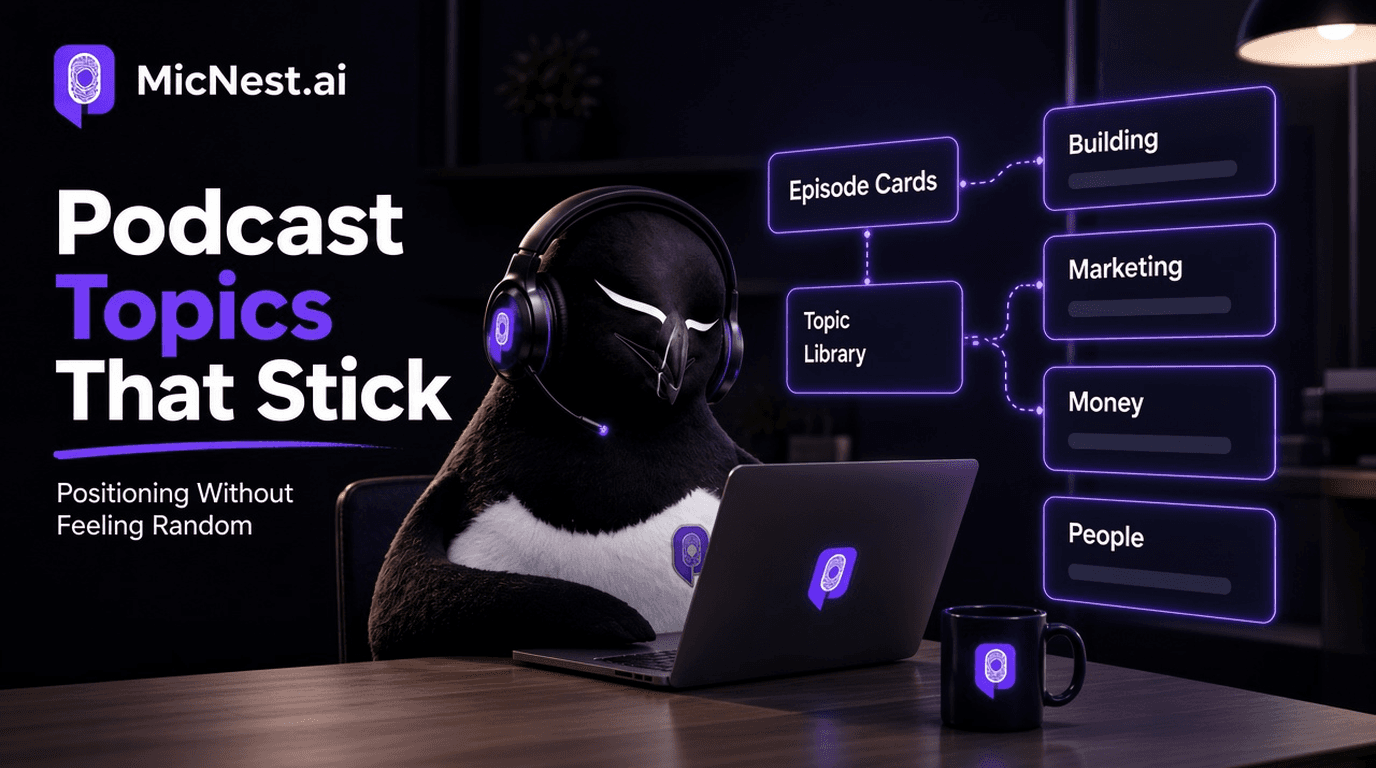
A useful framework is to define three to five content pillars.
For a creator-business podcast, that might look like:
Pillar 1: Building — products, businesses, and systems.
Pillar 2: Marketing — audience, positioning, and distribution.
Pillar 3: Money — pricing, revenue, and business models.
Pillar 4: People — hiring, leadership, and collaboration.
When you consider a potential episode, ask: which pillar does this belong to?
If an idea doesn't fit anywhere, that doesn't automatically mean you should reject it. It does give you a useful consistency check — the same way a solid podcast marketing strategy keeps promotion from becoming random noise.
Positioning Makes Your Back Catalog More Valuable
Clear positioning also helps your existing episodes.
Imagine someone discovers your podcast today. You have 150 episodes. Where should they start?
Without structure, the back catalog feels overwhelming. With clear positioning, you can organize the podcast archive around:
- Topics
- Problems
- Guests
- Beginner episodes
- Popular episodes
- Series
- Related conversations
A listener interested in startup fundraising shouldn't have to scroll through 150 episodes to find the three that matter. Topic structure is part of podcast SEO and discoverability — not only a branding nicety. See also make your podcast searchable and the searchable archive guide.
Turn Your Podcast Into a Clear Content Network
This is where a podcast website can do more than list episodes chronologically.
Organize content around the ideas inside the show:
Topic: Fundraising
→ Episode 12 → Episode 48 → Episode 91 → Episode 134 → Related article → Relevant guest
Now someone doesn't just see "150 episodes." They see a library organized around what they care about. That makes a broad catalog easier to navigate — and makes podcast branding something people experience as they click, not only a line in your bio.
Dedicated episode pages and guest pages strengthen those paths.
Use Your Audience to Refine Your Positioning
Positioning doesn't have to be perfect on day one. Your audience can show you what the podcast is becoming.
Pay attention to:
- Questions listeners repeatedly ask
- Episodes that attract the right audience
- Topics that generate meaningful discussion
- Search queries bringing people to your site
- Guests who resonate
- Episodes people recommend
- Content people return to
You may discover that listeners see your show differently than you originally imagined. That's useful. Adjust pillars and your podcast description to match what actually sticks.
Don't Confuse Variety With Lack of Positioning
A podcast can interview different people and discuss different subjects while still having a strong identity.
The common thread might be the audience, the problem, the outcome, or the host's perspective.
Example: a show interviews a CEO, a designer, a psychologist, and a researcher. Completely different guests. But if every conversation explores how people make better decisions under uncertainty, the podcast still has a recognizable identity.
The subject can change. The reason for the conversation stays consistent.
A Practical Podcast Positioning Test
Ask five people who know your podcast:
> In one sentence, what is this podcast about?
Don't help them. Don't explain. Just listen.
If their answers are roughly similar, that's a good sign.
If you hear "it's kind of about business…", "I think it's mostly interviews…", "they talk about lots of different things…", or "I'm not really sure…", your positioning — and how you frame podcast topics — may need work.
The 10-Second Test
Imagine someone lands on your podcast website. Give them ten seconds. Can they answer:
- Who is this for?
- What is it about?
- What will I get from it?
- Where should I start?
If not, simplify. You don't need more copy. You need clearer copy — especially in the headline, podcast description, and first recommended episodes.
A Simple Positioning Worksheet
Write down:
Our audience — Who are we specifically trying to serve?
Their problem — What are they trying to understand, solve, or achieve?
Our subject — What territory does the podcast cover?
Our promise — What will listeners consistently get?
Our perspective — What makes the conversations different?
Our content pillars — What three to five themes appear repeatedly?
Then combine them into one sentence.
Formula: A podcast for [audience] about [subject], helping them [outcome] through [unique approach].
Use that idea to shape your homepage, podcast description, social profiles, episode titles, content categories, guest strategy, newsletter, and search strategy — including how you think about podcast promotion.
How MicNest Can Support Clear Podcast Positioning
MicNest isn't a replacement for deciding what your podcast should stand for. That decision belongs to the creator.
What MicNest can do is help make that positioning visible throughout your content system — episodes organized around topics, guests, searchable conversations, related episodes, articles, dedicated episode pages, and newsletter content.
So positioning isn't limited to one podcast description. Someone can discover a specific topic, find several related conversations, explore the guests, read associated content, and understand what your show consistently covers.
Your positioning becomes something people can experience.
The Goal Isn't to Be Everything
Your podcast doesn't need to be for everyone. It needs to be clear enough that the right person recognizes themselves in it.
When someone sees your show and thinks, "This is exactly what I've been looking for," you've done something valuable.
Clear positioning doesn't guarantee growth. Unclear positioning makes growth harder, because every discovery moment asks the listener to figure out what you're offering.
Before asking "How do we reach more people?", ask: would the right person immediately understand why this podcast is for them?
That's where better podcast positioning — and better podcast topics — begins.
Frequently Asked Questions
What is podcast positioning?
Podcast positioning defines who your podcast is for, what it focuses on, what listeners can expect, and why it is meaningfully different from other shows. It shows up in your topics, description, and how the catalog is organized.
How specific should a podcast niche be?
Specific enough that the intended audience understands the value, but broad enough that you can consistently produce useful episodes. There is no universal ideal niche size.
Can a podcast cover multiple topics?
Yes. Multiple podcast topics work when they share a clear audience, problem, outcome, or perspective — often expressed as content pillars.
How do I know if my podcast positioning is unclear?
Ask people who know your show to explain it in one sentence without helping them. If their answers vary dramatically or stay vague, clarify your promise and pillars.
Should my podcast description mention the target audience?
Usually yes. Naming the intended listener makes the show's value easier to understand in a few seconds.
Does clear positioning mean I can't experiment?
No. Positioning is a center of gravity, not a prison. You can experiment with formats, guests, and topics while keeping a recognizable reason for the show to exist.
A podcast doesn't need to appeal to everyone. It needs to be instantly meaningful to the right people.
Related reading
Before vs after
Before
- — Pick episode ideas that feel interesting but don't share a thread
- — Leave 150 episodes as a chronological dump
- — Write a vague podcast description that could fit any show
After
- + Check ideas against content pillars
- + Organize the archive by topics, problems, and related conversations
- + Pass the one-sentence and 10-second positioning tests
Who is this for?
Hosts with broad catalogs
Creators with dozens of episodes who want clearer topics and starting points.
Multi-topic shows
Podcasts covering several subjects that still need a recognizable identity.
Growth-minded marketers
Teams shaping description, homepage, and guest strategy around positioning.
Your podcast doesn't need to appeal to everyone
It needs to be instantly meaningful to the right people. Clear podcast topics, content pillars, and a navigable catalog make that recognition possible.
Explore MicNest or start freeSources
- MicNest product — MicNest helps organize episodes around topics, guests, related conversations, and articles so positioning is visible across the site.
Frequently Asked Questions
What is podcast positioning? +
Podcast positioning defines who your podcast is for, what it focuses on, what listeners can expect, and why it is meaningfully different from other shows.
How specific should a podcast niche be? +
Specific enough that the intended audience understands the value, but broad enough that you can consistently produce useful episodes. There is no universal ideal niche size.
Can a podcast cover multiple topics? +
Yes. Multiple podcast topics work when they share a clear audience, problem, outcome, or perspective — often expressed as content pillars.
How do I know if my podcast positioning is unclear? +
Ask people who know your show to explain it in one sentence without helping them. If their answers vary dramatically or stay vague, clarify your promise and pillars.
Should my podcast description mention the target audience? +
Usually yes. Naming the intended listener makes the show's value easier to understand in a few seconds.
Does clear positioning mean I can't experiment? +
No. Positioning is a center of gravity, not a prison. You can experiment with formats, guests, and topics while keeping a recognizable reason for the show to exist.

