
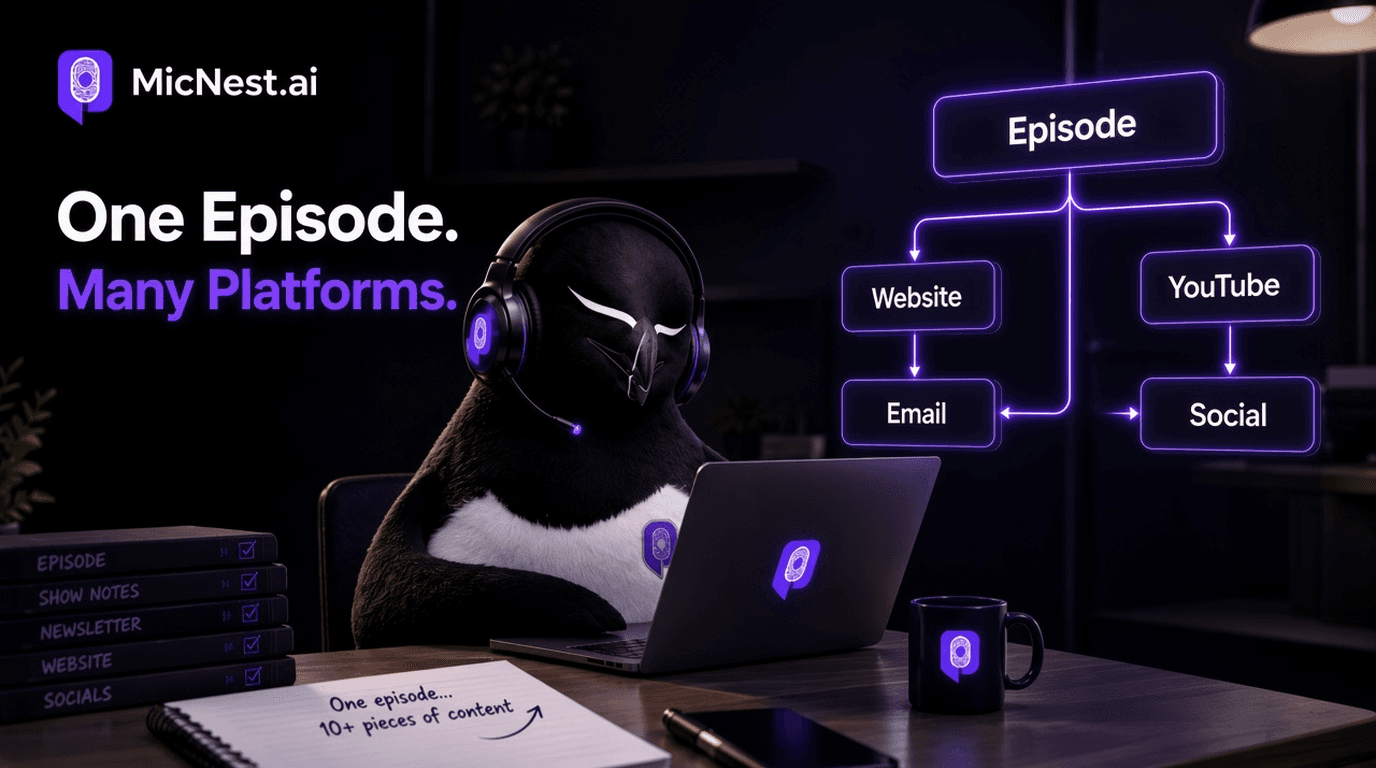
Definition
podcast promotion: A podcast distribution workflow is the process of moving one episode from the original recording into the destinations where people can find it — podcast apps, website, YouTube, email, social — by structuring the conversation once and adapting presentation per platform instead of rebuilding blank-field workflows for every channel.
In simple terms: A podcast distribution workflow is the process of moving one episode from the original recording into the destinations where people can find it — podcast apps, website, YouTube, email, social — by structuring the conversation once and adapting presentation per platform instead of rebuilding blank-field workflows for every channel.
Quick Answer
Publish the source, generate a transcript, extract topics, guests, chapters, quotes, and moments, then draft destination versions for site, YouTube, newsletter, and social. Review,
Publish the source, generate a transcript, extract topics, guests, chapters, quotes, and moments, then draft destination versions for site, YouTube, newsletter, and social. Review, publish, connect. Same conversation — different packaging.
MicNest turns each episode into structured content — pages, transcripts, topics, guests, and drafts — so podcast promotion and distribution adapt one conversation across destinations instead of rebuilding it by hand. Start at https://app.micnest.ai/auth/signup.
Key Takeaways
- ➔ Multi-platform shipping turns one talk into many repetitive tasks.
- ➔ Distribution gets content out; promotion creates attention — don't confuse them.
- ➔ "Create once, recreate everywhere" wastes time reconstructing the same answers.
- ➔ Structure the episode once: transcript → topics, guests, moments, quotes.
- ➔ Same source, different presentation per platform.
- ➔ Your website can connect channels into one library.
- ➔ Automate repetition; keep humans on judgment.
Publishing a podcast episode should feel like the finish line. Record. Edit. Publish. For many hosts, that's where another project starts.
The same episode has to move to hosting, YouTube, your website, newsletter, social, guest channels, directories, communities, short-form video — each with different formats, descriptions, images, dimensions, metadata, and dashboards.
One episode becomes a distribution workflow. Creators want reach. The pain is recreating the same information again and again. A better model treats the episode as the source of truth and builds distribution — and smarter podcast promotion — around it.
The Hidden Cost of Multi-Platform Distribution
A 60-minute interview may be done — then: upload audio, publish, upload video, YouTube description, episode page, show notes, newsletter, social posts, clips, captions, resize assets, send to guest, update links, track performance.
None of that is impossible alone. The friction is translating one conversation into many formats by hand. As the show grows, that friction compounds — same pattern as publishing admin and the marketing second job.
Why One Episode Becomes Many Workflows
Distribution rarely starts from one source of truth. Creators often run separate workflows per destination.
Podcast platform: title, description, artwork, audio, show notes, chapters, guest info.
YouTube: video, title, description, thumbnail, chapters, keywords, links, pinned comment.
Website: episode page, intro, summary, transcript, guest profile, related episodes, topics.
Newsletter: subject, intro, summary, insights, link, CTA.
Social: short post, quote, clip, caption, hook, CTA, platform formatting.
Content is the same. Workflows aren't. That's where time goes.
Distribution Is Not the Same as Promotion
Distribution gets content where the audience can find it. Promotion actively generates attention. They overlap; they're not identical.
Feed publish = distribution. LinkedIn post = promotion. Full episode on YouTube = distribution. A 30-second Short = promotion and repurposing. Newsletter = distribution to owned audience. A campaign around it = promotion.
If the publishing workflow is inefficient, adding channels just adds work — it doesn't fix the system. A social media strategy only helps if distribution underneath is sane.
The "Create Once, Recreate Everywhere" Problem
Common path: record → edit → publish → recreate → recreate → recreate.
The episode exists, but information isn't structured for reuse. So you keep going back: main topic? guest quote? key moments? description links? newsletter angle? clip section? topics?
Extract once instead of reconstructing. Better: record → understand → structure → generate → distribute.
Treat the Episode as Your Source of Truth
Inside a conversation: ideas, questions, answers, stories, quotes, topics, people, references, moments, takeaways, related subjects.
Structured once, that powers many destinations:
Episode → transcript → topics + guests + key moments + quotes + chapters → episode page + article + newsletter + clips + social
Not five unrelated inventions — multiple representations of one talk.
Four Layers of Distribution
1. Source — audio, video, the interview. Foundation.
2. Structured content — transcript, summary, chapters, topics, guest info, moments, quotes, related episodes, keywords. This layer makes reuse possible.
3. Publishing destinations — episode pages, YouTube descriptions, blog posts, newsletters, guest pages, search, topic pages. Adapt structured info; don't rebuild the episode.
4. Discovery — social, short-form, search, email, guest sharing, communities, recommendations. Where new people find the conversation.
Same Source, Different Presentation
Copy-pasting identically everywhere usually underperforms. Context differs.
Website: detailed page with transcript, topics, guest, related episodes.
YouTube: intent-led title, chapters, useful description.
Newsletter: three lessons.
LinkedIn: one idea.
Instagram: short clip with a hook.
Search: article answering a question from the talk.
Source stays. Format changes.
The Content Graph Behind a Podcast
Episodes shouldn't be isolated pages. A show on building a startup may touch fundraising, PMF, hiring, AI, entrepreneurship — connecting to other episodes, guest pages, articles, and back again.
That network makes distribution more valuable: each new episode strengthens the library.
Your Website Should Be the Connecting Layer
Treating the site as "one more place to post" misses the point. It can sit at the center: listen, read, search, related episodes, guests, topics, newsletter, archive.
Feed distributes. Social creates attention. The website connects everything.
How to Reduce Distribution Work
Don't eliminate every manual step. Cut unnecessary repetition.
- Publish the source episode.
- Generate the transcript.
- Extract structure (topics, chapters, moments, guest, quotes, takeaways, related).
- Generate destination drafts (site, newsletter, YouTube, social, search).
- Review — human judgment.
- Publish approved versions.
- Connect destinations to the next useful action.
Same idea as content automation: extract, don't recreate.
A Distribution Checklist
Core: published? clear title? complete description? chapters? artwork?
Website: own page? summary? transcript? related episodes? guest linked?
YouTube: uploaded? useful title/description? chapters? thumbnail?
Newsletter: included? takeaway? clear CTA?
Social: hook? clip? captions? clear destination?
Guest: shareable link? easy to find their episode? assets ready?
Consistency over perfection.
Automate Repetition, Not Judgment
Don't try to automate everything. Automate busywork.
Automate: transcription, summaries, chapters, topics, guest info, show notes, newsletter/social drafts, linking, episode page generation.
Keep human: editorial review, brand voice, sensitive claims, announcements, strategy, final publish.
AI handles repetition. Humans handle judgment.
What a Better System Looks Like
```text
PODCAST EPISODE
│
▼
TRANSCRIPT
│
┌─────────────┼─────────────┐
▼ ▼ ▼
TOPICS GUESTS KEY MOMENTS
│
CONTENT SYSTEM
│
┌──────────┬───────┼───────┬──────────┐
▼ ▼ ▼ ▼ ▼
Website YouTube Email Social Search
```
The middle layer matters. Without it, every platform is an isolated workflow. With it, every platform is an output.
How MicNest Fits
MicNest is built so you don't recreate the podcast every time it moves.
An episode becomes structured content: website experience, SEO pages, transcripts, topics, guests, searchable conversations, related content, newsletter material, repurposing paths.
Not just another publish slot — a content layer so one conversation supports multiple discovery and publishing workflows.
One episode → many manual tasks becomes one episode → structured content → many useful outputs.
Frequently Asked Questions
What is a podcast distribution workflow?
The process of moving an episode from the recording into destinations where people find it — podcast platforms, websites, YouTube, email, social — ideally with one structured source adapted per channel.
Why is podcast distribution so time-consuming?
Different platforms need different formats, descriptions, assets, and metadata. Repeating that for every episode creates heavy admin.
Should I publish my podcast on multiple platforms?
If those platforms reach your audience. You don't need everywhere — you need a repeatable workflow for the destinations that matter.
Should I create different content for every platform?
Keep the source conversation. Change the presentation. Newsletter, YouTube description, and social posts serve different contexts.
What should I automate in podcast distribution?
Transcription, summaries, topics, chapters, show notes, drafts, and repetitive prep. Keep humans on editorial decisions.
Is a podcast website still important if I'm on Spotify and Apple?
Yes. An owned site holds episodes, transcripts, topics, guests, search, and email together — and connects your other channels.
Make Distribution Boring
A good system should feel predictable, not thrilling. You publish. Structure updates. Website updates. Newsletter draft appears. Content connects. Social can be created. Guest gets a useful destination. Archive gets stronger.
You spend time on the next conversation — not moving info between dashboards.
Create once. Structure once. Distribute intelligently.
The goal isn't publishing in more places for its own sake. It's making every episode travel further without the workload growing with it.
Related Reading
Before vs after
Before
- — Separate blank-field workflows for host, YouTube, site, email, social
- — Reconstruct topics and quotes from the recording for every channel
- — More platforms mean more manual recreation
After
- + Episode → transcript → structure → destination drafts
- + Same source, adapted presentation per platform
- + Website connects discovery channels into one library
Who is this for?
Multi-platform creators
Hosts shipping to feed, YouTube, site, email, and social every week.
Solo producers
People recreating titles, descriptions, and assets for every destination.
Growth teams
Teams separating distribution from promotion and wanting less dashboard hopping.
Make distribution boring
One episode shouldn't mean ten isolated workflows. Structure the conversation once, adapt presentation per platform, and let distribution stay predictable so you can focus on the next interview.
Explore MicNest or start freeSources
- MicNest product — MicNest turns episodes into structured website content so distribution and promotion can reuse one conversation across destinations.
Frequently Asked Questions
What is a podcast distribution workflow? +
The process of moving an episode from the recording into destinations where people find it — podcast platforms, websites, YouTube, email, social — ideally with one structured source adapted per channel.
Why is podcast distribution so time-consuming? +
Different platforms need different formats, descriptions, assets, and metadata. Repeating that for every episode creates heavy admin.
Should I publish my podcast on multiple platforms? +
If those platforms reach your audience. You don't need everywhere — you need a repeatable workflow for the destinations that matter.
Should I create different content for every platform? +
Keep the source conversation. Change the presentation. Newsletter, YouTube description, and social posts serve different contexts.
What should I automate in podcast distribution? +
Transcription, summaries, topics, chapters, show notes, drafts, and repetitive prep. Keep humans on editorial decisions.
Is a podcast website still important if I'm on Spotify and Apple? +
Yes. An owned site holds episodes, transcripts, topics, guests, search, and email together — and connects your other channels.

