
Definition
podcast show notes: Podcast show notes are a structured summary of an episode — intro, key takeaways, topics, guest context, resources, and often timestamps — so someone can understand the conversation before they listen. They are not a full transcript; they organize what the episode already contains.
In simple terms: Podcast show notes are a structured summary of an episode — intro, key takeaways, topics, guest context, resources, and often timestamps — so someone can understand the conversation before they listen. They are not a full transcript; they organize what the episode already contains.
Quick Answer
Transcribe the episode, extract topics, guest details, moments, resources, and quotes, then draft description, show notes, chapters, and page content from that structure. Review fo
Transcribe the episode, extract topics, guest details, moments, resources, and quotes, then draft description, show notes, chapters, and page content from that structure. Review for accuracy. Publish. Don't open a blank doc and rewrite the same conversation five times.
MicNest treats the episode as the source — transcript, topics, moments, guest info, and related content — so show notes, episode pages, and newsletter drafts come from the conversation instead of a blank document. Start at https://app.micnest.ai/auth/signup.
Key Takeaways
- ➔ Metadata is many formats of the same conversation — not separate inventions.
- ➔ Small weekly publish tasks add up into a second job.
- ➔ Extract and restructure; don't recreate from scratch.
- ➔ Show notes help decide whether to listen; transcripts preserve detail.
- ➔ Chapters turn long audio into navigable sections.
- ➔ Connect episodes by topic, guest, and related content.
- ➔ AI drafts; humans approve names, nuance, and meaning.
You finished recording. The conversation went well. Then comes the part nobody talks about enough: publishing everything *around* the episode.
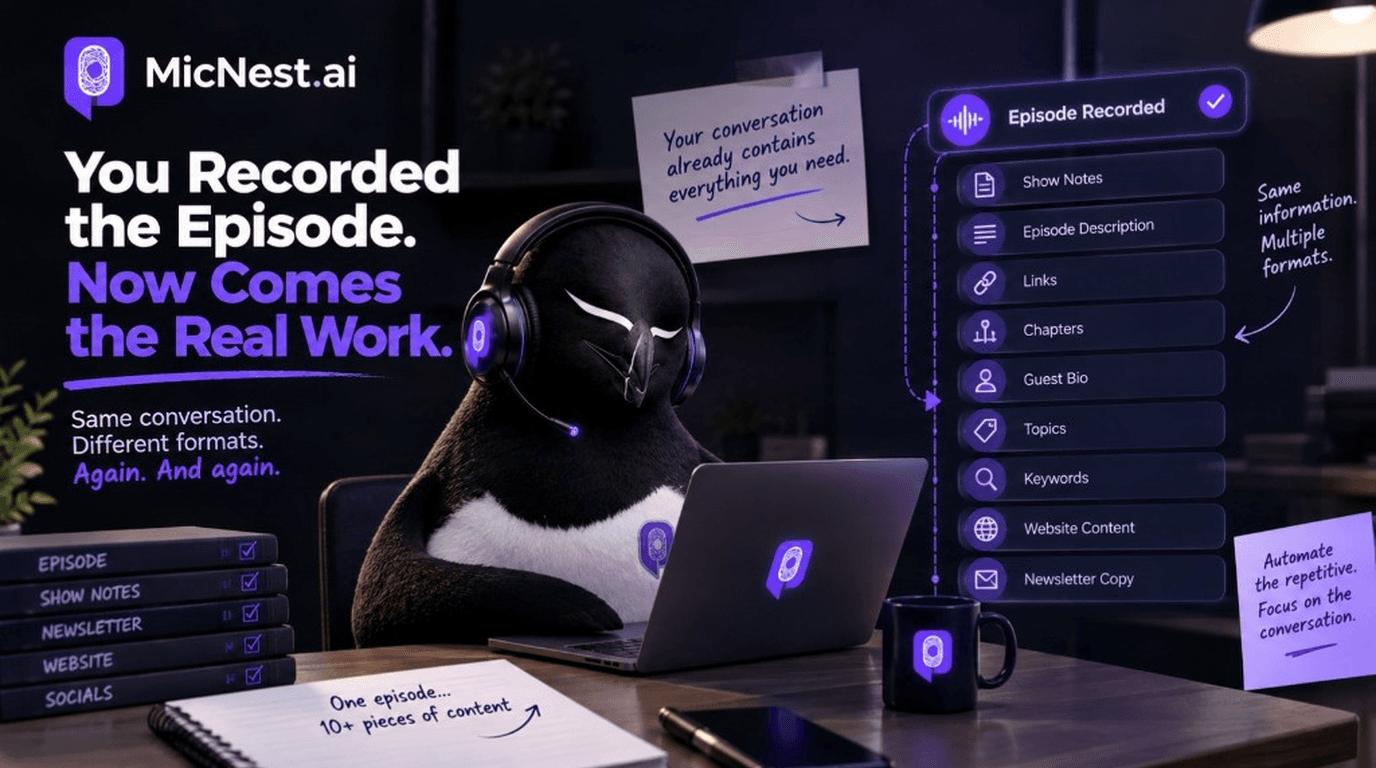
Description. Podcast show notes. Links. Timestamps. Guest info. Topics. Keywords. Website page. Maybe a newsletter. Maybe social. None of those tasks is hard on its own. You repeat them every week — and much of the information already sits inside the talk you just recorded.
Strange workflow: create the content once, then manually describe it over and over. A cleaner podcast publishing workflow treats the episode as the source of truth.
What Is Podcast Metadata?
Depending on your tools, it can include title, description, show notes, guest name and bio, links, topics, categories, keywords, chapters, publish date, episode number, transcript, and related episodes.
Some of it is required by hosting. Some helps listeners decide. Some helps discovery. These aren't unrelated assets. They're different representations of the same conversation — including a clear podcast description and solid podcast episode notes.
The Hidden Work After Recording
A typical path: record → edit → upload → write description → write show notes → add links → create chapters → update website → write newsletter → create social posts.
Recording is one piece. Everything around it is a second workload. Five minutes here, ten there, thirty rewriting what you already know — and publishing becomes another job. Same pattern as content automation trying to fix.
Why Manual Metadata Is So Repetitive
In a typical interview the guest introduces themselves, covers topics, answers questions, mentions books, tools, sites, people, stories, recommendations. That information already exists in the audio.
After recording you may still hand-build: episode description, show notes, guest bio, links, chapters, topics, newsletter, social. You're not inventing new information. You're extracting and restructuring. That distinction matters.
Your Episode Should Be the Source of Truth
Don't treat each publishing task as an independent job.
Episode → transcript → structured information → publishing outputs
From the transcript: main topics, key points, questions, answers, guest details, important moments, resources, quotes, timestamps, related subjects.
Same foundation can power an episode page, show notes, newsletter, search index, article, and social — more efficient than writing each piece alone. That's content repurposing applied to publish metadata.
What Good Show Notes Should Do
Show notes aren't just a longer description. They help someone understand the conversation before they commit to listening.
Useful notes can include: a clear intro (who and what), key takeaways, topics discussed, guest information, resources mentioned, timestamps, and related episodes.
Good show notes reduce the effort required to decide if this episode is for them.
Don't Turn Show Notes Into a Transcript
Copying the full transcript into the episode description is a common mistake. They solve different problems.
Transcript: the detailed record.
Show notes: the structured summary — what was discussed, who participated, major ideas, resources, where to find specific moments.
Both useful. Different jobs.
Chapters Are Another Layer
Long talks cover many subjects. Without chapters, finding one section means scrubbing the whole file.
Chapters turn 90 minutes into labeled segments: intro, guest background, building the company, first challenge, hiring, lessons, what's next.
Manually tagging every chapter is another repetitive task. The transcript already has clues — topic shifts, questions, major sections. Those can mark natural boundaries.
Metadata Should Connect Episodes
Treating every episode as isolated wastes the archive. If this one is about podcast SEO, you may already have episodes on search, content strategy, an SEO guest, or an article on discoverability.
Don't end at "Thanks for listening." Give a path: related topic → related episode → related guest → related article. Individual shows become a connected library — same idea as a strong podcast website.
Better Metadata Improves Discovery
People don't always search your exact show name. They search problems, questions, topics, people, solutions.
A detailed episode page with structured content gives more ways to show up. "Episode 84: John Smith" says little. "How John Smith Built a Remote Company: Hiring, Culture, and Scaling" gives context. Title, description, topics, transcript, guest info, and related content all contribute.
Build a Metadata Pipeline
- Record — conversation created.
- Transcribe — searchable text.
- Extract — topics, people, moments, questions, resources, statements.
- Structure — organized metadata.
- Generate — description, show notes, chapters, guest profile, website content, newsletter draft.
- Review — you check and correct.
- Publish — approved content to the right destinations.
Not publish-without-looking. Don't start from a blank document every time either.
Human Review Still Matters
Automation isn't "generate everything and never look." Models can garble names, companies, terms, context, sarcasm, quotes, nuance.
Better model: AI does extraction and first draft. You provide judgment and final approval. Humans stay where context matters.
The Bigger Problem: Content Fragmentation
It isn't only show notes. Conversation in one place, transcript elsewhere, guest info elsewhere, notes in a doc, newsletter in email, social in a scheduler, website somewhere else. Connections get hard to see.
A content system works the other way: one conversation becomes the foundation for many connected assets.
How MicNest Approaches This
MicNest is built so an episode isn't just an audio file in a feed.
It can become dedicated episode pages, transcripts, SEO-focused content, guest information, searchable conversations, topic connections, newsletter content, and related discovery.
Not more text for its own sake. Make the information already inside the podcast usable in more places. Conversation is the source. The system transforms. You review. Content keeps working for the audience.
A Simple Podcast Metadata Checklist
Episode basics: clear title? accurate description? guest identified? publish info correct?
Show notes: main topics? resources linked? takeaways clear?
Navigation: useful chapters? easy to find sections? accurate timestamps?
Discovery: does it say what problem or topic it covers? topics represented naturally? related episodes connected?
Reuse: newsletter? social moments? article ideas? shareable episode page for the guest?
Quality: reviewed? names and links correct? meaning preserved?
Stop Starting From a Blank Page
The biggest win isn't a prettier show notes template. It's the workflow.
Instead of record → blank document → write, think: record → understand → structure → generate → review → publish.
The conversation already holds most of the raw material. The publishing system should help extract it — less repetitive work, more time on the parts that need you.
Frequently Asked Questions
What should podcast show notes include?
A clear intro, key takeaways, topics, guest context, resources, and often timestamps or chapters. Enough for someone to understand the episode before they listen.
Are show notes the same as a transcript?
No. A transcript is the full conversation. Show notes are a structured summary built from it.
How can I speed up writing podcast episode descriptions?
Start from a transcript and extracted topics, guest details, and key moments. Draft the description from that structure, then edit — don't invent it from memory alone.
Should every episode have chapters?
Long episodes benefit most. Chapters help listeners jump to sections they care about. Natural topic shifts in the transcript are good chapter cues.
Can AI generate podcast show notes?
It can draft notes, chapters, and descriptions from a transcript. Human review still matters for names, links, accuracy, and tone.
How does MicNest help with podcast publishing metadata?
MicNest turns the episode into structured content — pages, transcripts, topics, guests, related episodes, and drafts — so publishing assets share one source instead of five blank docs.
Your Podcast Is Already Full of Metadata
Every episode has people, topics, questions, answers, stories, resources, ideas, moments, connections. Raw audio hides that. Once transcribed and structured, one episode can become multiple useful experiences.
Don't create the same information five times. Create it once. Structure it. Let it flow where the audience needs it.
Record once. Understand once. Publish everywhere.
Related Reading
Before vs after
Before
- — Record then open a blank doc for every publishing asset
- — Description, notes, chapters, and newsletter rewritten by hand
- — Content scattered across tools with no shared source
After
- + Episode → transcript → structured extract → drafts
- + Show notes, chapters, and page content share one foundation
- + Human review for accuracy; system handles the first pass
Who is this for?
Solo podcasters
Creators tired of rewriting descriptions and show notes every week.
Production teams
Teams building a metadata pipeline from transcript to publish.
Growth-focused hosts
Shows using structured episode pages for discovery, not only RSS titles.
Stop starting from a blank page
Podcast publishing shouldn't mean rewriting the same episode five times. Transcribe once, structure the metadata, generate drafts, review, then publish — with the conversation as the source of truth.
Explore MicNest or start freeSources
- MicNest product — MicNest turns episodes into structured pages, transcripts, topics, and drafts so show notes and publish metadata share one source.
Frequently Asked Questions
What should podcast show notes include? +
A clear intro, key takeaways, topics, guest context, resources, and often timestamps or chapters. Enough for someone to understand the episode before they listen.
Are show notes the same as a transcript? +
No. A transcript is the full conversation. Show notes are a structured summary built from it.
How can I speed up writing podcast episode descriptions? +
Start from a transcript and extracted topics, guest details, and key moments. Draft the description from that structure, then edit — don't invent it from memory alone.
Should every episode have chapters? +
Long episodes benefit most. Chapters help listeners jump to sections they care about. Natural topic shifts in the transcript are good chapter cues.
Can AI generate podcast show notes? +
It can draft notes, chapters, and descriptions from a transcript. Human review still matters for names, links, accuracy, and tone.
How does MicNest help with podcast publishing metadata? +
MicNest turns the episode into structured content — pages, transcripts, topics, guests, related episodes, and drafts — so publishing assets share one source instead of five blank docs.

