
Definition
podcast interview preparation: Podcast interview preparation is the work of understanding a guest and topic well enough to ask useful, specific questions — using both external sources and what your own show has already covered — without collecting more information than you will use.
In simple terms: Podcast interview preparation is the work of understanding a guest and topic well enough to ask useful, specific questions — using both external sources and what your own show has already covered — without collecting more information than you will use.
Quick Answer
Search your archive first — transcripts, topics, prior guests, and questions you've already asked. Spot gaps and disagreements. Then do focused external podcast guest research. Bui
Search your archive first — transcripts, topics, prior guests, and questions you've already asked. Spot gaps and disagreements. Then do focused external podcast guest research. Build a short list of context-rich questions, not a 40-item script.
MicNest turns your archive into searchable transcripts, topics, guests, and related episodes so podcast interview preparation starts from what you've already learned — then you research the guest externally for the gaps. Start at https://app.micnest.ai/auth/signup.
Key Takeaways
- ➔ Recording may take an hour; prep often takes longer.
- ➔ Research collects facts; preparation turns them into conversation.
- ➔ Your archive is a knowledge source, not only a listener library.
- ➔ Ask what you've already covered before repeating the same podcast questions.
- ➔ Prior guests give contrast, continuity, and sharper follow-ups.
- ➔ Combine internal research (archive) with external research (guest).
- ➔ Prep should give context for listening — not a rigid script.
A strong interview can look effortless. Thoughtful question, interesting answer, conversation that moves. Getting there often takes hours: guest site, prior interviews, articles, social posts, their work, then shaping it into one coherent talk. Weekly shows repeat that loop again and again.
In the Reddit pain points behind this series, research and prep show up as work that can eat a large part of the week. The useful question for podcast interview preparation is how to go deep without treating every guest as a brand-new research project. One answer: stop starting from zero. Your archive can be part of the system.
The Hidden Work Behind a Good Interview
Guest research → background → previous interviews → topic research → question prep → reviewing your own archive → final prep. By record time you've already invested hours. Then the next guest starts the cycle again. For a solo creator or small team, that load is real.
Why Guest Research Takes So Long
The problem is rarely "not enough information." It's information scattered across websites, LinkedIn, company pages, prior podcasts, YouTube, articles, books, news, social, and your own back catalog.
You're not only asking who this person is. You're asking what you can talk about with them that will be useful, interesting, and different. That is harder — and it's the heart of good podcast guest research.
Research vs Preparation
Research: they founded three companies.
Preparation: what did they learn from the first that changed how they built the second?
The goal isn't maximum information. It's the most interesting connections.
Your Archive Can Become a Research Asset
After 100 episodes you already have questions, answers, opinions, stories, guest experience, industry talk, contradictions, and lessons. That library isn't only for listeners. It can feed future shows.
Next guest is a SaaS founder? Search prior talks for hiring, fundraising, product-market fit, pricing, growth. Prep starts from what you've already learned — same idea as treating the back catalog as an asset, and AI podcast search when the library is large.
What Have You Already Asked?
After dozens of episodes it's easy to ask "What inspired you to start?" for the fifteenth time. A searchable archive surfaces repeats — and strong answers worth going deeper on.
Instead of the same question again: "We've heard several founders talk about hiring their first employee. You approached it differently. Why?" Now the interview has context.
Previous Guests Help Prep New Ones
New guests don't exist in isolation. Same industry, different opinions, similar problems, maybe disagreement.
You interviewed Founder A on fundraising. Founder B is next. Instead of generic questions: "Another founder we spoke with said X. You took a very different approach. Why?" The conversation becomes part of a larger body of knowledge. Continuity grows. Guest pages make those links easier to see.
Better Follow-Up Questions
Some of the best questions aren't planned. A guest says they changed hiring after the first 20 employees — what happened with the first 20?
If you already know prior guests discussed similar hiring problems, you get another layer: what changed, what stayed, why was your approach different? A searchable archive retrieves that when you need it, not only when you happen to remember.
Build a Podcast Knowledge Base
Think beyond Episode 1, 2, 3. Structure around people, topics, questions, ideas, stories, and related episodes. The show becomes a knowledge base for audience discovery and creator research.
Episode pages with transcripts and topics are the building blocks of that structure.
Search Your Own Show Before Opening 20 Tabs
Preparing an AI episode? Search the archive: what have guests said about AI agents? You might find relevant episodes, guests, perspectives, quotes, related questions. Then: what have we already asked? Where did guests disagree?
Those answers become discussion points. The archive enters the prep workflow before the tab pile.
Turn Previous Episodes Into Interview Context
Previous episode: how founders hire their first engineer. New guest: experienced CTO. Better question: "We've spoken with early-stage founders about first engineering hires. From the CTO side, what do they usually misunderstand?"
That's sharper than "How should startups hire engineers?" Context is the difference.
Two Kinds of Research
External: what's happening outside your podcast — the guest and their work.
Internal: what have we already learned?
Combine them for better questions. Neither alone is enough for strong podcast interview prep.
A Better Prep Workflow
Instead of: find guest → open dozens of tabs → read everything → take notes → write questions → forget half of it.
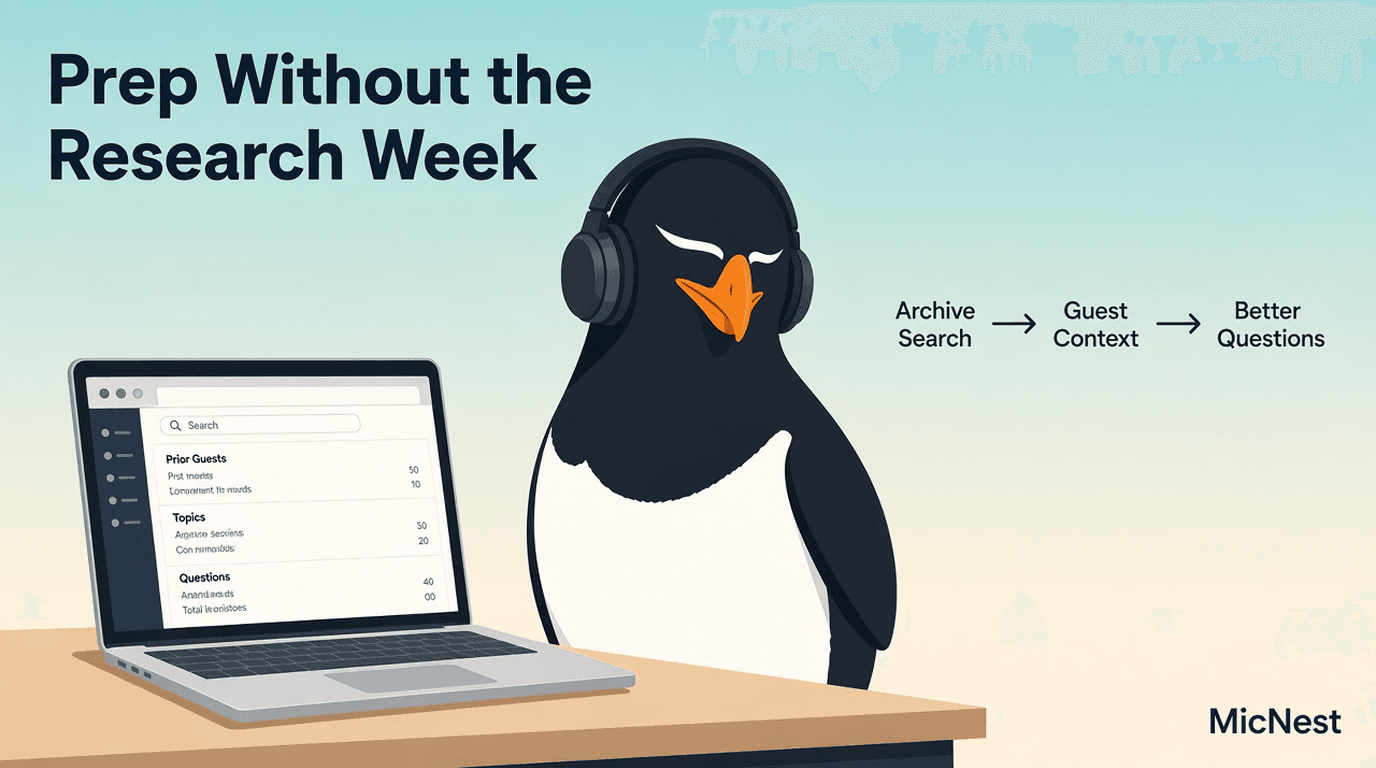
Try: identify guest → search archive → related guests → related topics → previous questions → identify gaps → external guest research → focused questions.
Research still happens. It's structured.
Find the Gaps in Your Coverage
Fifty startup episodes may cover fundraising, hiring, marketing, product, sales — and barely touch founder succession, international expansion, enterprise sales, or culture.
Those gaps become interview directions. Not "what should we talk about next?" but "what important questions haven't we explored yet?"
Your Podcast Can Learn From Itself
Every episode adds information. The next builds on it. Over time, 100 episodes shouldn't feel like 100 disconnected chats. They can become a growing body of knowledge.
Conversation → knowledge → research → better questions → better conversation
The show becomes more informed by its own history.
Episode Ideas From the Archive
Prep isn't only for the next guest. It also answers "what should we talk about next?"
The archive can reveal heavy topics, thin topics, repeated audience questions, subjects linking multiple guests, contradictions, unfinished threads, areas worth going deeper. Invent less from scratch. Look at what you've already accumulated.
Don't Turn Every Interview Into a Script
A research system shouldn't make interviews robotic. You don't need 40 questions on the desk.
If you understand the guest, their history, prior conversations, relevant topics, and important unanswered questions, you can listen harder. When something unexpected lands, you can follow it. Preparation should give context, not a script.
How MicNest Fits
MicNest treats episodes as a searchable knowledge library — not only a chronological list.
Conversations become searchable transcripts, topics, guest profiles, related episodes, articles, questions, and knowledge connections. That helps listeners discover content. The same knowledge helps you see what you've already discussed.
The goal: make the podcast more useful as it grows.
A Practical Research Checklist
Guest: what they've built, what they're known for, what they've said publicly, what changed in their career.
Archive: similar guests, prior takes on the topic, questions already asked, where guests disagree.
Topic: what's covered, what's missing, recurring questions, what's genuinely new.
Conversation: strongest open, what might surprise, useful follow-ups, what to avoid repeating.
That focuses prep without pretending one universal time budget exists.
Better Research, Not Zero Research
You shouldn't walk in knowing nothing. You also shouldn't spend a week collecting facts you'll never use.
Know the guest. Know your archive. Know what's already been discussed. Know what's missing. Then have the conversation.
Frequently Asked Questions
How long should I spend researching a podcast guest?
There is no universal number. It depends on the guest, subject, format, and how important the episode is. A structured archive can cut unnecessary repetition and focus the work.
Should I research previous podcast interviews with my guest?
Yes when useful. They show what they've already covered and where you can ask something different.
Can my old podcast episodes help me prepare for new interviews?
Yes. Prior episodes give context on topics, questions, guests, opinions, and ideas you've already explored.
How can I avoid asking the same podcast questions repeatedly?
Search previous transcripts and notes for recurring questions and topics. Use that to build deeper or more specific follow-ups.
Can podcast transcripts be used for research?
Yes. Transcripts make conversations searchable and faster to review than scrubbing full episodes by ear.
Can AI help with podcast interview preparation?
AI can help organize transcripts, identify topics, retrieve related talks, summarize prior discussions, and flag areas worth exploring. You still decide which questions fit the guest and the conversation.
Your Podcast Should Remember What It Has Learned
Every episode adds knowledge. If that knowledge disappears into an opaque archive, you start over every time.
Your next interview shouldn't begin with a blank page. It should begin with everything the show has already learned.
Previous conversations → searchable knowledge → better preparation → better questions → better conversations → more knowledge
Related Reading
Before vs after
Before
- — Every guest starts from a blank page and dozens of tabs
- — Repeated questions across episodes go unnoticed
- — Archive knowledge stays locked in old audio files
After
- + Search archive first, then research the guest externally
- + Build on prior guests, topics, and disagreements
- + Prep gives context for flexible conversation, not a rigid script
Who is this for?
Interview hosts
Creators who prep guests weekly and need depth without a full research week.
Solo producers
People balancing recording with jobs and limited prep hours.
Show runners
Teams building continuity across guests and topics.
Your podcast should remember what it has learned
Interview prep gets faster when your archive is searchable. Know the guest, know what you've already covered, find the gaps, then ask better questions.
Explore MicNest or start freeSources
- MicNest product — MicNest turns episodes into searchable transcripts, topics, guests, and related content so interview prep can start from the archive.
Frequently Asked Questions
How long should I spend researching a podcast guest? +
There is no universal number. It depends on the guest, subject, format, and how important the episode is. A structured archive can cut unnecessary repetition and focus the work.
Should I research previous podcast interviews with my guest? +
Yes when useful. They show what they've already covered and where you can ask something different.
Can my old podcast episodes help me prepare for new interviews? +
Yes. Prior episodes give context on topics, questions, guests, opinions, and ideas you've already explored.
How can I avoid asking the same podcast questions repeatedly? +
Search previous transcripts and notes for recurring questions and topics. Use that to build deeper or more specific follow-ups.
Can podcast transcripts be used for research? +
Yes. Transcripts make conversations searchable and faster to review than scrubbing full episodes by ear.
Can AI help with podcast interview preparation? +
AI can help organize transcripts, identify topics, retrieve related talks, summarize prior discussions, and flag areas worth exploring. You still decide which questions fit the guest and the conversation.

