
Definition
podcast description: How to get podcast sponsors means earning paid or trade placement from brands that want access to your listeners, usually with a short media kit, clear audience proof, package rates, and outbound pitches.
In simple terms: How to get podcast sponsors means earning paid or trade placement from brands that want access to your listeners, usually with a short media kit, clear audience proof, package rates, and outbound pitches.
Quick Answer
Build a one-page kit with show promise, audience, recent download ranges, packages, and contact info. Pitch brands that already serve your niche. Lead with fit and a specific host-
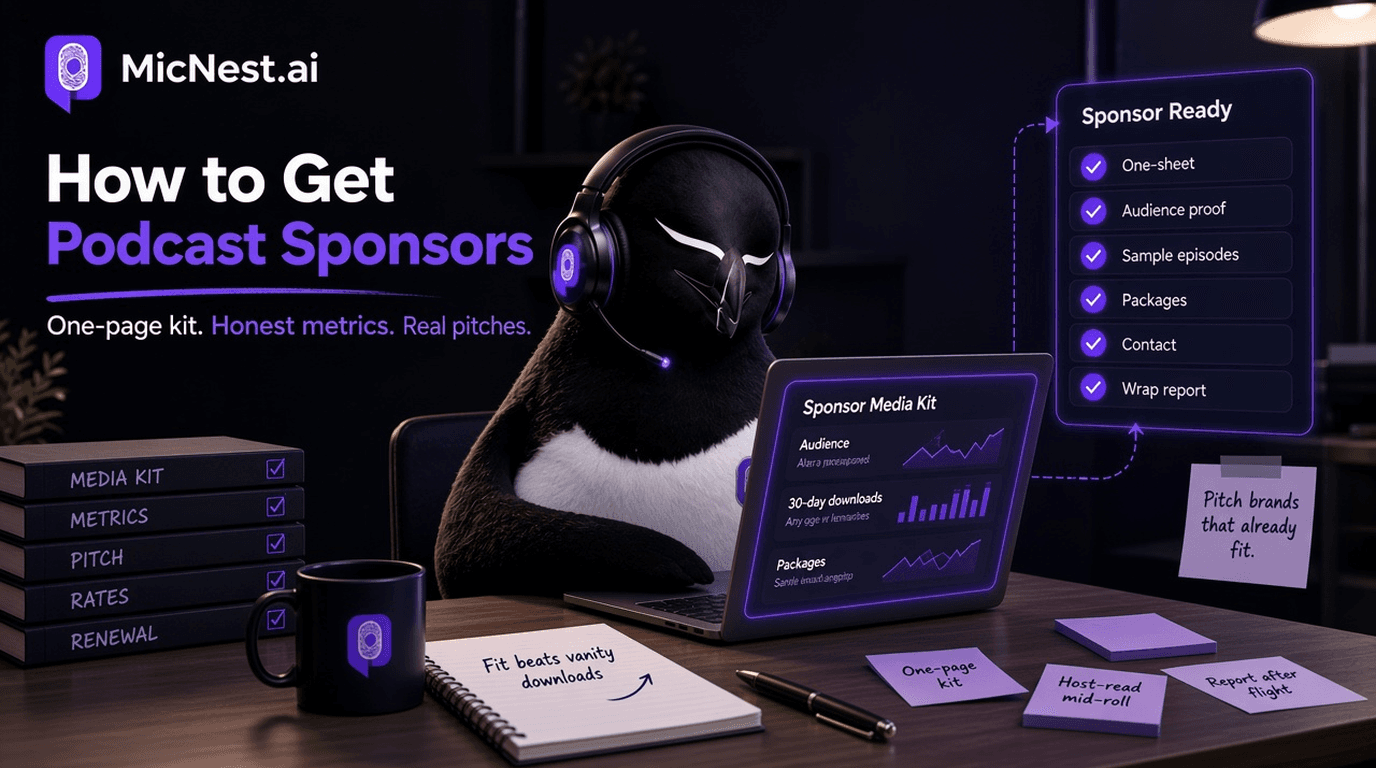
Build a one-page kit with show promise, audience, recent download ranges, packages, and contact info. Pitch brands that already serve your niche. Lead with fit and a specific host-read package, then report results after the flight.
MicNest turns clear show promises into searchable episode pages and a destination that matches your description. Start at https://app.micnest.ai/auth/signup.
Key Takeaways
- ➔ A one-page media kit beats a polished empty deck.
- ➔ Fit beats vanity downloads when you are early.
- ➔ Pitch brands that already sell to your listeners.
- ➔ Offer packages with length, placement, and inclusions.
- ➔ Price from your numbers and niche, then adjust with evidence.
- ➔ Host-reads that sound like you outperform stiff scripts.
- ➔ Report results; silence after payment kills renewals.
- ➔ Owned episode pages make your show easier for brands to evaluate.
Most people searching how to get podcast sponsors are not missing a Canva template. They are missing proof, a clear offer, and a pitch that fits the brand.
Reddit threads about media kits keep circling the same fear: numbers feel small, so the PDF gets longer. Publicists ignore long decks. Brands ignore vague "we have engaged listeners" claims. What works earlier than you think is a one-page sheet, honest metrics, and a reason that brand belongs in *your* niche.
This guide covers the kit, the numbers that matter, who to pitch, what to charge when you are early, and how to keep sponsorship from wrecking the listening experience.
1. What Brands Actually Buy
Sponsors are not buying "a podcast." They are buying a believable path to people who already care about a problem they solve.
That path needs three things:
- Audience match (who listens)
- Trust transfer (why your voice matters to that audience)
- A workable placement (when and how the message lands)
If you only have a few hundred downloads per episode, you can still win local businesses, SaaS tools in a narrow niche, or founders who guest and then sponsor. You will not win a national CPG brand that buys against big CPM charts. Pitch the right size.
Trade sponsorships (product for mentions) can be a training ground. Cash sponsorships need clearer numbers and a cleaner offer.
2. Build a One-Page Kit, Not a Brochure
Creators on r/podcasting say this constantly: keep it brief. A simple PDF or Google Doc is enough.
Include:
| Block | What to write |
|---|---|
| Show identity | Name, one-line promise, genre/niche, cadence |
| Host credibility | Why you are the right messenger (not a life story) |
| Audience | Who listens and why they stick |
| Metrics | Episodes published; average downloads in first 30 days; monthly downloads; growth trend if real |
| Proof | Notable guests, quotes, screenshots of reviews, clip examples |
| Best episodes | 3 links that show the show at its best |
| Packages | Pre-roll / mid-roll / host-read length + what is included |
| Contact | Email that you actually check |
Third person helps if press or agencies will copy/paste ("Host Ali interviews…"). First person is fine for direct founder-to-founder pitches.
Skip fake precision. "About 1,200 downloads in the first 30 days across recent episodes" beats inventing decimals. If demographics are incomplete, say what you know and what you are still collecting.
Podcast media kit searches often imply a design project. The design is secondary. Clarity is the product.
3. Which Metrics Belong on the Page
Hosts obsess over lifetime totals. Buyers care about recent performance and trajectory.
Useful:
- Average downloads in the first 7 or 30 days (state which)
- Monthly download range for the last 90 days
- Release consistency (weekly / biweekly)
- Platform mix if you have it (Apple, Spotify, YouTube)
- Newsletter or site traffic if those are real channels you sell
Less useful early:
- Lifetime downloads since episode one from three years ago
- Follower counts with no listening proof
- "Engagement" with no definition
If your host and a directory disagree on numbers, pick one primary source and note it. Mismatched dashboards confuse buyers more than a slightly lower honest figure. For context on messy stats, see podcast metrics.
4. Who to Pitch (And Who to Skip)
Start with brands your listeners already use or ask about on air.
Good targets:
- Tools and services named in episodes
- Local or regional businesses that match your geography
- Niche SaaS, educators, and communities adjacent to your topic
- Past guests whose product fits without forcing it
Weak targets:
- Random "we sponsor podcasts" spam lists with no niche overlap
- Brands whose customers are nothing like your listeners
- Agencies that only buy six-figure flights
Warm paths beat cold blasts: a guest intro, a mutual connection, or a short note after you used their product on air for real.
Personalize one sentence that proves you listened to *their* positioning. Mass-mail templates get deleted.
5. Packages You Can Sell Without Bluffing
Keep packages boring and clear.
Examples:
- Pre-roll host-read: 20–30 seconds at the open (after a short intro, not before anyone knows the show)
- Mid-roll host-read: 45–60 seconds at a natural break
- Episode feature: mention + link in show notes + social clip with logo
- Season partner: multiple episodes at a bundle rate
State deliverables: draft approval window, exclusive category or not, whether YouTube gets the same read, and whether you will share a performance note after 30 days.
Do not invent "guaranteed conversions." Sell attention and trust in a defined audience.
6. Pricing When You Are Still Early
There is no universal CPM that fits every niche. A tiny B2B show with buyers can out-earn a large entertainment feed with no purchase intent.
Practical approach:
- Estimate average downloads for the flight window
- Pick a CPM band that matches your niche risk (many indie shows start modestly and rise with proof)
- Convert to a flat episode rate so small brands can say yes without spreadsheet theater
- Offer a two- or four-episode starter so both sides can learn
Underselling forever is as bad as arrogance. Raise rates when you have renewals, waitlists, or clear response stories.
If cash is not ready, a clean product trade can fund gear or software. Write the deliverables the same way you would for a paid deal.
7. The Pitch Email That Gets Replies
Keep it short.
- Who you are and the show's one-line promise
- Why this brand fits (one concrete reason)
- Proof in one line (downloads range, niche, cadence)
- The offer (package + date options)
- Link to the one-pager and two sample episodes
- A single ask ("Open to a 15-minute call next week?")
Attach or link the PDF. Do not make them hunt five URLs.
Follow up once after a week. Twice max. Then move on.
8. Make the Read Sound Like Your Show
Listeners punish awkward ads. Sponsors notice when you sound embarrassed.
- Write the read in your voice, then let the brand adjust claims for accuracy
- Place mid-rolls at a real pause, not mid-sentence
- Keep claims honest; do not invent testimonials
- One sponsor per break when you can; stacked reads feel like a bargain bin
Your intro should still do its job before any sponsor talk. People need to know what the episode is before they care about a discount code.
9. After They Say Yes
Treat the flight like a project.
- Confirm copy, URL, discount code, and air dates in writing
- Record and QC the audio
- Publish notes and links the same day
- Send a short wrap: dates aired, links used, any qualitative replies, and next-step options
Renewals come from professionalism more often than from a perfect Canva cover.
10. How MicNest Helps the Sponsor Conversation
Brands evaluate risk. A show that only lives as an MP3 is harder to judge than a show with clear pages, guests, and searchable topics.
MicNest helps you keep an owned home for episodes, notes, and guests so your kit points somewhere real. When a sponsor asks "where does the listener go?", you have an answer beyond a bio link that changes every month.
Frequently Asked Questions
How do I get podcast sponsors with low downloads?
Pitch for fit, not scale. Local brands, niche tools, and past guests are realistic. Lead with who listens and why you are credible, then be honest about volume.
What should a podcast media kit include?
Show promise, host credibility, audience, recent download metrics, sample episodes, packages, and contact. One page is enough for most indie shows.
How much should I charge for a podcast sponsorship?
Start from recent downloads and niche value, quote a flat episode rate, and adjust after you have proof. Avoid promising outcomes you cannot measure.
Is a media kit required to get sponsors?
You need a clear leave-behind. It can be a Google Doc. Design polish matters less than accurate numbers and a specific offer.
Should I use host-read ads or programmatic ads first?
Host-reads build trust and are easier to sell direct. Programmatic can fill inventory later. Many shows start direct so the reads stay on-brand.
How many sponsors should one episode have?
Fewer is better. One clear partner per break usually sounds cleaner than three stacked pitches.
Can I trade product for a sponsorship mention?
Yes if deliverables are written down. Treat it like a paid deal so expectations stay clear.
What kills sponsor renewals?
Missed links, late reports, off-brand reads, and disappearing after payment. Ops matters as much as the pitch.
Final Takeaway
Learning how to get podcast sponsors is less about looking big and more about looking specific.
Write a one-page kit. Tell the truth about your numbers. Pitch brands that already belong next to your topic. Sell a package you can deliver. Read it like a human. Follow up with proof.
Sponsorship is a relationship business attached to a media product. The shows that win early are the ones that respect both sides.
Related reading
Before vs after
Before
- - Lead with biography and adjectives
- - Stuff keywords at the bottom of the description
- - Reuse one vague blurb on every episode
After
- + Lead with audience and outcome in the first lines
- + Write specific episode descriptions with guest and topic
- + Keep description, name, and titles saying the same thing
Who is this for?
Hosts rewriting vague show bios
Creators whose feed copy does not match the show.
New shows before launch
Hosts writing the first show description and trailer package.
Episode publishers
Hosts who paste the same blurb under every episode.
Make the first lines earn the play
Write a show and episode description strangers can skim in seconds, then keep titles and pages aligned with the same promise.
Explore MicNest or start freeFrequently Asked Questions
How do I get podcast sponsors with low downloads? +
Pitch for fit, not scale. Local brands, niche tools, and past guests are realistic. Lead with who listens and why you are credible, then be honest about volume.
What should a podcast media kit include? +
Show promise, host credibility, audience, recent download metrics, sample episodes, packages, and contact. One page is enough for most indie shows.
How much should I charge for a podcast sponsorship? +
Start from recent downloads and niche value, quote a flat episode rate, and adjust after you have proof. Avoid promising outcomes you cannot measure.
Is a media kit required to get sponsors? +
You need a clear leave-behind. It can be a Google Doc. Design polish matters less than accurate numbers and a specific offer.
Should I use host-read ads or programmatic ads first? +
Host-reads build trust and are easier to sell direct. Programmatic can fill inventory later. Many shows start direct so the reads stay on-brand.
How many sponsors should one episode have? +
Fewer is better. One clear partner per break usually sounds cleaner than three stacked pitches.
Can I trade product for a sponsorship mention? +
Yes if deliverables are written down. Treat it like a paid deal so expectations stay clear.
What kills sponsor renewals? +
Missed links, late reports, off-brand reads, and disappearing after payment. Ops matters as much as the pitch.

