
Definition
podcast networking: Podcast networking is building relationships with other shows so audiences can discover you through guest appearances, swaps, trailer shares, and collaborations. Done well, it targets listeners who already care about your topic, not cold scrollers who never open a podcast app.
In simple terms: Podcast networking is building relationships with other shows so audiences can discover you through guest appearances, swaps, trailer shares, and collaborations. Done well, it targets listeners who already care about your topic, not cold scrollers who never open a podcast app.
Quick Answer
Find shows with real audience overlap (same niche, similar size, different angle). Pitch a specific episode idea, swap appearances or promotions, and give new listeners a clear nex
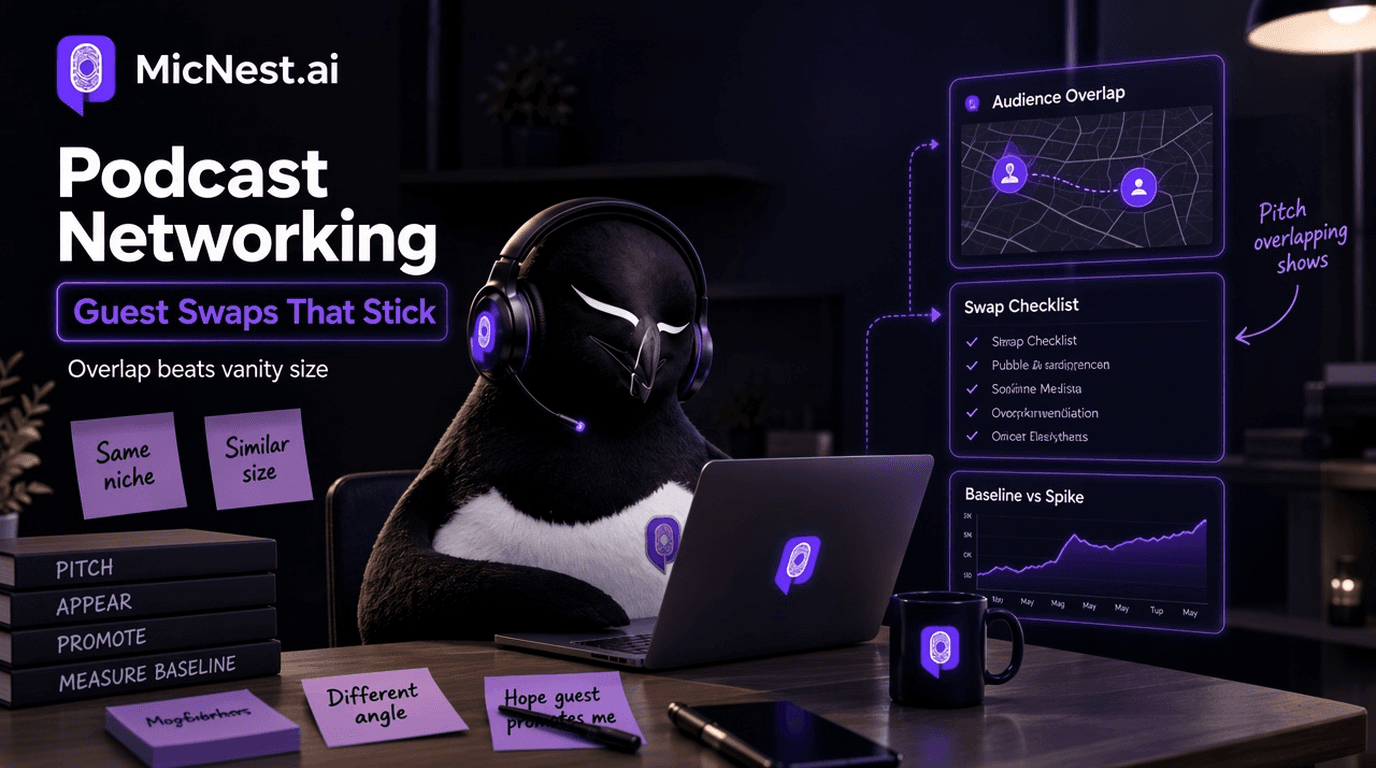
Find shows with real audience overlap (same niche, similar size, different angle). Pitch a specific episode idea, swap appearances or promotions, and give new listeners a clear next step, a strong episode page and searchable episode titles. Measure whether your baseline listening rises weeks later, not only the spike on swap week.
MicNest helps stuck shows become easier to discover, searchable episode pages, clearer titles, and a content destination beyond the feed. Start at https://app.micnest.ai/auth/signup.
Key Takeaways
- ➔ Flat downloads after consistency often mean a discovery problem, not a production problem.
- ➔ Appearing on other podcasts usually beats hoping your guests will promote you.
- ➔ Overlap matters more than size, adjacent niches create tourism, not retention.
- ➔ Pitch with a specific episode reference and a clear topic idea.
- ➔ After every appearance, send people somewhere useful: show notes, a page, a related episode.
- ➔ Track baseline listening after the spike dies down.
- ➔ One swap without distribution from both sides is just two more episodes.
Open r/podcasting on a given week and you'll see a familiar pattern.
Someone has published for months. Audio is fine. The schedule is consistent. Clips go out. Downloads still don't move.
Then the comments land on the same advice: stop hoping strangers find you in the apps alone. Go where listeners already are, other podcasts with overlapping audiences.
That is podcast networking in practice: guest swaps, thoughtful appearances, and collaborations built on fit, not follower counts.
Hosting a guest on your show is useful. It is not the same growth lever as *you* showing up on someone else's feed. Creators on Reddit say this constantly: hoping a guest will promote you is unreliable; pitching yourself onto aligned shows is the move.
This guide turns that community advice into a workable system, without treating every download spike as proof of lasting growth.
1. What Reddit Creators Keep Hitting
Recent r/podcasting threads circle the same stuck point: "I'm doing the right things and growth stalled."
Common themes in those discussions:
- Consistency alone stopped moving the needle after the early episodes
- Social clips get views but weak conversion to full listens
- Networks and sponsors ask for more downloads first
- "Appear on other podcasts" keeps coming up as a practical next step
That matches what many independent hosts learn the hard way: directories list you; other creators introduce you.
If your show already feels invisible for structural reasons (vague titles, thin pages, no owned destination) fix those too. Networking works better when someone who hears you once can find the rest of your catalog. See why podcasts don't get discovered for that audit.
2. Hosting Guests vs Appearing on Other Shows
These get mixed up.
| Move | What it mainly does |
|---|---|
| Invite a guest onto your show | Improves an episode; may bring a small bump if they share |
| Appear as a guest on their show | Puts you in front of *their* listeners |
| Mutual guest swap | Both audiences get a warm introduction |
| Trailer / promo swap | Short feed inserts pointing to each other's shows |
Reddit consensus is blunt: relying on guests to grow your show is often disappointing. Growing by how to get on a podcast that your audience already trusts is the stronger path.
You can still book great guests for content quality. Just don't confuse that with a growth system.
3. Overlap Beats Vanity Size
The swaps that stick share a pattern creators describe again and again:
- Same topic world
- Similar (or slightly larger) audience size
- Different format or angle, so it feels like more of what listeners want, not a clone
Swaps that look exciting and fade fast often look like this:
- Huge adjacent show
- Weak topical fit
- One-sided promotion
- No clear reason for their listeners to follow you after the episode
A mid-size show with 300 engaged listeners in your exact niche can outperform a broad show with thousands of casual downloads.
When you shortlist partners for podcast networking, ask: would their regular listener naturally care about my next five episodes?
4. How to Find Shows Worth Pitching
Build a list of 20–40 shows before you send anything.
Ways creators actually find partners:
- Shows your guests already appeared on
- Apple / Spotify search for your core topics
- "Listeners also liked" / similar-show recommendations
- Niche Facebook groups, Discords, and Reddit communities (without spamming)
- Asking peers which podcasts they trust in your space
Qualify each show quickly:
- Active in the last 30–60 days?
- Guests or interviews in the format you want?
- Audience language matches yours?
- Do they promote guests (links, social, show notes)?
- Can you picture your listeners enjoying *their* feed too?
Skip giant aspirational shows for your first ten pitches. Practice on realistic overlaps.
5. A Pitch That Doesn't Sound Like Spam
Generic "let's collab" messages get ignored.
A stronger pitch usually includes:
- One specific episode of theirs you listened to (and what worked)
- Why your audience overlaps
- Two or three concrete episode angles
- What you offer in return (swap, promo, trailer, social)
- Proof you're easy to book (links, bio, past appearances)
You're not begging for exposure. You're proposing a trade that helps both shows.
If you're learning how to promote a podcast beyond posting clips, this is the part that compounds: relationships you can return to.
6. Run the Appearance Like a Growth Asset
Getting booked is step one. Capture value after the mic goes off.
Before recording:
- Confirm how they'll credit you (show notes, link, social)
- Decide your one clear call to action (best episode, website, newsletter)
- Prep stories that fit *their* audience, not a recycled monologue
After it publishes:
- Share the episode with your audience too
- Cut podcast clips that point to the full conversation
- Update your site so people who search your name + topic find a useful page
- Add the appearance to a "As heard on" or guest-credits section if you have one
Thin follow-through is why many swaps feel like they "didn't work."
7. Measure Baseline, Not Just the Spike
Creators often report the same dashboard story: swap week looks amazing, then numbers settle.
That doesn't mean networking failed. It means the wrong metric was celebrated.
Write down:
- Average downloads (or unique listeners) for the two weeks *before* the appearance
- The spike week
- The average for the two weeks *after* the spike cools
If the post-spike baseline is higher, you likely gained people who stayed. If everything returns to the old floor, the overlap or the next-step path was weak.
Also watch referral signals on your podcast website: episode-page visits, search clicks, and whether new visitors explore related episodes. Downloads alone won't explain the whole path. For metric framing, see which podcast metrics matter.
8. A Simple Monthly Networking Routine
Don't turn this into a second full-time job.
Week 1: Add five qualified shows to your list. Listen to one episode each.
Week 2: Send three personalized pitches.
Week 3: Prep or record any booked appearance. Tighten your CTA and links.
Week 4: Promote published swaps. Review baselines. Note what overlap worked.
Repeat. Ten thoughtful relationships beat fifty cold blasts.
Pair this with sustainable podcast marketing habits so networking isn't your only channel, and so clips, titles, and pages support the traffic you borrow.
9. Mistakes That Waste Swaps
- Pitching shows with no real topic overlap
- Chasing celebrities instead of fit
- One-sided promotion agreements
- Vague CTAs ("check out my podcast" with no episode)
- No searchable destination when someone Googles you later
- Treating every spike as strategy confirmation
- Ignoring podcast SEO basics, weak titles and empty show notes make borrowed listeners bounce
Networking introduces people. Your catalog has to keep them.
10. How MicNest Fits
When someone hears you on another show, the next click often decides whether they stick.
MicNest helps you turn that moment into a destination: episode pages, clearer titles, searchable conversations, and pages guests and hosts can share with a real link, not only a directory listing.
You still do the relationship work. The platform helps the follow-through.
Frequently Asked Questions
What is podcast networking?
It's building relationships with other shows so listeners discover you through appearances, swaps, and collaborations, especially with overlapping niches.
Do guest swaps really work?
They can, when audiences overlap and both sides promote. Many creators see a short spike; lasting growth depends on fit and whether new listeners have a clear next episode to try.
Is hosting a guest enough to grow?
Usually not by itself. Hosting improves content. Appearing on other shows puts you in front of new listeners who already open podcast apps.
How do I get on a podcast as a guest?
Shortlist overlapping shows, listen first, then pitch specific episode ideas and a mutual value trade. Start with realistic mid-size shows in your niche.
What size show should I target?
Prefer similar size and tight topic fit over huge adjacent audiences. Engaged niche listeners convert better than broad casual reach.
How should I measure success after a swap?
Compare baseline listening before and after the spike week. Also check website visits and whether people explore more than one episode.
Should I still post podcast clips?
Yes as support, not as the whole plan. Clips work better when they send people to a full episode someone can actually finish.
How is this different from random promotion?
Random promotion chases attention everywhere. Podcast networking borrows attention from people who already listen to shows like yours.
Final Takeaway
If your downloads went flat after you "did everything right," the missing piece is often introduction, not another production upgrade.
Podcast networking: guest swaps, appearances, and collaborations with real overlap, is how many Reddit creators break that stall. Do it with fit, clear pitches, shared promotion, and honest baseline measurement.
Then make sure anyone who finds you once can find you again.
Related reading
Before vs after
Before
- — Assume more episodes alone will restart growth
- — Promote randomly without a discovery audit
- — Chase big guests with no audience overlap
After
- + Audit titles, pages, and entry points for strangers
- + Run one focused growth experiment per release cycle
- + Network with overlapping shows and measure baseline, not spikes
Who is this for?
Consistent publishers stuck flat
Hosts with months of episodes and little growth.
Clip-heavy creators
Shows with social views that don't convert to listens.
Niche interview podcasts
Creators ready to try guesting and overlap-based networking.
Break the plateau with discovery, not more of the same
When downloads stall despite consistency, audit how strangers find you (titles, pages, networking, and one growth experiment at a time) instead of only publishing harder.
Explore MicNest or start freeSources
- MicNest product — MicNest helps turn guest appearances into lasting discovery with episode pages and searchable content.
Frequently Asked Questions
What is podcast networking? +
It's building relationships with other shows so listeners discover you through appearances, swaps, and collaborations, especially with overlapping niches.
Do guest swaps really work? +
They can, when audiences overlap and both sides promote. Many creators see a short spike; lasting growth depends on fit and whether new listeners have a clear next episode to try.
Is hosting a guest enough to grow? +
Usually not by itself. Hosting improves content. Appearing on other shows puts you in front of new listeners who already open podcast apps.
How do I get on a podcast as a guest? +
Shortlist overlapping shows, listen first, then pitch specific episode ideas and a mutual value trade. Start with realistic mid-size shows in your niche.
What size show should I target? +
Prefer similar size and tight topic fit over huge adjacent audiences. Engaged niche listeners convert better than broad casual reach.
How should I measure success after a swap? +
Compare baseline listening before and after the spike week. Also check website visits and whether people explore more than one episode.
Should I still post podcast clips? +
Yes as support, not as the whole plan. Clips work better when they send people to a full episode someone can actually finish.
How is this different from random promotion? +
Random promotion chases attention everywhere. Podcast networking borrows attention from people who already listen to shows like yours.

